Difference between revisions of "Polygon"
From Conservapedia
Polish Kate (Talk | contribs) |
m (subcat) |
||
| (11 intermediate revisions by 7 users not shown) | |||
| Line 1: | Line 1: | ||
| − | + | A '''polygon''' is a union of disjoint [[line segment]]s that is [[connectedness|connected]]. | |
| + | |||
| + | A [[regular polygon]] has all sides equal and all angles equal. | ||
| + | |||
Types, by number of sides. | Types, by number of sides. | ||
# There is no such mathematical entity as a one sided polygon in a plane. (For higher dimensional analogies, see [[Mobius strip]] and [[Klein bottle]].) | # There is no such mathematical entity as a one sided polygon in a plane. (For higher dimensional analogies, see [[Mobius strip]] and [[Klein bottle]].) | ||
| Line 9: | Line 12: | ||
# [[Heptagon]] - seven sided. Some coins have been been heptagonal. | # [[Heptagon]] - seven sided. Some coins have been been heptagonal. | ||
# [[Octagon]] - eight sided, used for [[stop sign]]s in the U.S. | # [[Octagon]] - eight sided, used for [[stop sign]]s in the U.S. | ||
| − | + | # Higher orders of polygons are: [[nonagon]] (9-sided), [[decagon]] (10-sided), [[unodecagon]] (11-sided), [[duodecagon]] (12-sided) etc. | |
| − | [[Category:Geometry]] | + | # Polygons of higher orders than the duodecagon are often named ''n''-gons, where ''n'' is the amount of its sides. For example, a 42-gon would be a polygon with 42 sides. |
| + | ==Formulas== | ||
| + | The [[perimeter]] of a regular polygon is equal to <math>n sin\frac{180}{n} (2) (r)</math>, where ''r'' equals the length of the radius.<br> | ||
| + | The [[area]] of a regular polygon is equal to <math>n sin\frac{180}{n}cos\frac{180}{n}(r^2)</math> | ||
| + | [[Category:Plane Geometry]] | ||
Latest revision as of 02:05, January 16, 2009
A polygon is a union of disjoint line segments that is connected.
A regular polygon has all sides equal and all angles equal.
Types, by number of sides.
- There is no such mathematical entity as a one sided polygon in a plane. (For higher dimensional analogies, see Mobius strip and Klein bottle.)
- As with the one-sided polygon, there is no such thing as a two-sided polygon. (This would be two overlapping line segments.)
- Triangle - three sided, see isosceles triangle, equilateral triangle, right triangle
- Quadrilateral - four sided, see also square, rectangle, rhombus, and trapezoid
- Pentagon - five sided. The most famous one houses the Department of Defense.
- Hexagon - six sided, the shape of a bee hive cell, also used in some board games
- Heptagon - seven sided. Some coins have been been heptagonal.
- Octagon - eight sided, used for stop signs in the U.S.
- Higher orders of polygons are: nonagon (9-sided), decagon (10-sided), unodecagon (11-sided), duodecagon (12-sided) etc.
- Polygons of higher orders than the duodecagon are often named n-gons, where n is the amount of its sides. For example, a 42-gon would be a polygon with 42 sides.
Formulas
The perimeter of a regular polygon is equal to 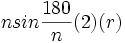 , where r equals the length of the radius.
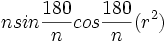
The area of a regular polygon is equal to