Difference between revisions of "Permian extinction:civilization"

From Conservapedia
Jump to: navigation, search
(new article)
 
Line 1: Line 1:
Sapient life, descended from [http://en.wikipedia.org/wiki/Gorgonopsia gorgonopsians], after a chance wandering in the shrubland of Gondwana that isolated them several million years before, evolves shortly (some 90,000 years) before the Permian Extinction, which wipes out 95% of all life on Earth, like that extinction does in OTL (it is the biggest extinction ever to strike Earth). Civilization arises 11,000 years before the extinction, starting near the mountains in the middle of the [http://en.wikipedia.org/wiki/Pangaea Pangaean supercontinent]. By the time of the extinction, airplanes ply the skies over the Paleo-Tethys Ocean from and to the lands surrounding it and the larger Panthalassic Ocean is being explored, and there is a high level of technology. Then the [http://en.wikipedia.org/wiki/Siberian_Traps Siberian Traps eruptions] begin anew, releasing great clouds of methane (thus triggering the extinction)... how will the people react?
+
== Permian Extinction and the Great Flood ==
  
== Date System and brief history ==
+
Secularist thinkers have attempted to undermine Biblical principles by introducing multiple ''extinction'' events into their version of human history.  One such event is called the 'Permian Extinction' but this might be better called the [[Great Flood.]]  It is important to recognize, however, that secularist thinkers are tapping into essential Biblical realities.  The Lord did attempt to extinguish all life on Earth, however, this was the [[Great Flood]] and not the 'Permian Extinction.'
 +
 
 +
 
 +
== Secularist Musings ==
 +
 
 +
For secularists, several large extinction events have been posited, the most dramatic being the Permian Extinction (which might correspond to the [[Great Flood]]).  For secularist thinkers, this event occurred "millions of years" ago, and formed the boundary between two [[geologic eras.]]  Furthermore, the P-T (Permian-Triassic) boundary serves as a useful dating mechanism.  Theories advanced by secularist thinkers include a) issues with the Pangea super continent b) comet impact c) supernova eruption but do not include the Lord's wrath at his sinful creation and decision to employ a [[Great Flood]] to wipe out all life on earth.  Regardless, many secularists believe that a number of species became extinct during this time period.
  
For simplicity, at first, the time frame will be dated based on the start of the extinction (that is, the start of the eruption span that results in the extinction). The Siberian Traps apparently erupted over hundreds of thousands of years; however, this is great enough a time span for evolution to occur, and the eruption may have been sporadic, occuring at various points over that long time period. (For comparison, the OTL human species is only 100,000 years old, and we're looking back 250 million years, so the apparent time span of the eruption may itself be greatly exaggerated.) The POD therefore occurs sometime after a phase of the Siberian Traps eruptions, in which climate change has caused an evolution of certain dicynodonts into intelligent beings, and the civilization takes about 90,000 years to start, with relatively minor eruptions from the Traps here and there. The great eruption comes some 12,000 years after that, spilling carbon dioxide into the atmosphere and causing gas hydrates to erupt from the Arctic waters after the earth gets warm enough. Therefore, the start of sapience is 102,000 before the extinction, and the start of civilization is 12,000 before the extinction. 15 years before the extinction, a series of earthquakes shake the already existing Siberian Traps area, which has various religious rock carvings (a la OTL's Deccan Traps) dating back hundreds of years, perhaps thousands of years. A tsunami results, devastating areas around the Paleo Tethys ocean and killing something like 100,000 people. Folks pick up after the disaster and go about everyday business. 9 years before the extinction, another earthquake shakes the area, sparking landslides, and, more importantly, sparking the formation of a fissure underground (unseen by people on the surface). 2 years before the extinction's start, harmonic tremors are detected under Siberia, prompting an eruption warning and sparking the greatest peacetime evacuation in the history that they know. A few months later, a huge eruption devastates a port town in the Siberian Traps area, and chains of volcanoes in the vicinity start to rumble, producing pyroclastic flows and enormous clouds of ash. However, this is not the main eruption: the Siberian Traps are composed of lava flows, not ash, after all, and thus this is just a prelude to the main show. Eruptions continue off and on for another couple of years, all over the continent of Siberia, and a huge, long fissure opens up, through which the upwelling of a great pool of magma suddenly gushes, like bleeding from a stab wound. It doesn't stop: more fissures open up, and more, and more. Twenty years into the extinction, civilization is still thriving, but the Earth's temperature has started to climb markedly after a dip, and clouds of ash are causing regular havoac with airplane flights and everyday business. Three hundred years into the extinction, substantial portions of the icecaps have melted, and water vapor and drowned shorelines are common phenomena. However, even five hundred years into the extinction, the effect is barely noticable, and wars and trade continue going on because the main impact of the extinction has been in the Siberian and South Chinese continents. At this point, in a steamy, warm world, the methane hydrates near the poles begin to evaporate, provoking enormous "burps". The methane converts to carbon dioxide, which contributes to warming, and temperatures, already on the rise, shoot up at alarming speed. So does the rate of ice melting at the poles (particularly the South Pole, which is closer to land). Acid rain, already a major problem, becomes worse. The oceans become so warm that there is no exchange of cool and warm water between the top and the bottom, and this stagnation (along with acid rain) causes a crash in seafood stocks, with numerous animals becoming extinct in the seas (and even on land) some 520 to 570 years into the extinction. People retreat to protective shelters as the vicious cycle of eruption and rain continues, causing massive quantities of plants to die and fall into the rivers, washing out to sea, causing, in turn, a great plummeting in levels of oxygen. By 610 years into the extinction, there is much talk of going to the relatively stable world of Mars, as Earth appears to be turning uninhabitable.


== Resources ==
 
== Resources ==
 
;[http://en.wikipedia.org/wiki/Permian_extinction Permian extinction in OTL]
 
;[http://en.wikipedia.org/wiki/Permian_extinction Permian extinction in OTL]
;[http://www.scotese.com/newpage5.htm World map of the time period, approximately - well, some 4 million years before, maybe, but it'll have to do]
 
;[http://soundwaves.usgs.gov/2004/02/permian-earth.gif Another period world map]


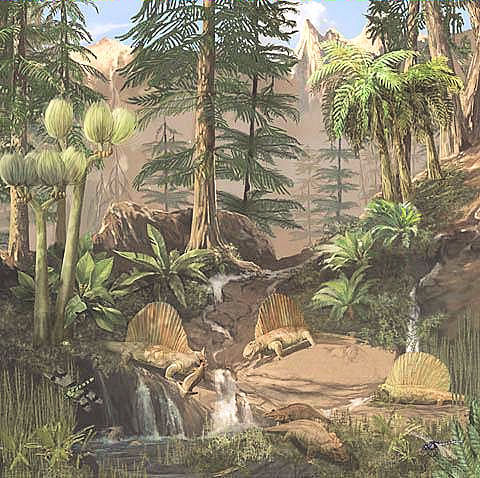
;[http://www.peabody.yale.edu/explore/aor/reptiles_04.html One artist's conception of Permian scenery]
 
;[http://www.peabody.yale.edu/explore/aor/reptiles_04.html One artist's conception of Permian scenery]
Line 21: Line 23:
 
Vegetation included (in what is now South China in OTL) swampy plants such as [http://en.wikipedia.org/wiki/Lepidodendron lepidodendron trees] that lived in swamp forests and (elsewhere) plenty of conifers, [http://en.wikipedia.org/wiki/Ginkgo ginkgo trees], and [http://en.wikipedia.org/wiki/Cycad cycads] (cycads probably occurring in tropical and other warm areas, which may have been practically everywhere in the warmer parts of the extinction period).
 
Vegetation included (in what is now South China in OTL) swampy plants such as [http://en.wikipedia.org/wiki/Lepidodendron lepidodendron trees] that lived in swamp forests and (elsewhere) plenty of conifers, [http://en.wikipedia.org/wiki/Ginkgo ginkgo trees], and [http://en.wikipedia.org/wiki/Cycad cycads] (cycads probably occurring in tropical and other warm areas, which may have been practically everywhere in the warmer parts of the extinction period).
  
Flowers did not yet exist in OTL; however, scientists in this alternative timeline have managed to produce them through tinkering with genetics. However, they are still rare and highly prized. Colorful palm-like plants and tree-like plants provide the color, and farms don't look very grassy: grass has yet to evolve in the Permian. Short plants with leaves and fruit-like parts and nutty/grainy parts are grown instead.


==Map==
 
==Map==
 
[[Image:Permian world map (Permian Extinction-Civilization).jpg|thumb|right|350px|The map.]]
 
[[Image:Permian world map (Permian Extinction-Civilization).jpg|thumb|right|350px|The map.]]
 
[[:Image:Permian world map (Permian Extinction-Civilization).jpg|World map (yeah, rudimentary, but I'll work at it)]]
 
[[:Image:Permian world map (Permian Extinction-Civilization).jpg|World map (yeah, rudimentary, but I'll work at it)]]

Revision as of 21:16, March 26, 2007

Permian Extinction and the Great Flood

Secularist thinkers have attempted to undermine Biblical principles by introducing multiple extinction events into their version of human history. One such event is called the 'Permian Extinction' but this might be better called the Great Flood. It is important to recognize, however, that secularist thinkers are tapping into essential Biblical realities. The Lord did attempt to extinguish all life on Earth, however, this was the Great Flood and not the 'Permian Extinction.'


Secularist Musings

For secularists, several large extinction events have been posited, the most dramatic being the Permian Extinction (which might correspond to the Great Flood). For secularist thinkers, this event occurred "millions of years" ago, and formed the boundary between two geologic eras. Furthermore, the P-T (Permian-Triassic) boundary serves as a useful dating mechanism. Theories advanced by secularist thinkers include a) issues with the Pangea super continent b) comet impact c) supernova eruption but do not include the Lord's wrath at his sinful creation and decision to employ a Great Flood to wipe out all life on earth. Regardless, many secularists believe that a number of species became extinct during this time period.


Resources

Permian extinction in OTL
One artist's conception of Permian scenery
Another artist's idea
The OTL Permian period according to Wikipedia
Animals that might have evolved into ATL "people" or been used for food or as beasts-of-burden

Large animals included gorgonopsians and dicynodonts, including the major large animal that survived the OTL extinction, lystrosaurs.

Seafood included (possibly) mollusks, brachiopods, ammonites, trilobites, cephalopods, and various other critters.

Vegetation included (in what is now South China in OTL) swampy plants such as lepidodendron trees that lived in swamp forests and (elsewhere) plenty of conifers, ginkgo trees, and cycads (cycads probably occurring in tropical and other warm areas, which may have been practically everywhere in the warmer parts of the extinction period).

Map

World map (yeah, rudimentary, but I'll work at it)