Difference between revisions of "The Hudson River School"
| Line 1: | Line 1: | ||
| − | '''The Hudson River School''' was not an institution but rather an informal group of like-minded painters. [[Thomas Cole]] (1801-1848) is acknowledged as the founder of this movement. The movement was fueled by the poetry of [[Ralph Waldo Emerson]] (1803-1882) and by the conviction that [[God]] had given the American people an abundance of natural resources as a source of wealth and prosperity. Cole's close friend, [[Asher Brown Durand|Asher Durand]] was also a prominent figure in the School. Durand believed that nature was an ineffable manifestation of God. Thomas Doughty, member of the School, was the first American artist to work exclusively as a landscapist. Other painters of the movement are Cole's prize pupil [[Frederic Edwin Church]], [[Thomas Moran]], [[Albert Bierstadt]], John Frederick Kensett, and Sanford Robinson Gifford. | + | '''The Hudson River School''' was not an institution but rather an informal group of like-minded painters. Its name was coined to identify a group of New York City-based landscape painters. [http://www.metmuseum.org/toah/hd/hurs/hd_hurs.htm] [[Thomas Cole]] (1801-1848) is acknowledged as the founder of this movement. The movement was fueled by the poetry of [[Ralph Waldo Emerson]] (1803-1882) and by the conviction that [[God]] had given the American people an abundance of natural resources as a source of wealth and prosperity. Cole's close friend, [[Asher Brown Durand|Asher Durand]] was also a prominent figure in the School. Durand believed that nature was an ineffable manifestation of God. Thomas Doughty, member of the School, was the first American artist to work exclusively as a landscapist. Other painters of the movement are Cole's prize pupil [[Frederic Edwin Church]], [[Thomas Moran]], [[Albert Bierstadt]], John Frederick Kensett, and Sanford Robinson Gifford. |
The Hudson River School style involved carefully detailed paintings with romantic, almost glowing lighting. | The Hudson River School style involved carefully detailed paintings with romantic, almost glowing lighting. | ||
Revision as of 02:42, January 19, 2014
The Hudson River School was not an institution but rather an informal group of like-minded painters. Its name was coined to identify a group of New York City-based landscape painters. [1] Thomas Cole (1801-1848) is acknowledged as the founder of this movement. The movement was fueled by the poetry of Ralph Waldo Emerson (1803-1882) and by the conviction that God had given the American people an abundance of natural resources as a source of wealth and prosperity. Cole's close friend, Asher Durand was also a prominent figure in the School. Durand believed that nature was an ineffable manifestation of God. Thomas Doughty, member of the School, was the first American artist to work exclusively as a landscapist. Other painters of the movement are Cole's prize pupil Frederic Edwin Church, Thomas Moran, Albert Bierstadt, John Frederick Kensett, and Sanford Robinson Gifford.
The Hudson River School style involved carefully detailed paintings with romantic, almost glowing lighting.

Cole, The Clove Catskills, 1827.

Thomas Doughty, In the Catskills, 1836.

Durand, Pastoral Landscape, 1861.
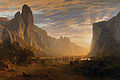
Albert Bierstadt, Looking Down Yosemite-Valley, 1865.

Thomas Moran, Shoshone Falls, Idaho, 1875.


External links
- The Hudson River School.
- American Landscape Painting.
- The Hudson River School. The Metropolitan Museum of Art.