Difference between revisions of "Lumber"
Jump to navigation
Jump to search
| Line 3: | Line 3: | ||
==Environmental Concerns== | ==Environmental Concerns== | ||
| − | Excessive logging can have harmful effects on the environment and damage natural habitat. An environmentally friendly method of logging is [[selective logging]]. | + | Excessive logging can have harmful effects on the [[environment]] and damage natural habitat. An environmentally friendly method of logging is [[selective logging]]. |
| + | |||
| + | ==See Also== | ||
| + | * [[Saw]] | ||
| + | * [[Chain saw]] | ||
| + | * [[Mill#Sawmill|Sawmill]] | ||
[[Category:Trees]] | [[Category:Trees]] | ||
Revision as of 08:35, January 8, 2015

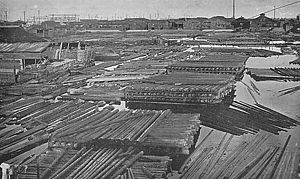
Kiba Lumberyard in Japan, 1933
Lumber is wood from a tree after felling, usually after being sawn from the felled log. Lumber is often used to refer to sized boards which are at least rough sawn. A lumberyard is a place where wood is prepared for sale. Lumber is used in the construction of buildings, homes, boats, etc.
Environmental Concerns
Excessive logging can have harmful effects on the environment and damage natural habitat. An environmentally friendly method of logging is selective logging.