Difference between revisions of "Pythagorean Theorem"
Jump to navigation
Jump to search
TimSvendsen (talk | contribs) |
|||
| Line 1: | Line 1: | ||
| − | The Pythagorean Theorem was developed by the [[Greek]] mathematician [[Pythagoras]]. Is is a mathematical relationship between the lengths of the sides of a right triangle which can be illustrated as follows: | + | The Pythagorean Theorem was developed by the [[Greece|Greek]] mathematician [[Pythagoras]]. Is is a mathematical relationship between the lengths of the sides of a right triangle which can be illustrated as follows: |
[[Image:Pythagorean_Theorem.png|left|350px|Pythagorean Theorem]] | [[Image:Pythagorean_Theorem.png|left|350px|Pythagorean Theorem]] | ||
Revision as of 04:33, January 26, 2007
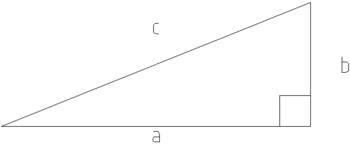
The Pythagorean Theorem was developed by the Greek mathematician Pythagoras. Is is a mathematical relationship between the lengths of the sides of a right triangle which can be illustrated as follows:


Many different proofs of the Pythagorean theorem have been devised. Euclid's proof is one of the most complicated and least intuitive.
One "proof," below, appeared in an ancient manuscript with no explanation other than the word "look!" Can you see just by looking that the square on the hypotenuse and the two squares on the other sides must take up equal amounts of area?
