Difference between revisions of "Pythagorean triple"
(add table) |
(arch) |
||
| Line 151: | Line 151: | ||
More formally: given a positive integer ''n'', the triple can be generated by the following two procedures: | More formally: given a positive integer ''n'', the triple can be generated by the following two procedures: | ||
| − | (see http://www.mcs.surrey.ac.uk/Personal/R.Knott/Pythag/pythag.html ) | + | (see http://web.archive.org/web/20090916034804/http://www.mcs.surrey.ac.uk/Personal/R.Knott/Pythag/pythag.html ) |
:<math> a= 2n + 1 \,:\, b=2n(n + 1) \,:\, c = 2n(n + 1) + 1 </math> | :<math> a= 2n + 1 \,:\, b=2n(n + 1) \,:\, c = 2n(n + 1) + 1 </math> | ||
Revision as of 02:53, February 11, 2017
Pythagorean triple is a triple of integers that follow the following formula:

It is similar to the Pythagorean Theorem which states the same for a right triangle for non-integer sides. Some of the simplest triples are:
- and
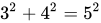

Studying these two triples, the reader may have the insight that
- and


This leads to a trivial sequence that generates some but not all possible triples is based on the positive integers starting with :[1]:

- If is odd, then and
- If is even, then and


Euclid's formula is a fundamental formula for generating all possible Pythagorean triples given an arbitrary pair of integers and with . The formula states that the following integers form a Pythagorean triple:



There are many other formulas for generating such triples.
The two above formulas are related. This table is intended as an aid to understanding the behavior of Euclid formula: E(m,n) -> (m2-n2 , 2mn , m2+n2)
| E(m,n) | ||||||||
| n | 1 | 2 | 3 | 4 | 5 | 6 | 7 | 8 |
| m | ||||||||
| 2 | (3,4,5) | |||||||
| PPT | ||||||||
| 3 | (8,6,10) | (5,12,13) | ||||||
| T2X E(2,1) | PPT | |||||||
| 4 | (15,8,17) | (12,16,20) | (7,24,25) | |||||
| PPT | Note 1 | PPT | ||||||
| 5 | (24,10,26) | (21,20,29) | (16,30,34) | (9,40,41) | ||||
| T2X E(3,2) | PPT | T2X E(4,1) | PPT | |||||
| 6 | (35,12,37) | (32,24,40) | (27,36,45) | (20,48,52) | (11,60,61) | |||
| PPT | 4X E(3,1) | 9X E(2,1) | 4X E(3,2) | PPT | ||||
| 7 | (48,14,50) | (45,28,53) | (40, 42, 58) | (33,56, 65) | (24,70,74) | (13,84,85) | ||
| T2X E(4,3) | PPT | T2X E(5,2) | PPT | T2X E(6,1) | PPT | |||
| 8 | (63,16,65) | (60,32,68) | (55,48,73) | (48,64,80) | (39, 80, 89) | (28, 96, 100) | (15, 112, 113) | |
| PPT | 4X E(4,1) | PPT | 16X E(2,1) | PPT | 4X E(4,3) | PPT | ||
| 9 | (80,18,82) | (77, 36, 85) | (72, 54, 90) | (65, 72, 97) | (56, 90, 106) | (45, 108, 117) | (32, 126, 130) | (17, 144, 145) |
| T2X E(5,4) | PPT | Note 2 | PPT | T2X E(7,2) | 9X E(3,2) | T2X E(8,1) | PPT |
Where the following are where both kinds of relationships apply (see below):
- Note 1 at E(4,2): 4X E(2,1) and T2X E(3,1)
- Note 2 at E(9,3): 9X E(3,1) and T2X E(6,3)
Table legend: Each triple is noted as either a PPT (Primitive Pythagorean Triple) or is noted by being related to some other lower m-value triple by one of two relationships.
- 4X, 9X, etc. is where the Euclid parameters are a simple multiple of some lower m-value cell (i.e. m and n have a common factor, i.e. a GCD greater than one) and thus the triple values are multiplied by the square of that factor.
- T2X indicates a "2X" relation with lower m-value cell. The relationship is that the lower m-value triple (a,b,c) results in this cell's values being (2b, 2a, 2c), i.e. all three triple values are doubled and a and b are transposed. If the lower-m value cell is E(m,n) then this new cell is E(m+n, m-n). E.g. For, E(5,2) which results in (21,20,29), the T2X is E(5+2, 5-2) or E(7,3) resulting in (40,42,58). When searching for the lower m-value cell, one can use the inverse formula: E((m+n)/2, (m-n)/2). E.g. when starting with E(7,3) and looking backwards, one finds E((7+3)/2, (7-3)/2)) or just E(5,2). In this case, the higher m-value parameters must be either both even or both odd.
See the next section for comments on the n=1 column and the n=m-1 diagonal.
Note that in the table above, as you go across a row from left to right (constant m), b become greater than a at n of (√2-1)* m or n = 0.41 * m.
The "odd" equation corresponds to the Euclid formula for the n=m-1 diagonal and the "even" equation corresponds to Euclid's formula where n=1 column in the table of the previous section.
More formally: given a positive integer n, the triple can be generated by the following two procedures: (see http://web.archive.org/web/20090916034804/http://www.mcs.surrey.ac.uk/Personal/R.Knott/Pythag/pythag.html )

Example: When n = 2, the triple produced is 5, 12, and 13. (This formula is actually the same as method I, substituting m with 2n + 1.)
Alternatively, one can generate triples from even integers using the following formulas. Given that m is an positive even number,

Example: When m = 4 the triple produced is 8, 15, and 17 (This formula is another specific case of method I, substituting n with 1).