Difference between revisions of "Public domain"
Jump to navigation
Jump to search
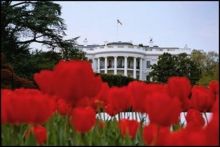
JasonAQuest (talk | contribs) (the White House and its gardens are not Public Domain) |
(not the real property - just the image) |
||
| Line 1: | Line 1: | ||
| − | A work is in the '''public domain''' if nobody holds any [[intellectual property]] [[rights]] on it. Works that are in the public domain can be freely copied. | + | [[Image:Tulips White House.jpg|right|220px|A public domain image of the [[White House]] ]]A work is in the '''public domain''' if nobody holds any [[intellectual property]] [[rights]] on it. Works that are in the public domain can be freely copied. |
Two examples of material in the public domain are [[United States]] [[government]] works (technically the copyright is held collectively by the American public), and writings for which their copyright has expired. In the United States, anything published before 1923 no longer has copyright protection and is in the public domain.<ref>[http://www.copyright.cornell.edu/training/Hirtle_Public_Domain.htm Public Domain]</ref> Laws vary by country, but in most of the world, works whose authors died at least 50, 70, or 100 years ago are in the public domain. | Two examples of material in the public domain are [[United States]] [[government]] works (technically the copyright is held collectively by the American public), and writings for which their copyright has expired. In the United States, anything published before 1923 no longer has copyright protection and is in the public domain.<ref>[http://www.copyright.cornell.edu/training/Hirtle_Public_Domain.htm Public Domain]</ref> Laws vary by country, but in most of the world, works whose authors died at least 50, 70, or 100 years ago are in the public domain. | ||
Revision as of 16:27, January 12, 2008

A work is in the public domain if nobody holds any intellectual property rights on it. Works that are in the public domain can be freely copied.
Two examples of material in the public domain are United States government works (technically the copyright is held collectively by the American public), and writings for which their copyright has expired. In the United States, anything published before 1923 no longer has copyright protection and is in the public domain.[1] Laws vary by country, but in most of the world, works whose authors died at least 50, 70, or 100 years ago are in the public domain.
See also
External links
- How Can I Tell Whether a Book Can Go Online? Guidance from the University of Pennsylvania Online Books project.
- FAIR USE - PUBLIC DOMAIN