Difference between revisions of "Economics"
Jump to navigation
Jump to search
(changed wording to enhance consistensy; avoid self-definitions. also removed "it is generally accepted..." ... generally accepted by whom?) |
m (Added reference.) |
||
| Line 23: | Line 23: | ||
''Main article: [[History of economics]]'' | ''Main article: [[History of economics]]'' | ||
| − | Economic thought originated with the rise of the state. Classical economics, or the long-run model, was articulated by [[Adam Smith]] and has since fomented the rise of free-market capitalism in economic thought. | + | Economic thought originated with the rise of the state. Classical economics, or the long-run model, was articulated by [[Adam Smith]] and has since fomented the rise of free-market capitalism in economic thought.<ref>http://cepa.newschool.edu/het/</ref> |
| + | <div class="references-small"> | ||
| + | <references /> | ||
[[Category:Economics]] | [[Category:Economics]] | ||
Revision as of 19:59, February 22, 2008

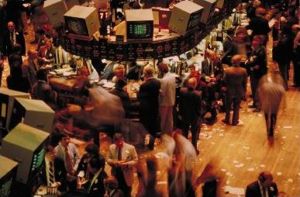
Face-to-face trading on the New York Stock Exchange's trading floor.
Economics is a social science concerned with how society produces, allocates, and consumes goods and services. Governments can be classified by their economic policy. The United States economic policy, set down in the Constitution and inspired by enlightenment thinkers.
Issues in economics
Economics deals with a large number of issues:
- Theory of value: What are things worth? How do we compute value?
- Economic justice: How are resources distributed in society? What is the ideal distribution?
- Economic prosperity: Which policies encourage economic growth and development?
- Economic prediction: How can we use economic information from today to predict future results? Which econometrics are leading indicators?
Disciplines within economics
Economics is a very broad discipline, and involves the following other disciplines as well:
- Moral philosophy: How ought a society produce and distribute goods and services?
- Psychology: What principles underlie human economic decision-making?
- Mathematics: What mathematical models can predict economic outcomes?
- Ecology: What economic policies and practices are ecologically sustainable?
Branches of economics
- Microeconomics: the study of economic decisions of firms and households acting in markets.
- Macroeconomics: the study of aggregate economic decisions and the results of those decisions in a local, national, or world economy.
History of economics
Main article: History of economics
Economic thought originated with the rise of the state. Classical economics, or the long-run model, was articulated by Adam Smith and has since fomented the rise of free-market capitalism in economic thought.[1]