Difference between revisions of "Barbed wire"
Jump to navigation
Jump to search
(Create page) |
|||
| Line 1: | Line 1: | ||
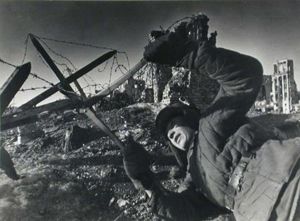
| − | [[Image:Stalingrad_Cutting_barbed_wire.jpg|thumb|right|300px|A [[Russia]]n soldier cutting barbed wire at the [[ | + | [[Image:Stalingrad_Cutting_barbed_wire.jpg|thumb|right|300px|A [[Russia]]n soldier cutting barbed wire at the [[Battle of Stalingrad]]]] |
'''Barbed wire''' is a type of twisted fencing wire with short projecting barbs that are designed to snag on hair, flesh or clothing. The original patent for barbed wire was awarded to Joseph F. Glidden of DeKalb, IL in 1874 and it became invaluable in restricting the movement of livestock, as it required only wooden stakes, staples and a hammer for unskilled labor to erect a stock-proof fence. This invention enabled the development of large-scale [[cattle]]-ranching. | '''Barbed wire''' is a type of twisted fencing wire with short projecting barbs that are designed to snag on hair, flesh or clothing. The original patent for barbed wire was awarded to Joseph F. Glidden of DeKalb, IL in 1874 and it became invaluable in restricting the movement of livestock, as it required only wooden stakes, staples and a hammer for unskilled labor to erect a stock-proof fence. This invention enabled the development of large-scale [[cattle]]-ranching. | ||
Revision as of 15:53, October 12, 2008

Barbed wire is a type of twisted fencing wire with short projecting barbs that are designed to snag on hair, flesh or clothing. The original patent for barbed wire was awarded to Joseph F. Glidden of DeKalb, IL in 1874 and it became invaluable in restricting the movement of livestock, as it required only wooden stakes, staples and a hammer for unskilled labor to erect a stock-proof fence. This invention enabled the development of large-scale cattle-ranching.
During the Great War, loose coils of barbed wire were widely used in trench warfare as they ensnared the heavy serge fabric of soldier's uniforms and thus prevented them freely advancing on enemy lines.