Difference between revisions of "Cologne"
Jump to navigation
Jump to search
BRichtigen (talk | contribs) |
|||
| Line 1: | Line 1: | ||
[[Image:Koeln (Cologne) Germany.jpg|right|350px]] | [[Image:Koeln (Cologne) Germany.jpg|right|350px]] | ||
| − | '''Köln''' (English: ''Cologne'') is a major city of western [[Germany]], situated on the [[River Rhine]] in the state of [[Nord Rhein-Westfalen]]. It has Roman origins (the name derives from its [[Latin]] name, ''Colonia Claudia Ara Agrippinensis'', 'the Colony of Claudia Agrippina the Younger', born there in AD 15). Köln was an | + | '''Köln''' (English: ''Cologne'') is a major city of western [[Germany]], situated on the [[River Rhine]] in the state of [[Nord Rhein-Westfalen]]. It has Roman origins (the name derives from its [[Latin]] name, ''Colonia Claudia Ara Agrippinensis'', 'the Colony of Claudia Agrippina the Younger', born there in AD 15). Köln was an important medieval city and is the seat of the Roman Catholic Archbishop of Cologne since 785; its cathedral is one of the most important medieval buildings in [[Europe]]. In 1942 Köln suffered the first 'thousand bomber raid' mounted by the [[RAF]]. |
The population of Köln is 991,000 (2007). | The population of Köln is 991,000 (2007). | ||
Revision as of 20:43, October 17, 2008

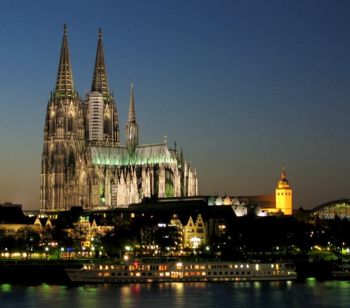
Köln (English: Cologne) is a major city of western Germany, situated on the River Rhine in the state of Nord Rhein-Westfalen. It has Roman origins (the name derives from its Latin name, Colonia Claudia Ara Agrippinensis, 'the Colony of Claudia Agrippina the Younger', born there in AD 15). Köln was an important medieval city and is the seat of the Roman Catholic Archbishop of Cologne since 785; its cathedral is one of the most important medieval buildings in Europe. In 1942 Köln suffered the first 'thousand bomber raid' mounted by the RAF.
The population of Köln is 991,000 (2007).