Difference between revisions of "Hubble Space Telescope"
(merge Hubble Deep Field here) |
DavidB4-bot (talk | contribs) m (→top: HTTP --> HTTPS [#1], replaced: http://www.nasa.gov → https://www.nasa.gov) |
||
| (11 intermediate revisions by 6 users not shown) | |||
| Line 1: | Line 1: | ||
[[Image:Hubble 01.jpg|right|thumb|350px|Hubble Space Telescope as seen from the Space Shuttle Discovery on mission STS-82.]] | [[Image:Hubble 01.jpg|right|thumb|350px|Hubble Space Telescope as seen from the Space Shuttle Discovery on mission STS-82.]] | ||
| − | The '''Hubble Space Telescope''' is an American space probe in | + | The '''Hubble Space Telescope''' is an American space probe in Low-Earth orbit (about 350 miles high) that is used to study and image celestial objects. It is operated by [[NASA]]'s [https://www.nasa.gov/centers/goddard/home/index.html Goddard Space Flight Center] and the [http://www.stsci.edu/resources/ Space Telescope Science Institute]. The [[telescope]] was launched April 25, 1990 and began operations soon thereafter. |
| − | After launch, it was found that all of the images from the telescope were out of focus. An investigation found that the primary mirror of the telescope had been ground to the wrong radius, preventing the telescope from properly focusing. In December, 1993, the | + | ==History== |
| + | Launch was years later than initially planned, due primarily to the [[Space Shuttle Challenger]] disaster. After launch, it was found that all of the images from the telescope were out of focus. An investigation found that the primary mirror of the telescope had been ground to the wrong radius, preventing the telescope from properly focusing. In December, 1993, the Space Shuttle Endeavor, during mission STS-61, captured the telescope and added a lens that corrected the defect in the primary mirror. Since then, the Hubble Space Telescope has been an invaluable tool to [[astronomy|astronomers]]. | ||
| − | The current mission of the telescope was recently extended by NASA. On January 17, 2004, primarily due to the recent [[Colombia]] shuttle accident and the perceived risk of shuttle flights, NASA announced that the final servicing mission to the Hubble Space Telescope would not be funded. Scientists around the world and members of congress put pressure on NASA to reconsider, and on October 31, 2006, NASA announced it would go ahead with a Hubble Space Telescope service mission in 2008. This fourth mission to Hubble should effectively extend the life of the telescope by another decade. | + | Hubble has a resolution of just less than 0.1 arcsec in red light.<ref>One arcsec is 1/3600 of a degree.</ref> Its main imaging camera has 16 million pixels. |
| + | |||
| + | The current mission of the telescope was recently extended by NASA. On January 17, 2004, primarily due to the recent [[Colombia]] shuttle accident and the perceived risk of shuttle flights, NASA announced that the final servicing mission to the Hubble Space Telescope would not be funded. Scientists around the world and members of congress put pressure on NASA to reconsider, and on October 31, 2006, NASA announced it would go ahead with a Hubble Space Telescope service mission in 2008. This fourth mission to Hubble cost $1 billion and should effectively extend the life of the telescope by another decade. | ||
The telescope is named after astronomer [[Edwin Hubble]] whose observations of galaxies led him to the discovery that the universe is expanding. | The telescope is named after astronomer [[Edwin Hubble]] whose observations of galaxies led him to the discovery that the universe is expanding. | ||
| − | < | + | |
| + | The total cost of Hubble to NASA so far has been about $9 billion.<ref>Dennis Overbye, [http://www.astromart.com/news/news.asp?news_id=746 "One Last Ride to the Hubble," ''New York Times'' Dec 4, 2007]</ref> | ||
| + | |||
| + | The Hubble has a 94-inch mirror. Earth-based telescopes with three times the diameter cost only 2% as much, but are affected by distortions caused by the atmosphere. Astronomers hope that new methods of adaptive optics will improve the resolution of earth-based telescopes, because funding on the scale of Hubble is difficult to achieve. | ||
| + | |||
| + | Hubble's successor will be the James Webb Space Telescope (JWST) is a large, infrared-optimized space telescope, scheduled for launch in 2014. Its mirror will be 6.5 meters.<ref>See [http://www.jwst.nasa.gov/ The James Webb Space Telescope]</ref> | ||
== Photography == | == Photography == | ||
| − | |||
| − | |||
'''The Hubble Ultra Deep Field''' is a picture taken by [[Hubble Telescope]]'s Advanced Camera for Surveys (ACS) and the Near Infrared Camera and Multi-object Spectrometer (NICMOS) of an "empty area" one tenth the diameter of a full moon when viewed from Earth. The 11.5 square [[arc minute]] area is equivalent to a grain of sand held at arm's length. Taken over a period of almost 11 days, the picture required 400 orbits around Earth and 800 exposures, which is equivalent to approximately 1 million seconds of exposure time. With an estimated 10,000 [[galaxy|galaxies]] in this image, nearly every speck of light is an entire galaxy or group of galaxies. | '''The Hubble Ultra Deep Field''' is a picture taken by [[Hubble Telescope]]'s Advanced Camera for Surveys (ACS) and the Near Infrared Camera and Multi-object Spectrometer (NICMOS) of an "empty area" one tenth the diameter of a full moon when viewed from Earth. The 11.5 square [[arc minute]] area is equivalent to a grain of sand held at arm's length. Taken over a period of almost 11 days, the picture required 400 orbits around Earth and 800 exposures, which is equivalent to approximately 1 million seconds of exposure time. With an estimated 10,000 [[galaxy|galaxies]] in this image, nearly every speck of light is an entire galaxy or group of galaxies. | ||
<gallery> | <gallery> | ||
Image:udf.jpg|The Hubble Ultra Deep Field, Click for a high resolution view. | Image:udf.jpg|The Hubble Ultra Deep Field, Click for a high resolution view. | ||
Image:Hudf-illustration.jpg|Location of the Hubble Ultra Deep Field in the sky. | Image:Hudf-illustration.jpg|Location of the Hubble Ultra Deep Field in the sky. | ||
| + | </gallery> | ||
| + | ====Other images==== | ||
| + | <gallery> | ||
| + | File:Hs-2005-35-a-large web.jpg|Small Magellanic Cloud | ||
| + | File:Hs-1994-02-c-web.jpg|Spiral galaxy M100 | ||
| + | File:Hs-2005-02-e-web.jpg|Red supergiant star V838 Monocerotis | ||
| + | File:CarinaNebula.jpg|Star birth in the Carina Nebula | ||
| + | File:BugNebulaNGC 6302.jpg|The Bug, or Butterfly Nebula NGC 6302 | ||
| + | File:StephansQuintet.jpg|Galactic grouping known as Stephan's Quintet | ||
| + | File:OmegaCentauri1.jpg|100,000 stars residing in the crowded core of Omega Centauri | ||
</gallery> | </gallery> | ||
| − | + | ==See also== | |
| − | |||
| − | |||
| − | == | ||
[[NASA]] | [[NASA]] | ||
| − | ==External | + | ==External links== |
| − | [http://hubblesite.org/ HubbleSite] | + | *[http://hubblesite.org/ HubbleSite] |
| − | + | *[http://www.aerospaceguide.net/spacehistory/hubble-history.html Hubble Space Telescope History] | |
| − | [http://www.aerospaceguide.net/spacehistory/hubble-history.html Hubble Space Telescope History] | + | *[http://www.mindspring.com/~deline/ Jim's Hubble Telescope Photo Gallery] |
| − | + | * Dennis Overbye, [http://www.astromart.com/news/news.asp?news_id=746 "One Last Ride to the Hubble," ''New York Times'' Dec 4, 2007] | |
| − | [http://www.mindspring.com/~deline/ Jim's Hubble Telescope Photo Gallery] | + | ====References==== |
| − | + | <references/> | |
| − | + | [[Category:Astronomy]] | |
| − | [[ | ||
Latest revision as of 17:32, September 26, 2018

The Hubble Space Telescope is an American space probe in Low-Earth orbit (about 350 miles high) that is used to study and image celestial objects. It is operated by NASA's Goddard Space Flight Center and the Space Telescope Science Institute. The telescope was launched April 25, 1990 and began operations soon thereafter.
History
Launch was years later than initially planned, due primarily to the Space Shuttle Challenger disaster. After launch, it was found that all of the images from the telescope were out of focus. An investigation found that the primary mirror of the telescope had been ground to the wrong radius, preventing the telescope from properly focusing. In December, 1993, the Space Shuttle Endeavor, during mission STS-61, captured the telescope and added a lens that corrected the defect in the primary mirror. Since then, the Hubble Space Telescope has been an invaluable tool to astronomers.
Hubble has a resolution of just less than 0.1 arcsec in red light.[1] Its main imaging camera has 16 million pixels.
The current mission of the telescope was recently extended by NASA. On January 17, 2004, primarily due to the recent Colombia shuttle accident and the perceived risk of shuttle flights, NASA announced that the final servicing mission to the Hubble Space Telescope would not be funded. Scientists around the world and members of congress put pressure on NASA to reconsider, and on October 31, 2006, NASA announced it would go ahead with a Hubble Space Telescope service mission in 2008. This fourth mission to Hubble cost $1 billion and should effectively extend the life of the telescope by another decade.
The telescope is named after astronomer Edwin Hubble whose observations of galaxies led him to the discovery that the universe is expanding.
The total cost of Hubble to NASA so far has been about $9 billion.[2]
The Hubble has a 94-inch mirror. Earth-based telescopes with three times the diameter cost only 2% as much, but are affected by distortions caused by the atmosphere. Astronomers hope that new methods of adaptive optics will improve the resolution of earth-based telescopes, because funding on the scale of Hubble is difficult to achieve.
Hubble's successor will be the James Webb Space Telescope (JWST) is a large, infrared-optimized space telescope, scheduled for launch in 2014. Its mirror will be 6.5 meters.[3]
Photography
The Hubble Ultra Deep Field is a picture taken by Hubble Telescope's Advanced Camera for Surveys (ACS) and the Near Infrared Camera and Multi-object Spectrometer (NICMOS) of an "empty area" one tenth the diameter of a full moon when viewed from Earth. The 11.5 square arc minute area is equivalent to a grain of sand held at arm's length. Taken over a period of almost 11 days, the picture required 400 orbits around Earth and 800 exposures, which is equivalent to approximately 1 million seconds of exposure time. With an estimated 10,000 galaxies in this image, nearly every speck of light is an entire galaxy or group of galaxies.

The Hubble Ultra Deep Field, Click for a high resolution view.

Location of the Hubble Ultra Deep Field in the sky.


Other images

Small Magellanic Cloud
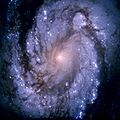
Spiral galaxy M100

Red supergiant star V838 Monocerotis

Star birth in the Carina Nebula

The Bug, or Butterfly Nebula NGC 6302
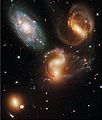
Galactic grouping known as Stephan's Quintet

100,000 stars residing in the crowded core of Omega Centauri


See also
External links
- HubbleSite
- Hubble Space Telescope History
- Jim's Hubble Telescope Photo Gallery
- Dennis Overbye, "One Last Ride to the Hubble," New York Times Dec 4, 2007
References
- ↑ One arcsec is 1/3600 of a degree.
- ↑ Dennis Overbye, "One Last Ride to the Hubble," New York Times Dec 4, 2007
- ↑ See The James Webb Space Telescope