Difference between revisions of "Kinetic Energy"
BillOhannity (Talk | contribs) (add kinetic energy for a body) |
m (Removed category physics) |
||
| (10 intermediate revisions by 6 users not shown) | |||
| Line 1: | Line 1: | ||
| − | '''Kinetic energy''' represents the [[energy]] | + | '''Kinetic energy''' represents the [[energy]] associated with the [[motion]] of an object.<ref>Serway and Beichner, ''Physics for Scientists and Engineers'', Fifth Edition</ref> It is defined as the work done by a force to accelerate that object from rest to some speed <math> v </math>, in the absence of any other [[force]]s acting upon the object. Kinetic energy is a scalar and has the same units as work (i.e. [[Joule]]). |
| − | + | ==Classical mechanics== | |
| + | ===Translational kinetic energy=== | ||
| − | + | In [[classical mechanics]], the translational kinetic energy of a ridid object, <math> K </math>, can be found as: | |
| − | + | <math> K = \frac{1}{2} m v^2</math> | |
| − | Where | + | Where |
| − | + | :<math> m </math> is the [[mass]] of the object | |
| + | :<math> v </math> is the [[velocity]] of the object | ||
| + | |||
| + | ===Rotational kinetic energy=== | ||
| + | |||
| + | The rotational kinetic energy of a rigid object is: | ||
| + | |||
| + | <math> K = {1 \over 2} I \omega ^2 </math> | ||
| + | |||
| + | Where | ||
| + | |||
| + | :<math> I </math> is the [[moment of inertia]] of the object | ||
| + | :<math> \omega </math> is the angular velocity of the object | ||
| + | |||
| + | ===Work-Energy theorem=== | ||
| + | |||
| + | The change of kinetic energy is equal to the total [[work]] done on it by the resultant of all [[force]]s acting on it. For a point mass this can be expressed as: | ||
| + | |||
| + | <math> \Sigma W = \Delta K = \frac{1}{2} m v_{f}^{2} - \frac{1}{2} m v_{I}^{2} </math> | ||
| + | |||
| + | Where | ||
| + | |||
| + | :<math> v_i </math> is the initial [[speed]] | ||
| + | :<math> v_f </math> is the final [[speed]] | ||
| + | |||
| + | Note that if the mass of an object is increased, the increase in kinetic energy increases linearly; if the [[velocity]] of an object is increased, the increase in kinetic energy increases [[quadratic equation|quadratically]]. For example, doubling the mass of an object doubles its kinetic energy; doubling its velocity quadruples its kinetic energy. | ||
| + | |||
| + | ===Derivation of translational kinetic energy=== | ||
| + | |||
| + | The [[work]] done by a force accelerating an object from rest, which is the kinetic energy is: | ||
| + | |||
| + | <math> W = K = \int F dx</math> | ||
| + | |||
| + | From Newton's second law, the [[force]], <math> F</math>, is <math> F =\frac{dp}{dt} </math>. Hence we can make the substitution and use the chain rule | ||
| + | |||
| + | <math> K = \int \frac{dp}{dt} dx = \int \frac{dp}{dx} \frac{dx}{dt} dx </math> | ||
| + | |||
| + | This is the same as | ||
| + | |||
| + | <math> K = \int v dp </math> | ||
| + | |||
| + | In [[classical mechanics]], [[momentum]] is given by <math> p = mv </math>. Differentiating and substituting into the above equation results in | ||
| + | |||
| + | <math> K = \int^{u}_{0} m v dv </math> | ||
| + | |||
| + | We want to integrate between 0 and the speed of the object, <math> u </math> as this defines kinetic energy. Performing the integration reveals that the kinetic energy is, as expected, the following: | ||
| + | |||
| + | <math> K = \frac{1}{2} mv^2 </math> | ||
| + | |||
| + | A similar method may be used to derive the formula for rotational kinetic energy. | ||
| + | |||
| + | == Kinetic Energy in Relativity == | ||
| + | |||
| + | In [[relativity]], kinetic energy can be expressed as: | ||
| + | |||
| + | <math> K = (\gamma - 1) m_0 c^2 </math> | ||
| + | |||
| + | where | ||
| + | :<math>\gamma</math> is the [[Lorentz factor]] | ||
| + | :<math>m_0</math> is the [[rest mass]] | ||
| + | :<math>c</math> is the [[speed of light]] | ||
| + | |||
| + | This can be shown to be equivalent to the classical equation for kinetic energy, <math>K=\frac{1}{2} m_0 v^2</math>, by performing a binomial expansion on it. Using the result: | ||
| + | |||
| + | <math> | ||
| + | (1+x)^n = 1 + nx+ \frac{n(n-1)x^2}{2} + ... | ||
| + | </math> | ||
| + | |||
| + | Expanding the [[Lorentz factor]] in this way, we see: | ||
| + | |||
| + | <math> | ||
| + | K=(1 + \frac{1}{2} \frac{v^2}{c^2}+ \frac{3}{8} \frac{v^4}{c^4}+...-1) m_0 c^2 | ||
| + | </math> | ||
| + | |||
| + | This simplifies to | ||
| + | |||
| + | <math> | ||
| + | K=\frac{1}{2} m_0 v^2 + \frac{3}{8} \frac{m_0 v^4}{c^2} +... | ||
| + | </math> | ||
| + | |||
| + | For speeds encountered everyday, which are a lot less than that of [[speed of light|light]] (such that <math>v<<c</math>), all terms apart from the first are very small and can be neglected. Hence, the formula reduces to: | ||
| + | |||
| + | <math>K \approx \frac{1}{2} m_0 v^2</math> | ||
| + | |||
| + | which is the classical formula. | ||
| + | |||
| + | ===Derivation=== | ||
| + | |||
| + | The kinetic energy is the [[work|work done]] accelerating a particle from rest to some speed <math>v</math>. Suppose the particle is at rest at <math>x_1</math> and speed <math>v</math> at position <math>x_2</math>. Hence: | ||
| + | |||
| + | <math>K = \int^{x_2}_{x_1} \vec{F} \dot d \vec{x}</math> | ||
| + | |||
| + | Since <math>\vec{F} = \vec{F}_{\perp} + \vec{F}_{\parallel}</math>, and a perpendicular force does no work, we can ignore the perpendicular component and write: | ||
| + | |||
| + | <math>K = \int^{x_2}_{x_1} F_{\parallel} dx = \int^{x_2}_{x_1} \gamma^3 m_0 a dx</math> | ||
| + | |||
| + | Since <math>a \, dx = \frac{dv_{\parallel}}{dt} dx = \frac{dx}{dt} dv</math>, we find the integral can be rewritten as: | ||
| + | |||
| + | <math>K = \int^{v_2}_{v_1} \frac{mv}{(1- \frac{v^2}{c^2})} dv</math> | ||
| + | |||
| + | where <math>v_1</math> is the initial speed and hence 0 by definition and <math>v_2</math> is the final speed. | ||
| + | |||
| + | Performing the integration reveals the kinetic energy as: | ||
| + | |||
| + | <math>K=(\gamma -1)m_0 c^2</math> | ||
==References== | ==References== | ||
<references/> | <references/> | ||
| − | + | ||
| − | [[Category: | + | [[Category:Mechanics]] |
Latest revision as of 17:21, April 7, 2017
Kinetic energy represents the energy associated with the motion of an object.[1] It is defined as the work done by a force to accelerate that object from rest to some speed  , in the absence of any other forces acting upon the object. Kinetic energy is a scalar and has the same units as work (i.e. Joule).
Contents
Classical mechanics
Translational kinetic energy
In classical mechanics, the translational kinetic energy of a ridid object,  , can be found as:

Where
 is the
 Rotational kinetic energy
The rotational kinetic energy of a rigid object is:

Where
 is the moment of inertia of the object
 is the angular velocity of the object
Work-Energy theorem
The change of kinetic energy is equal to the total work done on it by the resultant of all forces acting on it. For a point mass this can be expressed as:

Where
 is the initial
  is the final
 Note that if the mass of an object is increased, the increase in kinetic energy increases linearly; if the velocity of an object is increased, the increase in kinetic energy increases quadratically. For example, doubling the mass of an object doubles its kinetic energy; doubling its velocity quadruples its kinetic energy.
Derivation of translational kinetic energy
The work done by a force accelerating an object from rest, which is the kinetic energy is:

From Newton's second law, the force,  , is
, is  . Hence we can make the substitution and use the chain rule

This is the same as

In classical mechanics, momentum is given by  . Differentiating and substituting into the above equation results in

We want to integrate between 0 and the speed of the object,  as this defines kinetic energy. Performing the integration reveals that the kinetic energy is, as expected, the following:
A similar method may be used to derive the formula for rotational kinetic energy.
Kinetic Energy in Relativity
In relativity, kinetic energy can be expressed as:

where
 is the Lorentz factor
 is the rest mass
 is the speed of light
This can be shown to be equivalent to the classical equation for kinetic energy,  , by performing a binomial expansion on it. Using the result:

Expanding the Lorentz factor in this way, we see:

This simplifies to

For speeds encountered everyday, which are a lot less than that of light (such that  ), all terms apart from the first are very small and can be neglected. Hence, the formula reduces to:

which is the classical formula.
Derivation
The kinetic energy is the work done accelerating a particle from rest to some speed . Suppose the particle is at rest at  and speed at position
  . Hence:

Since  , and a perpendicular force does no work, we can ignore the perpendicular component and write:

Since 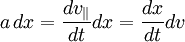 , we find the integral can be rewritten as:

where  is the initial speed and hence 0 by definition and
  is the final speed.
Performing the integration reveals the kinetic energy as:
References
- ↑ Serway and Beichner, Physics for Scientists and Engineers, Fifth Edition
