Difference between revisions of "Range"
(Adding oven) |
DavidB4-bot (talk | contribs) (→Non-mathematical uses: clean up & uniformity) |
||
| (2 intermediate revisions by 2 users not shown) | |||
| Line 1: | Line 1: | ||
| − | In [[mathematics]], the '''range''' of a function are the [[value]]s it hits. | + | In [[mathematics]], the '''range''' (or '''image''') of a [[function]] are the [[value]]s it hits. It is not to be confused with the codomain of a function, which is a designated set to which all the values of the function belong. |
| − | A range can also refer to a type of oven. | + | A function is [[onto]] (or surjective) if every value in its codomain is hit by the function, or, equivalently, if its range is equal to its codomain. More formally, a function <math>f: A \to B</math> is onto if for every <math>y \in B</math> there exists <math>x \in A</math> such that |
| + | <math>f(x) = y</math>. | ||
| + | |||
| + | ==Examples== | ||
| + | Let <math>f: \mathbb{R} \to \mathbb{R}</math> be the function defined by the equation <math>f(x) = x^2</math>. By definition, the codomain | ||
| + | of <math>f</math> is <math>\mathbb{R}</math>. However, the range of <math>f</math> consists of all nonnegative real numbers. Indeed, let <math>y</math> be a nonnegative real number. Then <math>f(\sqrt{y}) = y</math>, and so <math>y</math> is one of the values hit by <math>f</math>. | ||
| + | |||
| + | Let <math>g: \mathbb{R} \to \mathbb{R}</math> be the function defined by the equation <math>g(x) = x + 1</math>. Then, for every real number | ||
| + | <math>y</math>, we can see that <math>g(y-1) = (y-1) + 1 = y</math>, so every real number is hit by <math>g</math>. This means that the codomain and range of <math>g</math> are equal, namely <math>\mathbb{R}</math>. Therefore, <math>g</math> is onto. | ||
| + | |||
| + | ==Non-mathematical uses== | ||
| + | * A range can also refer to a type of oven. | ||
| + | * [[Shooting range]] | ||
| + | * Range - see [[distance]] and [[rangefinder]] in target and [[sniper]] [[shooting]] | ||
[[Category:Mathematics]] | [[Category:Mathematics]] | ||
| + | [[Category:Firearms Glossary]] | ||
| + | [[Category:Firearms]] | ||
Latest revision as of 06:32, July 12, 2016
In mathematics, the range (or image) of a function are the values it hits. It is not to be confused with the codomain of a function, which is a designated set to which all the values of the function belong.
A function is onto (or surjective) if every value in its codomain is hit by the function, or, equivalently, if its range is equal to its codomain. More formally, a function is onto if for every there exists such that .


Examples
Let be the function defined by the equation . By definition, the codomain of is . However, the range of consists of all nonnegative real numbers. Indeed, let be a nonnegative real number. Then , and so is one of the values hit by .


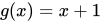
Let be the function defined by the equation . Then, for every real number , we can see that , so every real number is hit by . This means that the codomain and range of are equal, namely . Therefore, is onto.



Non-mathematical uses
- A range can also refer to a type of oven.
- Shooting range
- Range - see distance and rangefinder in target and sniper shooting