Difference between revisions of "Pythagorean triple"
Jump to navigation
Jump to search
(math) |
(insp) |
||
| Line 1: | Line 1: | ||
'''Pythagorean triple''' is a triple of [[integer]]s that follow the following formula: | '''Pythagorean triple''' is a triple of [[integer]]s that follow the following formula: | ||
:<math>a^2+b^2=c^2</math> | :<math>a^2+b^2=c^2</math> | ||
| + | It is similar to the Pythagorean Theorem which states the same for a [[right triangle]] for non-integer sides. | ||
Some of the simplest triples are: | Some of the simplest triples are: | ||
:<math>3^2+4^2=5^2</math> and <math>5^2+12^2=13^2</math> | :<math>3^2+4^2=5^2</math> and <math>5^2+12^2=13^2</math> | ||
Revision as of 00:50, February 10, 2017
Pythagorean triple is a triple of integers that follow the following formula:

It is similar to the Pythagorean Theorem which states the same for a right triangle for non-integer sides. Some of the simplest triples are:
- and
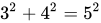

Studying these two triples, the reader may have the insight that
- and


This leads to a trivial sequence that generates some but not all possible triples is based on the positive integers starting with :[1]:

- If is odd, then and
- If is even, then and


Euclid's formula is a fundamental formula for generating all possible Pythagorean triples given an arbitrary pair of integers and with . The formula states that the following integers form a Pythagorean triple:



There are many other formulas for generating such triples.