Difference between revisions of "Vestigial Structures"
(removed vandalism) |
|||
| Line 1: | Line 1: | ||
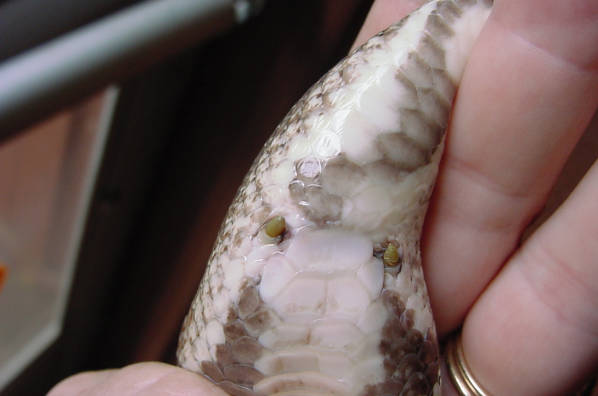
| − | Vestigial organs are those which resemble organs in other species but which are too small to be functionally useful. Examples include rear legs in some snakes<ref>[http://www.esconi.org/Karen_Komments_PDF/KK6-June2006.pdf Report on fossil snake with lizard-like features and legs]</ref>,<ref> [http://www.edwardtbabinski.us/images/spurs1.jpg Photo of python's rear leg stumps]</ref> and whales<ref>[http://www2.ucsc.edu/seymourcenter/PDF/3.%20Whale%20Skeleton%20Activity.pdf Diagram of blue whale skeleton, showing "leg" bones]</ref>, the appendix in humans<ref>[http://www.medicinenet.com/appendicitis/article.htm Diagram of appendix and information on appendicitis]</ref>, | + | Vestigial organs are those which resemble organs in other species but which are too small to be functionally useful. Examples include rear legs in some snakes<ref>[http://www.esconi.org/Karen_Komments_PDF/KK6-June2006.pdf Report on fossil snake with lizard-like features and legs]</ref>,<ref> [http://www.edwardtbabinski.us/images/spurs1.jpg Photo of python's rear leg stumps]</ref> and whales<ref>[http://www2.ucsc.edu/seymourcenter/PDF/3.%20Whale%20Skeleton%20Activity.pdf Diagram of blue whale skeleton, showing "leg" bones]</ref>, the appendix in humans<ref>[http://www.medicinenet.com/appendicitis/article.htm Diagram of appendix and information on appendicitis]</ref>, and wings in flightless birds such as ostriches or kiwi <ref>[http://www.chem.cmu.edu/groups/Collins/about/kiwi.html Kiwi information page]</ref>. |
Vesitigial organs are claimed to be strong evidence in favor of evolution - ostriches, for instance, would be claimed to have evolved from a flying ancestor which no longer needed to fly, and so in subsequent generations the wings shrunk until they were no longer capable of flight, thus helping the bird survive by requiring less food and energy. | Vesitigial organs are claimed to be strong evidence in favor of evolution - ostriches, for instance, would be claimed to have evolved from a flying ancestor which no longer needed to fly, and so in subsequent generations the wings shrunk until they were no longer capable of flight, thus helping the bird survive by requiring less food and energy. | ||
Revision as of 03:45, May 26, 2007
Vestigial organs are those which resemble organs in other species but which are too small to be functionally useful. Examples include rear legs in some snakes[1],[2] and whales[3], the appendix in humans[4], and wings in flightless birds such as ostriches or kiwi [5].
Vesitigial organs are claimed to be strong evidence in favor of evolution - ostriches, for instance, would be claimed to have evolved from a flying ancestor which no longer needed to fly, and so in subsequent generations the wings shrunk until they were no longer capable of flight, thus helping the bird survive by requiring less food and energy.
Creationists usually claim that vestigial organs aren't really useless at all - for instance, in ostriches the wings might be used for balance or sexual display. However, it is hard to extend this explanation to internal leg bones in right whales, or the near-invisible wings of the kiwi.[6] , [7].