Difference between revisions of "Succession"
(Created page with "'''Succession''' is a core concept in the field of ecology. Succession is the process by which a given ecosystem recovers its composition of species after a disturbance, ...") |
DavidB4-bot (talk | contribs) (→External links: clean up & uniformity) |
||
| Line 1: | Line 1: | ||
'''Succession''' is a core concept in the field of [[ecology]]. Succession is the process by which a given [[ecosystem]] recovers its composition of species after a disturbance, such as a [[flood]], [[fire]], or [[earthquake]]. One commonly used example of this is the recovery of the ecosystem after the 1980 eruption of [[Mt. St. Helens]]. Generally after a disturbance, the first species to re-establish themselves will be species referred to as "R-selected". These species generally have short generation times and produce large quantities of young, of which only a few may survive to adulthood. These traits make these species suited to colonize an area such as one that has recently suffered a disturbance. Once a population of R-selected species exists in an area, they will modify the environment, either enabling or inhibiting the further colonization of other species. Eventually the ecosystem will move from being dominated by R-selected species to being dominated by a "climax community" of K-selected species, which generally have longer generations, fewer young, but are able to utilize a given set of resources more efficiently. | '''Succession''' is a core concept in the field of [[ecology]]. Succession is the process by which a given [[ecosystem]] recovers its composition of species after a disturbance, such as a [[flood]], [[fire]], or [[earthquake]]. One commonly used example of this is the recovery of the ecosystem after the 1980 eruption of [[Mt. St. Helens]]. Generally after a disturbance, the first species to re-establish themselves will be species referred to as "R-selected". These species generally have short generation times and produce large quantities of young, of which only a few may survive to adulthood. These traits make these species suited to colonize an area such as one that has recently suffered a disturbance. Once a population of R-selected species exists in an area, they will modify the environment, either enabling or inhibiting the further colonization of other species. Eventually the ecosystem will move from being dominated by R-selected species to being dominated by a "climax community" of K-selected species, which generally have longer generations, fewer young, but are able to utilize a given set of resources more efficiently. | ||
| − | ==External | + | ==External links== |
| − | [http://www.physicalgeography.net/fundamentals/images/succession.gif a simple image of plant succession] | + | * [http://www.physicalgeography.net/fundamentals/images/succession.gif a simple image of plant succession] |
| − | [[ | + | [[Category:Ecology]] |
Latest revision as of 19:51, July 13, 2016
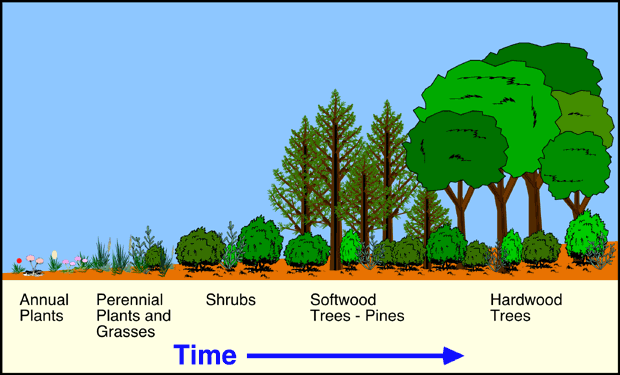
Succession is a core concept in the field of ecology. Succession is the process by which a given ecosystem recovers its composition of species after a disturbance, such as a flood, fire, or earthquake. One commonly used example of this is the recovery of the ecosystem after the 1980 eruption of Mt. St. Helens. Generally after a disturbance, the first species to re-establish themselves will be species referred to as "R-selected". These species generally have short generation times and produce large quantities of young, of which only a few may survive to adulthood. These traits make these species suited to colonize an area such as one that has recently suffered a disturbance. Once a population of R-selected species exists in an area, they will modify the environment, either enabling or inhibiting the further colonization of other species. Eventually the ecosystem will move from being dominated by R-selected species to being dominated by a "climax community" of K-selected species, which generally have longer generations, fewer young, but are able to utilize a given set of resources more efficiently.