Difference between revisions of "Characteristic polynomial"
m (Reverted edits by ThomasPickett (talk) to last revision by DavidB4-bot) |
|||
| Line 3: | Line 3: | ||
:<math>f(\lambda) = \det(A-\lambda I)</math> | :<math>f(\lambda) = \det(A-\lambda I)</math> | ||
| − | where <math>I</math> is the [[identity matrix]]. The [[root]]s of this [[polynomial]] are the [[eigenvalue]]s of the matrix. | + | where <math>I</math> is the [[identity matrix]]. The [[root (Mathematics)|root]]s of this [[polynomial]] are the [[eigenvalue]]s of the matrix. |
The degree of this polynomial equals the length of the matrix's side. The number of roots therefore is not greater than this number. | The degree of this polynomial equals the length of the matrix's side. The number of roots therefore is not greater than this number. | ||
Latest revision as of 23:56, February 22, 2023
The characteristic polynomial of a square matrix  is given by,

where  is the identity matrix. The roots of this polynomial are the eigenvalues of the matrix.
The degree of this polynomial equals the length of the matrix's side. The number of roots therefore is not greater than this number.
Example
Take 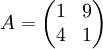
Then 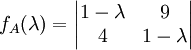

 .
.
So, the roots of the characteristic polynomial are {-5, 7} - and these are the eigenvalues of the matrix. If you look at the slightly different matrix
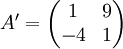 ,
,
you find the characteristic polynomial
 .
.
This polynomial has no roots in  , so if
  describes a linear map between to two dimensional real vector spaces, then this map has no eigenvalue. However, if is seen as a mapping of complex vector spaces,
  can be factorized:
 .
.
For complex spaces, the sum of algebraic multiplicities of the eigenvalues equals the degree of the characteristic polynomial.
