Difference between revisions of "Economics"
Jump to navigation
Jump to search
(Replacing page with 'GO ON LIBERALS, LIBERTARTIANS, AND LEFTISTS! F*CK ALL THIS FASCISTS! F*CK EM ALL!!! ='''LET'S VANDALIZE THIS F*CKIN SHIT!!!!!=') |
(Undo revision 301122 by Special:Contributions/Asd (User talk:Asd)) |
||
| Line 1: | Line 1: | ||
| − | + | [[Image:NYSE-floor.jpg|right|thumb|Face-to-face trading on the [[New York Stock Exchange]]'s trading floor.]] | |
| + | '''Economics''' is a social [[science]] concerned with how society produces, allocates, and consumes goods and services. | ||
| − | =''' | + | == Issues in economics == |
| + | Economics deals with a large number of issues: | ||
| + | * [[Theory of value]]: What are things worth? Why are they worth what they're worth? | ||
| + | * [[Economic justice]]: What is a "fair" distribution of resources in a society? | ||
| + | * [[Economic prosperity]]: What policies encourage economic growth and development? | ||
| + | * [[Economic prediction]]: What can the economic realities today tell us about the economic realities of tomorrow? | ||
| + | |||
| + | == Disciplines within economics == | ||
| + | Economics is a very broad discipline, and involves the following other disciplines as well: | ||
| + | * [[Moral philosophy]]: How ''ought'' a society produce and distribute goods and services? | ||
| + | * [[Psychology]]: What principles underlie human economic decision-making? | ||
| + | * [[Mathematics]]: What mathematical models can predict economic outcomes? | ||
| + | * [[Ecology]]: What economic policies and practices are ecologically sustainable? | ||
| + | |||
| + | ==Branches of economics== | ||
| + | * [[Microeconomics]]: the study of economic decisions in individual people, businesses, and markets; | ||
| + | * [[Macroeconomics]]: the study of economic dynamics and policies in an entire economy | ||
| + | |||
| + | == History of economics== | ||
| + | ''Main article: [[History of economics]]'' | ||
| + | |||
| + | It is generally accepted that the formal study of economics began with the Scotsman [[Adam Smith]], in his book [[An Inquiry into the Nature and Causes of the Wealth of Nations]]. The origins of the field however, lie in the [[banking]] industry, which has developed over thousands of years.{{fact}} | ||
| + | |||
| + | [[Category:Economics]] | ||
Revision as of 13:40, September 27, 2007

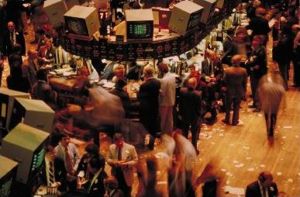
Face-to-face trading on the New York Stock Exchange's trading floor.
Economics is a social science concerned with how society produces, allocates, and consumes goods and services.
Issues in economics
Economics deals with a large number of issues:
- Theory of value: What are things worth? Why are they worth what they're worth?
- Economic justice: What is a "fair" distribution of resources in a society?
- Economic prosperity: What policies encourage economic growth and development?
- Economic prediction: What can the economic realities today tell us about the economic realities of tomorrow?
Disciplines within economics
Economics is a very broad discipline, and involves the following other disciplines as well:
- Moral philosophy: How ought a society produce and distribute goods and services?
- Psychology: What principles underlie human economic decision-making?
- Mathematics: What mathematical models can predict economic outcomes?
- Ecology: What economic policies and practices are ecologically sustainable?
Branches of economics
- Microeconomics: the study of economic decisions in individual people, businesses, and markets;
- Macroeconomics: the study of economic dynamics and policies in an entire economy
History of economics
Main article: History of economics
It is generally accepted that the formal study of economics began with the Scotsman Adam Smith, in his book An Inquiry into the Nature and Causes of the Wealth of Nations. The origins of the field however, lie in the banking industry, which has developed over thousands of years.[Citation Needed]