Difference between revisions of "George McGovern"
Jump to navigation
Jump to search
| Line 1: | Line 1: | ||
[[Image:Maclaine.jpg |right|125px|]] | [[Image:Maclaine.jpg |right|125px|]] | ||
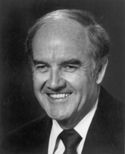
| − | '''George McGovern''' (b. 1922) is a former university professor who became a [[liberal]] [[Democratic Party|Democratic]] Congressman and Senator from [[South Dakota]]. | + | '''George McGovern''' (b. 1922) is a former university professor who became a [[liberal]] [[Democratic Party|Democratic]] Congressman and Senator from [[South Dakota]]. A decorated World War II veteran, McGovern served in the US Army Air Forces. As a populist, anti-war candidate who won the Democratic nomination for president in 1972, McGovern lost in a landslide against the incumbent [[Richard Nixon]]. |
The [[Democratic Party]] subsequently changed its procedures for nominating presidential candidates in order to give about one-third of the nominating (delegate) power to existing office-holders, in order to make it more difficult for a populist but unelectable candidate like McGovern to win the Democratic presidential nomination. | The [[Democratic Party]] subsequently changed its procedures for nominating presidential candidates in order to give about one-third of the nominating (delegate) power to existing office-holders, in order to make it more difficult for a populist but unelectable candidate like McGovern to win the Democratic presidential nomination. | ||
Revision as of 20:34, October 8, 2007

George McGovern (b. 1922) is a former university professor who became a liberal Democratic Congressman and Senator from South Dakota. A decorated World War II veteran, McGovern served in the US Army Air Forces. As a populist, anti-war candidate who won the Democratic nomination for president in 1972, McGovern lost in a landslide against the incumbent Richard Nixon.
The Democratic Party subsequently changed its procedures for nominating presidential candidates in order to give about one-third of the nominating (delegate) power to existing office-holders, in order to make it more difficult for a populist but unelectable candidate like McGovern to win the Democratic presidential nomination.