Difference between revisions of "Fundamental theorem of calculus"
(removed potentially confusing statement) |
|||
| Line 2: | Line 2: | ||
*[[Differentiation]] -- find the slope of a function's graph at a given point. | *[[Differentiation]] -- find the slope of a function's graph at a given point. | ||
*[[integral|Integration]] -- find the area under a graph between two given limits. | *[[integral|Integration]] -- find the area under a graph between two given limits. | ||
| − | The Fundamental Theorem of Calculus says that the two operations are inverses -- to find the area under the graph of f(x) between a and b, find the function g(x) whose derivative is f(x) (the ''antiderivative'' of f). The area under the graph of f between x=a and x=b is just g(b)-g(a). | + | The Fundamental Theorem of Calculus says that the two operations are inverses -- to find the area under the graph of f(x) between a and b, find the function g(x) whose derivative is f(x) (that is, find the ''antiderivative'' of f). The area under the graph of f between x=a and x=b is just g(b)-g(a). |
| − | + | The antiderivative of a function is often called the ''indefinite integral''. (Indefinite because the limits a and b haven't been specified.) So, for example, the derivative of <math>\frac{x^3}{3}+7</math> is <math>x^2</math>. From this it follows that the antiderivative of | |
| + | <math>x^2</math> could be <math>\frac{x^3}{3}+7</math>. But note that the "7" in that formula was a red herring. Adding any constant to a function doesn't change its derivative, so the antiderivative of <math>x^2</math> could have any constant added to it. This arbitrary constant is usually written '''C''' and is called the "constant of integration". The indefinite integral could be written: | ||
| − | :<math>\int^{ | + | :<math>\int x^2\ \mathrm{d}x = \frac{x^3}{3} + C\,</math>, |
| + | |||
| + | The Fundamental Theorem of Calculus says that the area under the graph of <math>x^2</math> between a and b is the difference in the values of <math>\frac{x^3}{3}+C</math> between a and b. Note that the constant of integration cancels out. | ||
| + | |||
| + | This kind of integral is called a ''definite integral'', written with the limits: | ||
| + | |||
| + | :<math>\int_a^b x^2\ \mathrm{d}x = \frac{b^3}{3} - \frac{a^3}{3}\,</math>, | ||
| + | |||
| + | The above is a simplified "intuitive" treatment of calculus and of this theorem. The actual "rigorous" proof, "rigorous" definitions of derivative and integral, and statement of the conditions under which the theorem is true, are beyond the scope of this article. | ||
| − | |||
[[Category:Calculus]] | [[Category:Calculus]] | ||
[[Category:Mathematics]] | [[Category:Mathematics]] | ||
Revision as of 23:20, July 4, 2008
The Fundamental Theorem of Calculus, first proven by James Gregory, is the rather remarkable result that the two fundamental operations of calculus are just inverses of each other. Those two operations are performed on functions from the real numbers to the real numbers, and are most easily visualized when the functions are expressed in terms of graphs. The operations are:
- Differentiation -- find the slope of a function's graph at a given point.
- Integration -- find the area under a graph between two given limits.
The Fundamental Theorem of Calculus says that the two operations are inverses -- to find the area under the graph of f(x) between a and b, find the function g(x) whose derivative is f(x) (that is, find the antiderivative of f). The area under the graph of f between x=a and x=b is just g(b)-g(a).
The antiderivative of a function is often called the indefinite integral. (Indefinite because the limits a and b haven't been specified.) So, for example, the derivative of  is
is  . From this it follows that the antiderivative of
could be . But note that the "7" in that formula was a red herring. Adding any constant to a function doesn't change its derivative, so the antiderivative of could have any constant added to it. This arbitrary constant is usually written C and is called the "constant of integration". The indefinite integral could be written:
. From this it follows that the antiderivative of
could be . But note that the "7" in that formula was a red herring. Adding any constant to a function doesn't change its derivative, so the antiderivative of could have any constant added to it. This arbitrary constant is usually written C and is called the "constant of integration". The indefinite integral could be written:
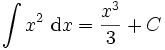 ,
,
The Fundamental Theorem of Calculus says that the area under the graph of between a and b is the difference in the values of  between a and b. Note that the constant of integration cancels out.
This kind of integral is called a definite integral, written with the limits:
 ,
,
The above is a simplified "intuitive" treatment of calculus and of this theorem. The actual "rigorous" proof, "rigorous" definitions of derivative and integral, and statement of the conditions under which the theorem is true, are beyond the scope of this article.
