Difference between revisions of "User:JakeRMurrin"
JakeRMurrin (talk | contribs) |
JakeRMurrin (talk | contribs) (New scholarship suggests my earlier claims needed radical revision.) |
||
| Line 1: | Line 1: | ||
"There were 750,000 "unnatural deaths" in Cambodia from 1975-78.....The Nixon [and Ford] administrations predicted a million deaths in Cambodia if US aid were to cease." | "There were 750,000 "unnatural deaths" in Cambodia from 1975-78.....The Nixon [and Ford] administrations predicted a million deaths in Cambodia if US aid were to cease." | ||
| − | -Noam Chomsky, infamously praising the Khmer Rouge for saving hundreds of thousands of lives and for killing virtually no one at all. The prediction actually referred to the likely death toll from a Communist take-over, and asserted that the Khmer Rouge would murder more than one million people if they took power (see: http://www.paulbogdanor.com/chomsky/manufacturing.html) The Khmer Rouge should indeed take the blame for those who were killed by their refusal to allow foreign aid, although before 1975 an aid cut-off would likely have cost only thousands of lives at most, and the Khmer Rouge did nothing to alleviate the famine they artificially cultivated. Chomsky cultists (Wade Frazier, I'm looking at you) ''still'' use these easily debunked claims to openly deny the Khmer Rouge genocide, largely thanks to willful ignorance and self-deception. | + | -Noam Chomsky, infamously praising the Khmer Rouge for saving hundreds of thousands of lives and for killing virtually no one at all. The prediction actually referred to the likely death toll from a Communist take-over, and asserted that the Khmer Rouge would murder more than one million people if they took power (see: http://www.paulbogdanor.com/chomsky/manufacturing.html) The Khmer Rouge should indeed take the blame for those who were killed by their refusal to allow foreign aid, although before 1975 an aid cut-off would likely have cost only thousands of lives at most, and the Khmer Rouge did nothing to alleviate the famine they artificially cultivated. Chomsky cultists (Wade Frazier, I'm looking at you) ''still'' use these easily debunked claims to openly deny the Khmer Rouge genocide, largely thanks to willful ignorance and self-deception. |
"Oh will there be a dreadful bloodbath/ When the Khmer Rouge come to town?/ Aye, there'll be a dreadful bloodbath/ When the Khmer Rouge come to town." | "Oh will there be a dreadful bloodbath/ When the Khmer Rouge come to town?/ Aye, there'll be a dreadful bloodbath/ When the Khmer Rouge come to town." | ||
| Line 13: | Line 13: | ||
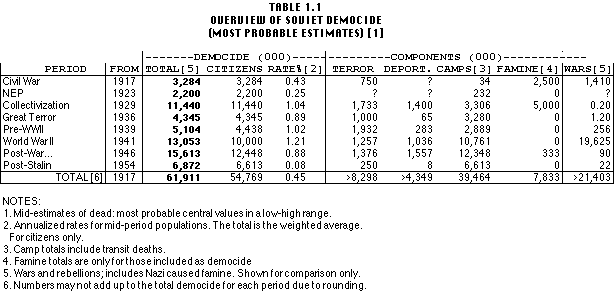
Soviet Russia: 62,000,000 killed. http://www.hawaii.edu/powerkills/USSR.TAB1.1.GIF | Soviet Russia: 62,000,000 killed. http://www.hawaii.edu/powerkills/USSR.TAB1.1.GIF | ||
| − | Cambodian Democide State (67-94): | + | Cambodian Democide State (67-94): 3,450,000 killed. |
| − | ::::67-75: Cambodian | + | ::::67-75: Cambodian Civil War: 250,000 killed: http://www.mekong.net/cambodia/deaths.htm |
| − | + | ::::75-78: Khmer Rouge Hell-State: 2,200,000 killed. | |
| − | + | :::::Investigators have uncovered and examined the remains of 1,386,734 Cambodians found in mass graves near Khmer Rouge execution centers whose cause of death has been determined to have been primarily execution by the former Khmer Rouge regime. See: http://www.mekong.net/cambodia/deaths.htm and http://www.mekong.net/cambodia/toll.htm "If the remains in the mass graves give us a reasonable approximation of the number of executions, what does that tell us about the overall death toll? Etcheson explains that, according to Kiernan, Osborne's data suggests that executions amounted to 31% of the death toll; meanwhile, "The demographer Marek Sliwinski estimates that about 40% of the death toll resulted from execution, 36% from starvation, 13% from disease, and the remainder from either combat or natural causes. Other work carried out by a political scientist, Steve Heder, suggested that different proportions of the total death toll could be attributed to execution for urban versus rural dwellers, about 33% among 'new people' and 50% among 'base people.' Thus the various estimates of the proportion of deaths resulting from execution range from a low of about 30% for the overall population to a high of 50% among base people." Considering these figures, Etcheson continues: | |
| − | ::::75-78: Khmer Rouge Hell-State: 2, | + | |
| − | :::::Investigators have uncovered and examined the remains of 1 | + | "The implications of these figures are enormous. If these calculations of the proportion of deaths due to causes other than execution are accurate, then we begin to approach an astonishing conclusion. It begins to look possible that the original Cambodian estimate of 3.3 million deaths during the Khmer Rouge regime might be very nearly correct. |
| − | ::::78-nineties: Samrin's Gulag: 1, | + | |
| − | :::::Samrin Regime: At least 500,000 (lowest estimate) to 1,500,000 (highest estimate) directly killed by the state in democide. See Rummel: http://www.hawaii.edu/powerkills/SOD.CHAP4.HTM | + | "If as little as 31% of the death toll was the result of executions, then a total of 3.3 million deaths would imply slightly more than one million executions, and the Documentation Center data suggest they have already found more victims of execution than that. If we apply Heder's top estimate of 50% for base people to the entire population, and find upon the completion of the mass grave surveys that the number of suspected victims of execution is around 1.5 million, then we again end up with a figure in the vicinity of three million total dead in the Pol Pot time. In either case, we would be driven to the conclusion that not one million, not two million, but rather three million Cambodians died untimely deaths during the Khmer Rouge regime." |
| − | + | ||
| + | A casual reading of Etcheson's report suggests that his own estimate of the death toll, then, would be approximately three million. According to Etcheson, however, this was not his intention. Personally, Etcheson suggests that the death toll was between 2 and 2.5 million, with a "most likely" figure of 2.2 million. | ||
| + | |||
| + | There is exactly one word that makes this sentence inaccurate: the word untimely. | ||
| + | |||
| + | What Etcheson seems to have overlooked in this particular remark is how the difficulty of separating natural and unnatural deaths would affect calculations of the ratios of deaths from execution, and deaths from other causes. It is very doubtful that those respondents in the surveys conducted by Heder, Osborne, and Kiernan would be able to discern which deaths should be considered normal mortality, and which should be considered excess mortality; thus, the ratios Etcheson refers to are more valuable for calculating all deaths, and not only untimely deaths. | ||
| + | |||
| + | Prewar death rates would suggest that roughly 500,000 deaths would be represent normal mortality for the duration of the Khmer Rouge regime. Three million deaths, then, would mean roughly 2.5 million excess deaths; and if the proportion of deaths by execution was higher than 30%, the toll would be somewhat less. | ||
| + | |||
| + | A 1975 population of roughly 8 million seems highly likely. As noted, most demographers believe that a census will generally be an undercount, particularly in a underdeveloped country. Bannister and Johnson note that "A 1964 survey in Cambodia indicated that the 1962 census may have missed about four percent of the population." Migozzi, too, believed that the census was an undercount; and, as noted previously, Siampos and Heuveline believed that birth rates were underestimated. Meanwhile, prevailing estimates of the war toll were probably overestimated; Bannister and Johnson described their estimate of 275,000 excess deaths as "the highest mortality we can justify." | ||
| + | |||
| + | Demographic evidence also suggests that the birth rate for the Pol Pot time did not decline quite as drastically as previously believed. Assuming a normal growth rate of 3%, and a normal crude death rate of 19 per thousand, the normal crude birth rate would have been approximately 49 per thousand. Heuveline and Poch estimated a 34% decrease in total fertility; and over a relatively short period of time, a decrease in fertility would have been accompanied by an approximately equal decline in the crude birth rate. This would mean that the crude birth rate would have been around 32 births per thousand, which in turn would mean that the annual growth rate (crude births per thousand, minus crude deaths per thousand) would have been around 1.3%. A starting population of 8.002 million, compounded by an annual growth rate of 1.3%, would have meant an expected population of roughly 8.39 million in 1979. I would regard this as the "most likely" figure for the expected population. Given the imprecision of the data, it is probably more reasonable to specify a plausible range, rather than a single figure. The high end of the range, assuming these same growth rates, but with a starting population of 8.102 million, would yield an expected 1979 population of 8.495 million. The low end of the plausible range, meanwhile, would be fairly close to Kiernan's estimate of an expected 1979 population of 8.215 million. On the assumption that Vickery's higher estimate of the numbers exiled to Vietnam might be correct, we could lower this figure by about 50,000, yielding an expected population of 8.165 million for 1979. | ||
| + | |||
| + | How many survivors were there? Bannister and Johnson suggest about 6.36 million inside Cambodia at the end of 1978. They also suggest a population loss of 218,000 due to migration. The majority of these however, were the 150,000 ethnic Vietnamese who were previously subtracted from the starting population; the remaining 58,000 fled to Thailand, Laos, and Vietnam before 1979. The number of survivors, then, would be 6.418 million. | ||
| + | |||
| + | But was the 1980 count accurate? Heuveline believes that the surviving population was just under 6 million. Bannister and Johnson acknowledge that the administrators compiling the 1980 count had an incentive to overestimate the number of persons within their jurisdiction, but also note that a census will generally be an undercount. Presumably because they viewed these two factors as offsetting one another, they did not adjust the figure. However, I would argue that if, as Bannister and Johnson suggest, we should treat the 1980 figure as an undercount typical of a census, we should also make a corresponding adjustment to our starting population to compensate for that probable undercount... and, as noted previously, such an adjustment would result in an even higher estimate of excess deaths. I'm also inclined to believe that many of those who fled to Vietnam during the civil war probably returned prior to the 1980 count. | ||
| + | |||
| + | I am unaware of any evidence to suggest that Bannister and Johnson's figure would be an underestimate; thus, we could affix 6.418 million at the upper end of the range of plausible estimates. The lower end of the range would probably be roughly 6 million. In the absence of any precise data, I would regard the median - 6.209 million - as the most likely figure. | ||
| + | |||
| + | Subtracting this figure from the most likely expected population - 8.39 million - suggests roughly 2.18 million excess deaths." | ||
| + | |||
| + | See here: http://www.mekong.net/cambodia/deaths.htm | ||
| + | |||
| + | ::::78-nineties: Samrin's Gulag: 1,000,000 killed. | ||
| + | :::::Samrin Regime: At least 500,000 (lowest estimate) to 1,500,000 (highest estimate) directly killed by the state in democide. See Rummel: http://www.hawaii.edu/powerkills/SOD.CHAP4.HTM Most likely: 800,000 killed. | ||
:::::Civil War (78-94): 200,000 Cambodians killed. See: http://users.erols.com/mwhite28/warstat3.htm#Cambodian | :::::Civil War (78-94): 200,000 Cambodians killed. See: http://users.erols.com/mwhite28/warstat3.htm#Cambodian | ||
| − | + | North Korean Slave State: 6,250,000 killed. | |
| − | + | ::::Korean war of aggression cost as many as 2.5 million lives (see: http://www.hawaii.edu/powerkills/SOD.CHAP10.HTM), including 500,000 South Korean POWs worked to death in concentration camps. Given the large number of "hostiles" sent to perform hard labor in North Korea (not counting those in the concentration camps)--possibly more than 4 million in 1989 alone according to human rights groups--more than 2 million North Koreans have been killed by the state through slave labor since the end of the war if we assume a death rate of just over 1%. (See: http://www.hawaii.edu/powerkills/SOD.CHAP10.HTM) A ''further'' 3 million North Koreans have been starved to death by the state in just the most recent famine. (See: http://www.rense.com/political/koreastarve.htm) South Korean intelligence shows the pop. fell from 25m to 22m: http://users.erols.com/mwhite28/warstat2.htm#North | |
| − | |||
| − | |||
| − | North Korean Slave State: | ||
| − | ::::Korean war of aggression cost 2.5 million lives (see: http://www.hawaii.edu/powerkills/SOD.CHAP10.HTM), including 500,000 South Korean POWs worked to death in concentration camps. Given the large number of "hostiles" sent to perform hard labor in North Korea (not counting those in the concentration camps)--possibly more than 4 million in 1989 alone according to human rights groups--more than 2 million North Koreans have been killed by the state through slave labor since the end of the war if we assume a death rate of just over 1%. (See: http://www.hawaii.edu/powerkills/SOD.CHAP10.HTM) A ''further'' 3 million North Koreans have been starved to death by the state in just the most recent famine. (See: http://www.rense.com/political/koreastarve.htm) South Korean intelligence shows the pop. fell from 25m to 22m: http://users.erols.com/mwhite28/warstat2.htm#North | ||
::::Additional 100,000 in party purges: http://users.erols.com/mwhite28/warstat2.htm#North | ::::Additional 100,000 in party purges: http://users.erols.com/mwhite28/warstat2.htm#North | ||
| + | ::::Black Book of Communism: 1.5 million worked to death and 3 million starved to death. These figures are more likely. Based on range, an average of 1,750,000 died in Korean war. | ||
Revision as of 03:59, September 25, 2010
"There were 750,000 "unnatural deaths" in Cambodia from 1975-78.....The Nixon [and Ford] administrations predicted a million deaths in Cambodia if US aid were to cease."
-Noam Chomsky, infamously praising the Khmer Rouge for saving hundreds of thousands of lives and for killing virtually no one at all. The prediction actually referred to the likely death toll from a Communist take-over, and asserted that the Khmer Rouge would murder more than one million people if they took power (see: http://www.paulbogdanor.com/chomsky/manufacturing.html) The Khmer Rouge should indeed take the blame for those who were killed by their refusal to allow foreign aid, although before 1975 an aid cut-off would likely have cost only thousands of lives at most, and the Khmer Rouge did nothing to alleviate the famine they artificially cultivated. Chomsky cultists (Wade Frazier, I'm looking at you) still use these easily debunked claims to openly deny the Khmer Rouge genocide, largely thanks to willful ignorance and self-deception.
"Oh will there be a dreadful bloodbath/ When the Khmer Rouge come to town?/ Aye, there'll be a dreadful bloodbath/ When the Khmer Rouge come to town." -US print and television journalists, singing to the tune of "She Was Poor But She Was Honest," openly mock the very idea of a Communist genocide in Cambodia. See: http://jim.com/canon.htm#ch2
Although leftists like to minimize their comrades' crimes, Communism has been the greatest killer in history:
Communist China: 77,000,000 killed. http://democraticpeace.wordpress.com/2008/11/24/reevaluating-chinas-democide-to-73000000
Soviet Russia: 62,000,000 killed. http://www.hawaii.edu/powerkills/USSR.TAB1.1.GIF
Cambodian Democide State (67-94): 3,450,000 killed.
- 67-75: Cambodian Civil War: 250,000 killed: http://www.mekong.net/cambodia/deaths.htm
- 75-78: Khmer Rouge Hell-State: 2,200,000 killed.
- Investigators have uncovered and examined the remains of 1,386,734 Cambodians found in mass graves near Khmer Rouge execution centers whose cause of death has been determined to have been primarily execution by the former Khmer Rouge regime. See: http://www.mekong.net/cambodia/deaths.htm and http://www.mekong.net/cambodia/toll.htm "If the remains in the mass graves give us a reasonable approximation of the number of executions, what does that tell us about the overall death toll? Etcheson explains that, according to Kiernan, Osborne's data suggests that executions amounted to 31% of the death toll; meanwhile, "The demographer Marek Sliwinski estimates that about 40% of the death toll resulted from execution, 36% from starvation, 13% from disease, and the remainder from either combat or natural causes. Other work carried out by a political scientist, Steve Heder, suggested that different proportions of the total death toll could be attributed to execution for urban versus rural dwellers, about 33% among 'new people' and 50% among 'base people.' Thus the various estimates of the proportion of deaths resulting from execution range from a low of about 30% for the overall population to a high of 50% among base people." Considering these figures, Etcheson continues:
"The implications of these figures are enormous. If these calculations of the proportion of deaths due to causes other than execution are accurate, then we begin to approach an astonishing conclusion. It begins to look possible that the original Cambodian estimate of 3.3 million deaths during the Khmer Rouge regime might be very nearly correct.
"If as little as 31% of the death toll was the result of executions, then a total of 3.3 million deaths would imply slightly more than one million executions, and the Documentation Center data suggest they have already found more victims of execution than that. If we apply Heder's top estimate of 50% for base people to the entire population, and find upon the completion of the mass grave surveys that the number of suspected victims of execution is around 1.5 million, then we again end up with a figure in the vicinity of three million total dead in the Pol Pot time. In either case, we would be driven to the conclusion that not one million, not two million, but rather three million Cambodians died untimely deaths during the Khmer Rouge regime."
A casual reading of Etcheson's report suggests that his own estimate of the death toll, then, would be approximately three million. According to Etcheson, however, this was not his intention. Personally, Etcheson suggests that the death toll was between 2 and 2.5 million, with a "most likely" figure of 2.2 million.
There is exactly one word that makes this sentence inaccurate: the word untimely.
What Etcheson seems to have overlooked in this particular remark is how the difficulty of separating natural and unnatural deaths would affect calculations of the ratios of deaths from execution, and deaths from other causes. It is very doubtful that those respondents in the surveys conducted by Heder, Osborne, and Kiernan would be able to discern which deaths should be considered normal mortality, and which should be considered excess mortality; thus, the ratios Etcheson refers to are more valuable for calculating all deaths, and not only untimely deaths.
Prewar death rates would suggest that roughly 500,000 deaths would be represent normal mortality for the duration of the Khmer Rouge regime. Three million deaths, then, would mean roughly 2.5 million excess deaths; and if the proportion of deaths by execution was higher than 30%, the toll would be somewhat less.
A 1975 population of roughly 8 million seems highly likely. As noted, most demographers believe that a census will generally be an undercount, particularly in a underdeveloped country. Bannister and Johnson note that "A 1964 survey in Cambodia indicated that the 1962 census may have missed about four percent of the population." Migozzi, too, believed that the census was an undercount; and, as noted previously, Siampos and Heuveline believed that birth rates were underestimated. Meanwhile, prevailing estimates of the war toll were probably overestimated; Bannister and Johnson described their estimate of 275,000 excess deaths as "the highest mortality we can justify."
Demographic evidence also suggests that the birth rate for the Pol Pot time did not decline quite as drastically as previously believed. Assuming a normal growth rate of 3%, and a normal crude death rate of 19 per thousand, the normal crude birth rate would have been approximately 49 per thousand. Heuveline and Poch estimated a 34% decrease in total fertility; and over a relatively short period of time, a decrease in fertility would have been accompanied by an approximately equal decline in the crude birth rate. This would mean that the crude birth rate would have been around 32 births per thousand, which in turn would mean that the annual growth rate (crude births per thousand, minus crude deaths per thousand) would have been around 1.3%. A starting population of 8.002 million, compounded by an annual growth rate of 1.3%, would have meant an expected population of roughly 8.39 million in 1979. I would regard this as the "most likely" figure for the expected population. Given the imprecision of the data, it is probably more reasonable to specify a plausible range, rather than a single figure. The high end of the range, assuming these same growth rates, but with a starting population of 8.102 million, would yield an expected 1979 population of 8.495 million. The low end of the plausible range, meanwhile, would be fairly close to Kiernan's estimate of an expected 1979 population of 8.215 million. On the assumption that Vickery's higher estimate of the numbers exiled to Vietnam might be correct, we could lower this figure by about 50,000, yielding an expected population of 8.165 million for 1979.
How many survivors were there? Bannister and Johnson suggest about 6.36 million inside Cambodia at the end of 1978. They also suggest a population loss of 218,000 due to migration. The majority of these however, were the 150,000 ethnic Vietnamese who were previously subtracted from the starting population; the remaining 58,000 fled to Thailand, Laos, and Vietnam before 1979. The number of survivors, then, would be 6.418 million.
But was the 1980 count accurate? Heuveline believes that the surviving population was just under 6 million. Bannister and Johnson acknowledge that the administrators compiling the 1980 count had an incentive to overestimate the number of persons within their jurisdiction, but also note that a census will generally be an undercount. Presumably because they viewed these two factors as offsetting one another, they did not adjust the figure. However, I would argue that if, as Bannister and Johnson suggest, we should treat the 1980 figure as an undercount typical of a census, we should also make a corresponding adjustment to our starting population to compensate for that probable undercount... and, as noted previously, such an adjustment would result in an even higher estimate of excess deaths. I'm also inclined to believe that many of those who fled to Vietnam during the civil war probably returned prior to the 1980 count.
I am unaware of any evidence to suggest that Bannister and Johnson's figure would be an underestimate; thus, we could affix 6.418 million at the upper end of the range of plausible estimates. The lower end of the range would probably be roughly 6 million. In the absence of any precise data, I would regard the median - 6.209 million - as the most likely figure.
Subtracting this figure from the most likely expected population - 8.39 million - suggests roughly 2.18 million excess deaths."
See here: http://www.mekong.net/cambodia/deaths.htm
- 78-nineties: Samrin's Gulag: 1,000,000 killed.
- Samrin Regime: At least 500,000 (lowest estimate) to 1,500,000 (highest estimate) directly killed by the state in democide. See Rummel: http://www.hawaii.edu/powerkills/SOD.CHAP4.HTM Most likely: 800,000 killed.
- Civil War (78-94): 200,000 Cambodians killed. See: http://users.erols.com/mwhite28/warstat3.htm#Cambodian
- 78-nineties: Samrin's Gulag: 1,000,000 killed.
North Korean Slave State: 6,250,000 killed.
- Korean war of aggression cost as many as 2.5 million lives (see: http://www.hawaii.edu/powerkills/SOD.CHAP10.HTM), including 500,000 South Korean POWs worked to death in concentration camps. Given the large number of "hostiles" sent to perform hard labor in North Korea (not counting those in the concentration camps)--possibly more than 4 million in 1989 alone according to human rights groups--more than 2 million North Koreans have been killed by the state through slave labor since the end of the war if we assume a death rate of just over 1%. (See: http://www.hawaii.edu/powerkills/SOD.CHAP10.HTM) A further 3 million North Koreans have been starved to death by the state in just the most recent famine. (See: http://www.rense.com/political/koreastarve.htm) South Korean intelligence shows the pop. fell from 25m to 22m: http://users.erols.com/mwhite28/warstat2.htm#North
- Additional 100,000 in party purges: http://users.erols.com/mwhite28/warstat2.htm#North
- Black Book of Communism: 1.5 million worked to death and 3 million starved to death. These figures are more likely. Based on range, an average of 1,750,000 died in Korean war.