Probability density function
In probability theory, a probability density function (say) f is a real valued and continuous function whose value is the probability density of the variable that it is a function of. Since it is a density, the actual probability P that the variable will be in the interval [a,b] is
- Failed to parse (MathML with SVG or PNG fallback (recommended for modern browsers and accessibility tools): Invalid response ("Math extension cannot connect to Restbase.") from server "https://wikimedia.org/api/rest_v1/":): {\displaystyle P(a \leq x \leq b) = \int_a^b f(x) \, dx }
This density function is intended to express mathematically the total apportionment of the values of the variable it represents over its entire domain. It is necessary to express probability this way for a variable or parameter which may take on a continuum of values, so that the total probability covering the entire domain of support may converge to a finite value. The counterpart for a discretely distributed variable is the probability mass function.
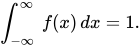
In order to qualify, such a function must meet the following criteria:
(1) i.e., finitely convergent (to unity by convention).
(2) for a<b, i.e., is non-decreasing

Such a function leads to the definition of an associated cumulative distribution function.