Integration using polar coordinates
Integration using polar coordinates is a technique for solving integrals using polar coordinates. Sometimes an integral that is complicated in one set or coordinates, such as Cartesian coordinates become very easy or even trivial in polar coordinates.
Example
Consider the integral
Failed to parse (MathML with SVG or PNG fallback (recommended for modern browsers and accessibility tools): Invalid response ("Math extension cannot connect to Restbase.") from server "https://wikimedia.org/api/rest_v1/":): {\displaystyle I = \int^{\infty}_{-\infty} e^{-x^2} \, \text{d}x}
This can be converted into polar coordinated by multiplying by itself, so that


This can be expressed as the double integral,

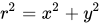
Now the usefulness of polar coordinates becomes apparent as in polar coordinates, . The bounds mean the integral is over the entire x-y plane, so varies from to and from to . To convert the differentials, we must multiply by the Jacobian, to get


This can be integrated by separating the integral. The integral gives and the integral gives . This means the initial integral, is Failed to parse (MathML with SVG or PNG fallback (recommended for modern browsers and accessibility tools): Invalid response ("Math extension cannot connect to Restbase.") from server "https://wikimedia.org/api/rest_v1/":): {\displaystyle \sqrt{2 \pi}} .

Other methods of integration
The primary methods of integration include:
- Integration by parts
- Integration using polar coordinates
- Multiple integration
- Residue calculus (for definite integrals)
- Method of simultaneous convolutions
- Mellin transforms
- Inflation-restriction sequences