Difference between revisions of "Sergei Prokofiev"
Jump to navigation
Jump to search
m (bypass disambiguation) |
|||
| Line 3: | Line 3: | ||
{{Clear}} | {{Clear}} | ||
| − | + | okofiev.org/biography/index.html] | |
| − | |||
| − | |||
| − | |||
| − | |||
| − | |||
| − | |||
| − | |||
| − | |||
| − | |||
| − | |||
| − | |||
| − | |||
| − | |||
Outstanding works: | Outstanding works: | ||
Revision as of 04:48, March 23, 2013

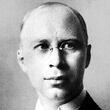
Sergei Prokofiev (Sontsovka, 1891 - Moscow, 1953) was a Russian composer, one of the greatest of the 20th century. He was also a pianist and conductor. Prokofiev was posthumously awarded the Lenin Prize in 1957 for his Seventh Symphony. [1]
okofiev.org/biography/index.html]
Outstanding works:
- Piano Concerto No. 2 in G minor, Op. 16
- Romeo and Juliet (ballet)
- The Second Violin Concerto
- Symphony No. 1 in D, Op. 25, "Classical" [3]
- Symphonic Suite, Op. 60, (includes the famous Troika).
- The three War Sonatas
- Peter and the Wolf
- Sonata for Violin and Piano in F minor
- The Tale of the Stone Flower, Op. 118, (ballet)
- Symphony No. 7 in C-sharp minor, Op. 131
Prokofiev also applied his superb scoring skills to the theatrical stage as well. He wrote music for several plays including Egyptian Nights (1934), Boris Godunov (1936), Eugene Onegin (1936), and Hamlet (1937). Ibidem
Prokofiev died March 5, 1953, the same day as Josef Stalin.
See also
External links
- Sergei Prokofiev
- Sergei Prokofiev Ballet Notes.