Difference between revisions of "Miguel Cabrera"
Jump to navigation
Jump to search
| Line 32: | Line 32: | ||
*[http://www.franzmayer.org.mx/ingles/pintura.html Painting and drawing] The Franz Mayer Museum. | *[http://www.franzmayer.org.mx/ingles/pintura.html Painting and drawing] The Franz Mayer Museum. | ||
| + | [[File:Cabrera, Castas, from Spaniard and Mulatta, Morisca, ca. 1763.jpg|thumb|left|Castas, "from Spaniard and Mulatta, Morisca", ca. 1763.]] | ||
{{Clear}} | {{Clear}} | ||
Latest revision as of 11:07, April 19, 2015


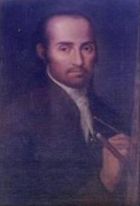
Miguel Cabrera (Oaxaca 1695 - 1768) Mexican painter, s. XVIII. He is considered one of the most important painters of his time in New Spain.
Cabrera's works include religious paintings like: grand wall paintings, retablo designs (like Santa Prisca de Taxco), portraits (like Juan de Palafox y Mendoza and Sor Juana Inés de la Cruz) and a series of castas ("breed" or "race") paintings. He painted for the Archbishop and for the Jesuit order. Cabrera's painting was influenced by Bartolomé Esteban Murillo.
In 1753, Miguel Cabrera founded Mexico's first "Academy of Painting".
The portrait of Sor Juana Inés de la Cruz shows her in her famous library.
- "...and clearly delighted in showing how well he could render costume and class within the tight formula of two parents and one child. These paintings may be of greater sociological than aesthetic interest, but they are invaluable and often endearing documents of daily life. In a casta by another artist, for example, set in a family kitchen, we are quietly reminded that the chocolate and tobacco Europeans had come to favor were American products." [1]
See also


External links

- Andrés Blaisten Museum
- Miguel Cabrera
- Miguel Cabrera In Spanish.
- Zinacantépec, a colonial convento near Toluca, Mexico
- Painting and drawing The Franz Mayer Museum.

Bibliography
- Painting/Drawing Leibsohn, Dana, and Barbara Mundy, Vistas: Spanish American Visual Culture, 1520-1820.