Difference between revisions of "Diagoras of Melos"
Jump to navigation
Jump to search
Conservative (talk | contribs) |
Conservative (talk | contribs) |
||
| Line 3: | Line 3: | ||
The Athenians accused him of impiety, and he fled the city. He died in Corinth.<ref>[http://www.definitions.net/definition/DIAGORAS%20OF%20MELOS Diagoras of Melos]</ref> | The Athenians accused him of impiety, and he fled the city. He died in Corinth.<ref>[http://www.definitions.net/definition/DIAGORAS%20OF%20MELOS Diagoras of Melos]</ref> | ||
| + | |||
| + | According to the book ''Greek Lyric Poetry: A Complete Collection of the Surviving Passages from the Greek Song-writers'' by George Stanley Farnell, "His position as a poet seems to be one of little prominence, and he probably abandoned his art for philosophical speculation."<ref>''Greek Lyric Poetry: A Complete Collection of the Surviving Passages from the Greek Song-writers'' by George Stanley Farnell, page 269</ref> There is little information about Diagoras of Melos' life and his beliefs. And no atheist poems have been found written by him as far as the historical record. See also: [[Atheism and poetry]] | ||
== See also == | == See also == | ||
Revision as of 21:28, November 29, 2015

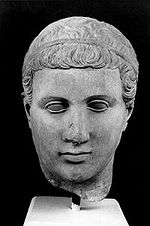
Diagoras of Melos was a 5th century B.C. Greek philosopher, poet, sophist and atheist.
The Athenians accused him of impiety, and he fled the city. He died in Corinth.[1]
According to the book Greek Lyric Poetry: A Complete Collection of the Surviving Passages from the Greek Song-writers by George Stanley Farnell, "His position as a poet seems to be one of little prominence, and he probably abandoned his art for philosophical speculation."[2] There is little information about Diagoras of Melos' life and his beliefs. And no atheist poems have been found written by him as far as the historical record. See also: Atheism and poetry
See also
External links
Notes
- ↑ Diagoras of Melos
- ↑ Greek Lyric Poetry: A Complete Collection of the Surviving Passages from the Greek Song-writers by George Stanley Farnell, page 269