Difference between revisions of "Paul Klee"
(Changed category) |
|||
| (14 intermediate revisions by 4 users not shown) | |||
| Line 1: | Line 1: | ||
| + | [[Image:Klee.JPG|thumb|Paul Klee, 1939.]] | ||
'''Paul Klee''' (Münchenbuchsee, Switzerland, 1879 - Berne, 1940) was a [[Swiss]] [[Expressionist]] [[painter]], graphic artist, and [[art]] theorist of [[Jewish]] ancestry. He studied at the Academy of Fine Arts in [[Munich]]. Klee was friend of the Russian painter [[Wassily Kandinsky]]. He wrote ''Pedagogical Sketchbook''. | '''Paul Klee''' (Münchenbuchsee, Switzerland, 1879 - Berne, 1940) was a [[Swiss]] [[Expressionist]] [[painter]], graphic artist, and [[art]] theorist of [[Jewish]] ancestry. He studied at the Academy of Fine Arts in [[Munich]]. Klee was friend of the Russian painter [[Wassily Kandinsky]]. He wrote ''Pedagogical Sketchbook''. | ||
| Line 7: | Line 8: | ||
</blockquote> | </blockquote> | ||
| − | Klee was also a violinist; at age seven, he started playing music. ''Klee died, painfully, at age 61 of the rare skin hardening disease, Scleroderma.'' [[Ibidem]] | + | Klee was also a violinist; at age seven, he started playing music. In 1906, he married the pianist Lily Stumpf. ''Klee died, painfully, at age 61 of the rare skin hardening disease, Scleroderma.'' [[Ibidem]] |
<center> | <center> | ||
| + | |||
| + | Art does not reproduce what is visible; it makes things visible. - Paul Klee | ||
| + | |||
<gallery> | <gallery> | ||
| + | Image:Klee il giardino del tempio.jpg|Il giardino del tempio. | ||
Image:Paul Klee paint.jpg | Image:Paul Klee paint.jpg | ||
Image:Paul Klee ad parnassum.jpg|Ad Parnassum | Image:Paul Klee ad parnassum.jpg|Ad Parnassum | ||
| − | |||
Image:Klee The One Who Understands 1934.jpg|The One Who Understands | Image:Klee The One Who Understands 1934.jpg|The One Who Understands | ||
</gallery> | </gallery> | ||
</center> | </center> | ||
| + | |||
<blockquote> | <blockquote> | ||
Klee's studies in the related fields of natural history, comparative anatomy and anthropology had brought Klee to the belief that nature was characterized by the permutation and movement of fundamental units of construction. He wanted to achieve an equivalent way of working in painting. In addition to his interest in the natural world. Klee also turned to theories of both color and music. As he worked on the basis of units of construction taken from nature, Klee tried to create linear improvisations which he likened to the melody of the work. Klee evolved a system of color organization in which all the colors of the spectrum were conceived of as moving around a central axis dominated by the three pigmentary colors - red, yellow and blue. [http://www.artchive.com/artchive/K/klee/parnassu.jpg.html] | Klee's studies in the related fields of natural history, comparative anatomy and anthropology had brought Klee to the belief that nature was characterized by the permutation and movement of fundamental units of construction. He wanted to achieve an equivalent way of working in painting. In addition to his interest in the natural world. Klee also turned to theories of both color and music. As he worked on the basis of units of construction taken from nature, Klee tried to create linear improvisations which he likened to the melody of the work. Klee evolved a system of color organization in which all the colors of the spectrum were conceived of as moving around a central axis dominated by the three pigmentary colors - red, yellow and blue. [http://www.artchive.com/artchive/K/klee/parnassu.jpg.html] | ||
</blockquote> | </blockquote> | ||
| + | |||
| + | [[File:Paul Klee, The Chair-Animal, 1922.jpg|thumb|center|300px|The Chair-Animal, 1922.]] | ||
== See also == | == See also == | ||
| − | + | [[File:Fire Evening by Paul Klee, 1929.JPG|thumb|Fire Evening, 1929.]] | |
*[[Painting Galleries]] | *[[Painting Galleries]] | ||
| + | *[[Gallery of Jewish Painting]] | ||
| + | *[[Mordecai Ardon]] | ||
| − | + | <br> | |
== External links == | == External links == | ||
| + | *[http://www.artcyclopedia.com/artists/klee_paul.html Paul Klee] | ||
| + | *[http://www.abcgallery.com/K/klee/kleebio.html Biography] Olga's Gallery. | ||
| − | + | ||
| + | {{DEFAULTSORT:Klee, Paul}} | ||
| + | |||
| + | [[Category:European Jews]] | ||
| + | [[Category:Jewish People]] | ||
| + | [[Category:Swiss Painters]] | ||
Latest revision as of 22:39, May 12, 2017

Paul Klee (Münchenbuchsee, Switzerland, 1879 - Berne, 1940) was a Swiss Expressionist painter, graphic artist, and art theorist of Jewish ancestry. He studied at the Academy of Fine Arts in Munich. Klee was friend of the Russian painter Wassily Kandinsky. He wrote Pedagogical Sketchbook.
Klee was a prolific artist with more than 10,000 paintings, drawings, and etchings. His style went from expressionism to cubism, to surrealism. He was an orientalist; his first pure abstract was In the Style of Kairouan, (1914). Other works included Southern (Tunisian) Gardens, (1919), The Twittering Machine, (1922) and Fish Magic, (1925).
True Orientalist from the earliest years of his artistic life, Paul Klee profoundly altered his color palette, compositional approach to space, graphic symbolism, and dexterous architectural translation of three dimensions into two; a fundamental visual iconography that would persist and metamorphose, perpetually reinventing itself throughout his prolific, but tragically abbreviated career. [1]
Klee was also a violinist; at age seven, he started playing music. In 1906, he married the pianist Lily Stumpf. Klee died, painfully, at age 61 of the rare skin hardening disease, Scleroderma. Ibidem
Art does not reproduce what is visible; it makes things visible. - Paul Klee
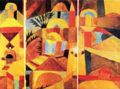
Il giardino del tempio.


Ad Parnassum

The One Who Understands


Klee's studies in the related fields of natural history, comparative anatomy and anthropology had brought Klee to the belief that nature was characterized by the permutation and movement of fundamental units of construction. He wanted to achieve an equivalent way of working in painting. In addition to his interest in the natural world. Klee also turned to theories of both color and music. As he worked on the basis of units of construction taken from nature, Klee tried to create linear improvisations which he likened to the melody of the work. Klee evolved a system of color organization in which all the colors of the spectrum were conceived of as moving around a central axis dominated by the three pigmentary colors - red, yellow and blue. [2]

See also

![[2]](http://www.artchive.com/artchive/K/klee/parnassu.jpg.html)