Difference between revisions of "Arthur Schopenhauer"
Jump to navigation
Jump to search
| Line 1: | Line 1: | ||
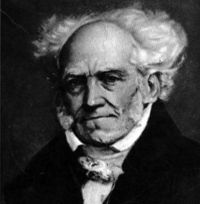
| + | [[Image:Schopenhauer.jpg|right|200px]] | ||
'''Arthur Schopenhauer''' (1788 - 1860), was an important [[Germany|German]] [[philosopher]] of the 19th Century. He profoundly affected [[Friedrich Nietzsche]], and was among the first to contend that at its center, the [[universe]] is not a rational place. He was inspired by [[Plato]] and [[Kant]]. | '''Arthur Schopenhauer''' (1788 - 1860), was an important [[Germany|German]] [[philosopher]] of the 19th Century. He profoundly affected [[Friedrich Nietzsche]], and was among the first to contend that at its center, the [[universe]] is not a rational place. He was inspired by [[Plato]] and [[Kant]]. | ||
| Line 4: | Line 5: | ||
Schopenhauer wrote "The World as Will and Idea" and "On the Will to Nature" in 1836. | Schopenhauer wrote "The World as Will and Idea" and "On the Will to Nature" in 1836. | ||
| − | + | {{Clear}} | |
== See also == | == See also == | ||
Revision as of 04:12, May 27, 2008

Arthur Schopenhauer (1788 - 1860), was an important German philosopher of the 19th Century. He profoundly affected Friedrich Nietzsche, and was among the first to contend that at its center, the universe is not a rational place. He was inspired by Plato and Kant.
Schopenhauer's father chose his son's first name because of its identical spelling in German, French and English.
Schopenhauer wrote "The World as Will and Idea" and "On the Will to Nature" in 1836.