Difference between revisions of "Greeks"
Jump to navigation
Jump to search
| Line 2: | Line 2: | ||
'''Greeks''', people from [[Greece]]; in [[Literature]] and [[History ]] often people from the ancient Greece. Greek culture has evolved over thousands of years, since the Mycenaean civilization (1600 - 1100 BC). | '''Greeks''', people from [[Greece]]; in [[Literature]] and [[History ]] often people from the ancient Greece. Greek culture has evolved over thousands of years, since the Mycenaean civilization (1600 - 1100 BC). | ||
| − | Classical Greek or Ancient Greek refers to the period from 5th to 4th centuries BC; The Hellenistic period, that was the zenith of Greek influence goes from the death of [[Alexander the Great]] in 323 BC until the rise of [[Rome]] in 146 BC, and its culture until the advent of [[Christianity]]. | + | Classical Greek or Ancient Greek refers to the period from 5th to 4th centuries BC; The [[Hellenistic culture|Hellenistic]] period, that was the zenith of Greek influence goes from the death of [[Alexander the Great]] in 323 BC until the rise of [[Rome]] in 146 BC, and its culture until the advent of [[Christianity]]. |
<br> | <br> | ||
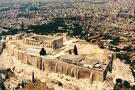
[[Image:Greek empire.jpg|left|Acropolis, Athens, Greece.]] | [[Image:Greek empire.jpg|left|Acropolis, Athens, Greece.]] | ||
Revision as of 02:12, June 4, 2008

Greeks, people from Greece; in Literature and History often people from the ancient Greece. Greek culture has evolved over thousands of years, since the Mycenaean civilization (1600 - 1100 BC).
Classical Greek or Ancient Greek refers to the period from 5th to 4th centuries BC; The Hellenistic period, that was the zenith of Greek influence goes from the death of Alexander the Great in 323 BC until the rise of Rome in 146 BC, and its culture until the advent of Christianity.

See also
External links
- Ancient Greek People For kids.