Difference between revisions of "Algebraic topology"
m (links) |
(It makes more sense to say the fundamental group is isomorphic to Z as a group. It's awkward to say a group is isomorphic to a ring; really, it's isomorphic to the additive group of that ring.) |
||
| Line 4: | Line 4: | ||
if there exists a [[mapping]] <math>H:[0,1]\times[0,1]\rightarrow X</math> with <math>H(t,0) = \gamma_1(t)</math> and <math>H(t,1) = \gamma_2(t)</math>. We can define an group structure on the resulting [[equivalence class]] of curves by declaring <math>\gamma_1\cdot\gamma_2</math> to be the curve <math>\gamma_2</math> followed by <math>\gamma_1</math>, and rescaled so that the resulting curve still has domain <math>[0,1]</math>. This group is called the fundamental group of <math>X</math> | if there exists a [[mapping]] <math>H:[0,1]\times[0,1]\rightarrow X</math> with <math>H(t,0) = \gamma_1(t)</math> and <math>H(t,1) = \gamma_2(t)</math>. We can define an group structure on the resulting [[equivalence class]] of curves by declaring <math>\gamma_1\cdot\gamma_2</math> to be the curve <math>\gamma_2</math> followed by <math>\gamma_1</math>, and rescaled so that the resulting curve still has domain <math>[0,1]</math>. This group is called the fundamental group of <math>X</math> | ||
<br /><br /> | <br /><br /> | ||
| − | Example: The most important example is the topological space <math>S^1</math>. It can be shown that the fundamental group of <math>S^1</math> is the | + | Example: The most important example is the topological space <math>S^1</math>. It can be shown that the fundamental group of <math>S^1</math> is isomorphic to the additive group of [[integer]]s <math>\mathbf{Z}</math>. |
[[Category:Topology]] | [[Category:Topology]] | ||
[[Category:Algebra]] | [[Category:Algebra]] | ||
Revision as of 03:26, January 18, 2009
Algebraic topology is a branch of mathematics that uses abstract algebra to understand topological spaces.
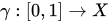
One of the most useful tools in algebraic topology is the fundamental group, of a topological space . The definition is as follows: Let be a fixed point in . Consider the space of all curves which begin and end at . We consider two such curves to be (homotopically) equivalent if we can continuously deform the first curve into the second. More precisely, we consider to be equivalent to
if there exists a mapping with and . We can define an group structure on the resulting equivalence class of curves by declaring to be the curve followed by , and rescaled so that the resulting curve still has domain . This group is called the fundamental group of
Example: The most important example is the topological space . It can be shown that the fundamental group of is isomorphic to the additive group of integers .