Difference between revisions of "Antonio Canova"
| Line 26: | Line 26: | ||
File:Canova Apollo Crowning Himself.jpg|Apollo Crowning Himself. | File:Canova Apollo Crowning Himself.jpg|Apollo Crowning Himself. | ||
</gallery> | </gallery> | ||
| + | </center> | ||
| − | |||
<blockquote> | <blockquote> | ||
Revision as of 15:09, September 18, 2009

Antonio Canova (Venice, 1757 - Venice, 1822) was an Italian sculptor and painter. He is best known for his sculpture of "Pauline Bonaparte", 1805 to 1808. Other works included the tombs of popes Clement XIV (1783 – 87) and Clement XIII (1787 – 92). Called "the supreme minister of beauty" and "a unique and truly divine man" by contemporaries, Antonio Canova was considered the greatest sculptor of his time. [1]


Pauline Bonaparte (1805-1808) at Borghese Gallery.
In 1802, by special request of Napoleon I, he went to Paris and modelled a colossal figure of the emperor, holding a Victory in his hand (Apsley House, London). His "Bust of Napoleon" is in the Corcoran Gallery, Washington. [2]
Canova sculpted also, among many others, his well-known Three Graces from 1812 to 1816.

Three Graces.
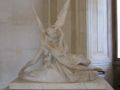
Psyche and Cupid.

Dancer.

Cupid and Psyche.

Apollo Crowning Himself.


In 1815 Canova went to Paris, as the pope's envoy, to negotiate for the return of the art treasures carried away from Italy by Napoleon in his campaign, and conducted his mission so successfully that a large part of the spoils was recovered. In acknowledgment of his services he was created Marquis of Ischia... In 1818 Canova was commissioned to make a heroic statue of Washington for the State House, Raleigh, N.C. He clothed him as a Roman warrior but the head was mild and full of dignity. [3]

Cupid's Kiss at Hermitage.
See also
External links
- Antonio Canova
- Antonio Canova
- Antonio Canova State Hermitage Museum.