Difference between revisions of "Hallelujah"
Jump to navigation
Jump to search
m |
m |
||
| Line 6: | Line 6: | ||
Subhan'Allah (Arabic: '''سبحان الله''') is an [[Arabic]] expression translated as "Glorious is God." | Subhan'Allah (Arabic: '''سبحان الله''') is an [[Arabic]] expression translated as "Glorious is God." | ||
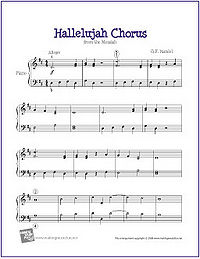
| − | ''The Hallelujah'' is a Handel's chorus; it occurs at the end of the second part of Handel's ''Messiah'' famous oratorio. | + | ''The Hallelujah'' is a [[George Frideric Handel]]'s chorus; it occurs at the end of the second part of Handel's ''Messiah'' famous oratorio. |
== See also == | == See also == | ||
Revision as of 18:44, January 24, 2010

Hallelujah or "Praise the Lord" is an expression that comes from the Hebrew words (הַלְּלוּיָהּ) Halellu yah and means "praise Yah" (a joyous praise to God). This term is used 24 times in the Bible; occurring mainly in Psalms. It is considered a joyful word of praise to God.
In the past Hallelujah was chanted mainly at the Easter service.
Subhan'Allah (Arabic: سبحان الله) is an Arabic expression translated as "Glorious is God."
The Hallelujah is a George Frideric Handel's chorus; it occurs at the end of the second part of Handel's Messiah famous oratorio.