Difference between revisions of "National Gallery"
(→Petite gallery) |
|||
| Line 2: | Line 2: | ||
<blockquote> | <blockquote> | ||
| − | The first paintings in the National Gallery collection came from the banker and collector John Julius Angerstein. In 1856, [[William Turner|Joseph Mallord William Turner]] bequeathed over 1,000 paintings, drawings and watercolors. From 1855 to 1865, the Gallery's collection of Italian painting expanded and widened in scope to become one of the best in the world. In 1871 the Gallery's collection was broadened yet further, when 77 paintings were bought from the collection of the late Prime Minister, Sir Robert Peel. | + | The first paintings in the National Gallery collection came from the banker and collector John Julius Angerstein. In 1856, [[William Turner|Joseph Mallord William Turner]] bequeathed over 1,000 paintings, drawings and watercolors. From 1855 to 1865, the Gallery's collection of Italian painting expanded and widened in scope to become one of the best in the world. In 1871 the Gallery's collection was broadened yet further, when 77 paintings were bought from the collection of the late Prime Minister, Sir Robert Peel. Later bequests of note were those of Dr. Ludwig Mond who in 1909 gave 42 Italian renaissance paintings, including the ''Mond Crucifixion'' by [[Raphael]]; bequests of George Salting in 1910, Austen Henry Layard in 1916 and Sir Hugh Lane in 1917. |
</blockquote> | </blockquote> | ||
Revision as of 19:06, June 21, 2011
The National Gallery is an art gallery in London, United Kingdom. Located on Trafalgar Square, it was founded in 1824. The National Gallery houses the British collection of Western European painting from the 13th to the 19th centuries.
The first paintings in the National Gallery collection came from the banker and collector John Julius Angerstein. In 1856, Joseph Mallord William Turner bequeathed over 1,000 paintings, drawings and watercolors. From 1855 to 1865, the Gallery's collection of Italian painting expanded and widened in scope to become one of the best in the world. In 1871 the Gallery's collection was broadened yet further, when 77 paintings were bought from the collection of the late Prime Minister, Sir Robert Peel. Later bequests of note were those of Dr. Ludwig Mond who in 1909 gave 42 Italian renaissance paintings, including the Mond Crucifixion by Raphael; bequests of George Salting in 1910, Austen Henry Layard in 1916 and Sir Hugh Lane in 1917.
Petite gallery

The Arnolfini Marriage by Jan van Eyck.

Caravaggio, Supper at Emmaus.

Seaport with the Embarkation of Saint Ursula by Claude Lorrain.

Rembrandt, Self Portrait at the Age of 34 (detail).

Thomas Gainsborough, Mr. and Mrs. Andrews.
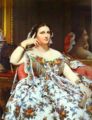
Madame Moitessier by Jean-Auguste-Dominique Ingres


