Difference between revisions of "Absolute value"
m (real number, unsigned portion) |
|||
| Line 1: | Line 1: | ||
| − | The absolute value of a | + | The absolute value of a number is a measure of the size of that number. The absolute value of <math>x</math> is written <math>|x|</math>. If <math>x</math> is a positive number, then <math>|x| = x</math>. If <math>x</math> is a negative number, then <math>|x| = -x</math>. If <math>x=0</math> then <math>|x| = 0</math>. |
| + | |||
| + | Absolute value has several useful properties. One is the ''multiplicative'' property. If <math>x</math> and <math>y</math> are two numbers, then <math>|xy| = |x| \times |y|</math>. Another is the ''triangle inequality'', which is the fact that <math>|x+y| \leq |x| + |y|</math>. For example, if <math>x = 3</math> and <math>y = -5</math>, then <math>|x+y| = |3 + (-5)| = |3 - 5| = |-2| = 2</math>, while <math>|x| + |y| = |-5| + |3| = 5 + 3 = 8</math>. In this case, the triangle inequality is the fact that 2 is not more than 8. | ||
| + | |||
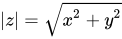
| + | Complex numbers also have an absolute value. If <math>z = x+iy</math> is a complex number with real part <math>x</math> and imaginary part <math>y</math>, then <math>|z| = \sqrt{x^2 + y^2}</math>. If we represent <math>z</math> as a point in the complex plane with coordinates <math>(x,y)</math>, then <math>|z|</math> is the distance from this point to the origin. The absolute value of complex numbers also has the multiplicative property and satisfies the triangle inequality. | ||
Revision as of 13:46, April 9, 2007
The absolute value of a number is a measure of the size of that number. The absolute value of is written . If is a positive number, then . If is a negative number, then . If then .


Absolute value has several useful properties. One is the multiplicative property. If and are two numbers, then . Another is the triangle inequality, which is the fact that . For example, if and , then , while . In this case, the triangle inequality is the fact that 2 is not more than 8.





Complex numbers also have an absolute value. If is a complex number with real part and imaginary part , then . If we represent as a point in the complex plane with coordinates , then is the distance from this point to the origin. The absolute value of complex numbers also has the multiplicative property and satisfies the triangle inequality.