Difference between revisions of "Discretionary spending"
Jump to navigation
Jump to search
| Line 1: | Line 1: | ||
Spending ([[budget authority]] and [[outlays]]) controlled in annual [[appropriation|appropriations]] [[act|acts]].<ref>[http://www.senate.gov/reference/glossary_term/discretionary_spending.htm] US Senate Reference</ref> The political philosopher and journalist [[George Will]] contends that all government spending is discretionary spending with the exception of debt service.<ref>[http://www.econtalk.org/archives/2011/02/george_will_on.html Econtalk], George will, Feb-28-2011</ref> | Spending ([[budget authority]] and [[outlays]]) controlled in annual [[appropriation|appropriations]] [[act|acts]].<ref>[http://www.senate.gov/reference/glossary_term/discretionary_spending.htm] US Senate Reference</ref> The political philosopher and journalist [[George Will]] contends that all government spending is discretionary spending with the exception of debt service.<ref>[http://www.econtalk.org/archives/2011/02/george_will_on.html Econtalk], George will, Feb-28-2011</ref> | ||
| + | |||
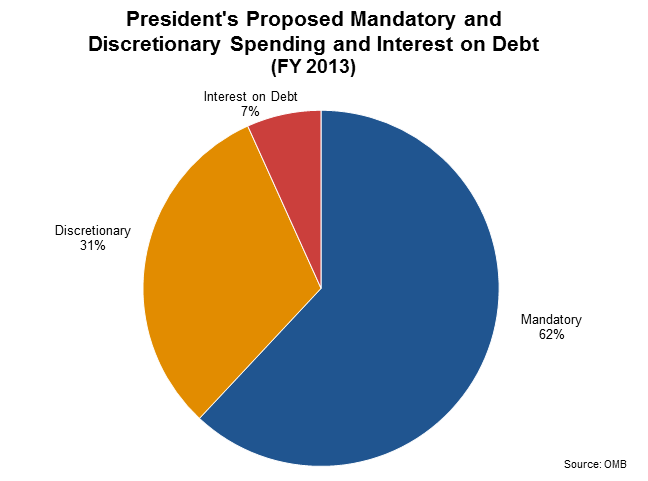
| + | In 2013, only 31% of the United States federal budget was discretionary spending, the balance being [[mandatory spending]] and interest on the [[national debt]].<ref>http://nationalpriorities.org/media/uploads/federal_budget_101/Figure8.3.png</ref> | ||
==See also== | ==See also== | ||
Revision as of 03:05, January 6, 2013
Spending (budget authority and outlays) controlled in annual appropriations acts.[1] The political philosopher and journalist George Will contends that all government spending is discretionary spending with the exception of debt service.[2]
In 2013, only 31% of the United States federal budget was discretionary spending, the balance being mandatory spending and interest on the national debt.[3]