Pangaea
Introduction
Pangaea (Greek Spelling) or "Pangea" is the name given to the supercontinent believed to have broken up into the existing continents.
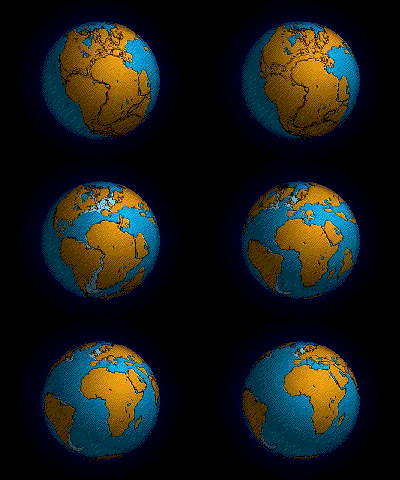
According to the uniformitarian time-scale, Pangea existed during the Paleozoic and Mesozoic eras about 250 million years ago, before the process of plate tectonics separated Pangaea into the continents we have today. The Supercontinent Theory explain the apparent "puzzle piece fittings" of the major continents today. The name Pangea came from German Alfred Wegener, a chief proponent of the continental drift theory, in 1920.
The Break Up
Some scientists theorize that Pangaea first began to break up in the Early-Middle Jurassic, when Pangaea created a rift from the Tethys Ocean from the east and the Pacific from the west. The rifting took place between North America and Africa, and produced multiple failed rifts, the Mississippi River being the largest. The rift resulted in a new ocean, which today we call the Atlantic.
According to the uniformitarian model, the second major division of the Pangea continent occurred 150 million years ago, when the minor supercontinent of Gondwana divided up into its respective modern continents: South America, Africa and India. Also, the continent of Cimmeria collided with Eurasia, causing a subduction zone called the Tethyan Trench.
At the same time, Madagascar, Australia and India are thought to have separated from Antarctica and moved North. While Madagascar has since locked on the African Plate, India and Australia continue to move at about 5-6 cm a year.
To see an animation of the Pangea Break Up, click here: [1]