Indefinite integral
An indefinite integral, or antiderivative, is an integral without upper and lower limits.
Indefinite Integrals
There are an infinite number of antiderivatives for a given function, because each indefinite integral can have an arbitrary constant added to it which disappears upon differentiation. However, the fundamental theorem of calculus relates a definite integral to an indefinite integral by taking its value at the boundary points.
Whenever any expression is integrated the constant of integration, , is always added.

A list of simple antiderivatives
The identity antiderivative:

Polynomial and simple rational


The general rule for polynomial expressions is:

Note: . See below for when


Rational
For a more detailed treatment, see Partial fractions in integration.
Rational antiderivatives are much more difficult and follow different rules.


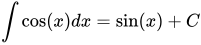
Trigonometric


Exponential
- Failed to parse (MathML with SVG or PNG fallback (recommended for modern browsers and accessibility tools): Invalid response ("Math extension cannot connect to Restbase.") from server "https://wikimedia.org/api/rest_v1/":): {\displaystyle \int e^x = e^x + C}
- Failed to parse (MathML with SVG or PNG fallback (recommended for modern browsers and accessibility tools): Invalid response ("Math extension cannot connect to Restbase.") from server "https://wikimedia.org/api/rest_v1/":): {\displaystyle \int a^x = \ln(a)a^x + C}