Difference between revisions of "NATO enlargement"
| Line 2: | Line 2: | ||
'''NATO expansion''' since the [[Clinton administration|Clinton era]] represents a betrayal of the international agreements that ended the [[Cold War]], caused the [[Fall of the Wall]], and collapse of [[Soviet]] [[communism]]. Western [[oligarch]]s and [[neo-fascist]] [[globalism|global]] interests have profited immeasurably from ending the Cold War and betraying security agreements made with the Russian Federation in the late 1980s and early 1990s. | '''NATO expansion''' since the [[Clinton administration|Clinton era]] represents a betrayal of the international agreements that ended the [[Cold War]], caused the [[Fall of the Wall]], and collapse of [[Soviet]] [[communism]]. Western [[oligarch]]s and [[neo-fascist]] [[globalism|global]] interests have profited immeasurably from ending the Cold War and betraying security agreements made with the Russian Federation in the late 1980s and early 1990s. | ||
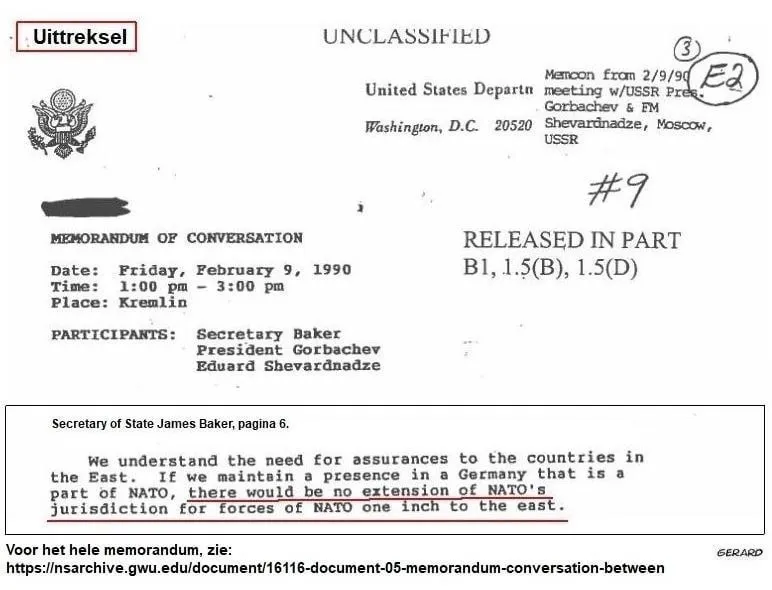
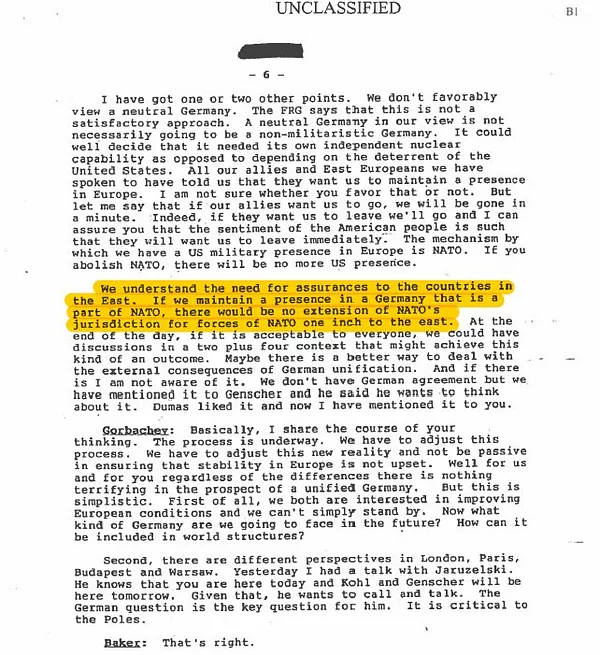
| − | To assent to the reunification of Germany, Soviet leader [[Mikhail Gorbachev]] ultimately agreed to a proposal from then U.S. Secretary of State [[James Baker (DOS)]] that a reunited Germany would be part of NATO but the military alliance would not move “one inch” to the east, that is, absorb any of the former [[Warsaw Pact]] nations into NATO.<ref>https://substackcdn.com/image/fetch/w_1456,c_limit,f_webp,q_auto:good,fl_progressive:steep/https%3A%2F%2Fsubstack-post-media.s3.amazonaws.com%2Fpublic%2Fimages%2F03c2978a-e903-461c-943e-8124481200b2_772x590.jpeg</ref><ref>https://substackcdn.com/image/fetch/w_600,c_limit,f_webp,q_auto:good,fl_progressive:steep/https%3A%2F%2Fpbs.substack.com%2Fmedia%2FFs9pHl7XoAUzGW5.jpg</ref> | + | To assent to the reunification of Germany, Soviet leader [[Mikhail Gorbachev]] ultimately agreed to a proposal from then U.S. Secretary of State [[James Baker (DOS)]] that a reunited Germany would be part of NATO but the military alliance would not move “one inch” to the east, that is, absorb any of the former [[Warsaw Pact]] nations into [[NATO]].<ref>https://substackcdn.com/image/fetch/w_1456,c_limit,f_webp,q_auto:good,fl_progressive:steep/https%3A%2F%2Fsubstack-post-media.s3.amazonaws.com%2Fpublic%2Fimages%2F03c2978a-e903-461c-943e-8124481200b2_772x590.jpeg</ref><ref>https://substackcdn.com/image/fetch/w_600,c_limit,f_webp,q_auto:good,fl_progressive:steep/https%3A%2F%2Fpbs.substack.com%2Fmedia%2FFs9pHl7XoAUzGW5.jpg</ref> |
On Feb. 9, 1990, Baker said: “We consider that the consultations and discussions in the framework of the 2+4 mechanism should give a guarantee that the reunification of Germany will not lead to the enlargement of NATO’s military organization to the East.” On the next day, then German Chancellor [[Helmut Kohl]] said: “We consider that NATO should not enlarge its sphere of activity.”<ref>https://consortiumnews.com/2022/01/28/the-tangled-tale-of-nato-expansion-at-the-heart-of-ukraine-crisis/</ref> Gorbachev's mistake was not to get it in writing as a legally-binding agreement.<ref>For years it was believed there was no written record of the Baker-Gorbachev exchange at all, until the National Security Archive at George Washington University in December 2017 published a series of memos and cables about these assurances against NATO expansion eastward.</ref> | On Feb. 9, 1990, Baker said: “We consider that the consultations and discussions in the framework of the 2+4 mechanism should give a guarantee that the reunification of Germany will not lead to the enlargement of NATO’s military organization to the East.” On the next day, then German Chancellor [[Helmut Kohl]] said: “We consider that NATO should not enlarge its sphere of activity.”<ref>https://consortiumnews.com/2022/01/28/the-tangled-tale-of-nato-expansion-at-the-heart-of-ukraine-crisis/</ref> Gorbachev's mistake was not to get it in writing as a legally-binding agreement.<ref>For years it was believed there was no written record of the Baker-Gorbachev exchange at all, until the National Security Archive at George Washington University in December 2017 published a series of memos and cables about these assurances against NATO expansion eastward.</ref> | ||
Revision as of 03:39, October 27, 2023

NATO expansion since the Clinton era represents a betrayal of the international agreements that ended the Cold War, caused the Fall of the Wall, and collapse of Soviet communism. Western oligarchs and neo-fascist global interests have profited immeasurably from ending the Cold War and betraying security agreements made with the Russian Federation in the late 1980s and early 1990s.
To assent to the reunification of Germany, Soviet leader Mikhail Gorbachev ultimately agreed to a proposal from then U.S. Secretary of State James Baker (DOS) that a reunited Germany would be part of NATO but the military alliance would not move “one inch” to the east, that is, absorb any of the former Warsaw Pact nations into NATO.[2][3]
On Feb. 9, 1990, Baker said: “We consider that the consultations and discussions in the framework of the 2+4 mechanism should give a guarantee that the reunification of Germany will not lead to the enlargement of NATO’s military organization to the East.” On the next day, then German Chancellor Helmut Kohl said: “We consider that NATO should not enlarge its sphere of activity.”[4] Gorbachev's mistake was not to get it in writing as a legally-binding agreement.[5]
| “U.S. Secretary of State James Baker’s famous ‘not one inch eastward’ assurance about NATO expansion in his meeting with Soviet leader Mikhail Gorbachev on February 9, 1990, was part of a cascade of assurances about Soviet security given by Western leaders to Gorbachev and other Soviet officials throughout the process of German unification in 1990 and on into 1991, according to declassified U.S., Soviet, German, British and French documents …
The documents show that multiple national leaders were considering and rejecting Central and Eastern European membership in NATO as of early 1990 and through 1991, that discussions of NATO in the context of German unification negotiations in 1990 were not at all narrowly limited to the status of East German territory, and that subsequent Soviet and Russian complaints about being misled about NATO expansion were founded in written contemporaneous memcons and telcons at the highest levels. … The documents reinforce former CIA Director Robert Gates’s criticism of ‘pressing ahead with expansion of NATO eastward [in the 1990s], when Gorbachev and others were led to believe that wouldn’t happen.’ … President George H.W. Bush had assured Gorbachev during the Malta summit in December 1989 that the U.S. would not take advantage (‘I have not jumped up and down on the Berlin Wall”) of the revolutions in Eastern Europe to harm Soviet interests.’”[6] |
The minutes of a March 6, 1991 meeting in Bonn, West Germany between political directors of the foreign ministries of the US, UK, France, and Germany contain multiple references to “2+4” talks on German unification in which Western officials made it “clear” to the Soviet Union that NATO would not push into territory east of Germany. “We made it clear to the Soviet Union – in the 2+4 talks, as well as in other negotiations – that we do not intend to benefit from the withdrawal of Soviet troops from Eastern Europe,” the document in British foreign ministry archives quotes US Assistant Secretary of State for Europe and Canada Raymond Seitz. “NATO should not expand to the east, either officially or unofficially,” Seitz added. A British representative also mentions the existence of a “general agreement” that membership of NATO for eastern European countries is “unacceptable.”[7]
In May 1995 President Bill Clinton was invited to Moscow for the 50th anniversary Victory Day celebrations of the defeat of Hitler. In Moscow, Russian President Boris Yeltsin berated Clinton about NATO expansion, seeing “nothing but humiliation” for Russia: “For me to agree to the borders of NATO expanding towards those of Russia – that would constitute a betrayal on my part of the Russian people.”[8]
After the Soviet Union collapsed depriving NATO of its original reason for existence, skeptics of the alliance included liberals as much as conservatives. In 1998, 10 Democratic Senators joined nine Republicans in opposing the first, fateful round of NATO enlargement with Hungary, the Czech Republic, and Poland added, extending the alliance to Russia's border. Among the dissenters was Senator Paul Wellstone of Minnesota. In between voting against the first Iraq war in 1991 and the second after Sept. 11, Sen. Wellstone warned that expanding NATO would jeopardize Europe's hard-won gains. “There is peace between states in Europe, between nations in Europe, for the first time in centuries,” he said. “We do not have a divided Europe, and I worry about a NATO expansion which could redivide Europe and again poison relations with Russia.”[9]
Russian reaction
Vladimir Putin assumed office as the president of Russia on the last day of 1999. In an interview with David Frost broadcast on the BBC on March 13, 2000, Putin expressed his desire to see Russia join NATO:[10]
| Frost: Tell me about your views on NATO, if you would. Do you see NATO as a potential partner, or rival, or an enemy?
Putin: Russia is a part of European culture. I simply cannot see my country isolated from Europe, from what we often describe as the civilized world. That is why it is hard for me to regard NATO as an enemy. I think that such a perception has nothing good in store for Russia and the rest of the world. ... We strive for equal cooperation, partnership, we believe that it is possible to speak even about higher levels of integration with NATO. But only, I repeat, if Russia is an equal partner. As you know, we constantly express our negative attitude to NATO's expansion to the East. ... Frost: Is it possible that Russia will ever join NATO? Putin: Why not? I do not rule out such a possibility. I repeat, on condition that Russia's interests are going to be taken into account, if Russia becomes a full-fledged partner. I want to specially emphasize this. ... When we say that we object to NATO's expansion to the East, we are not expressing any special ambitions of our own, ambitions in respect of some regions of the world. ... By the way, we have never declared any part of the world a zone of our national interests. Personally, I prefer to speak about strategic partnership. The zone of strategic interests of any particular region means first of all the interests of the people who live in that region. ... |
Within hours after the September 11, 2001 attacks, Vladimir Putin was the first foreign leader to call President George W. Bush and offer sympathy and support for what became the first invocation of NATO Article V, "an attack against one is an attack against all."[11] Putin announced a five-point plan to support the war on terror, pledging that the Russian government would (1) share intelligence with their American counterparts, (2) open Russian airspace for flights providing humanitarian assistance (3) cooperate with Russia's Central Asian allies in Uzbekistan and Kyrgyzstan to provide similar kinds of airspace access to American flights, (4) participate in international search and rescue efforts, and (5) increase direct assistance -humanitarian as well as military assistance—to the Afghan Northern Alliance. The intelligence Putin shared, including data that helped American forces find their way around Kabul and logistical information about Afghanistan's topography and caves, contributed to the success of operation and rout of the Taliban. Two weeks after the attacks, Putin was invited to make a speech to a Special Session of the Bundestag, the first ever by a Russian head of state to the German parliament.[12] Among the numerous subjects Putin addressed in fluent German was peace and stability in the common European home:
| "But what are we lacking today for cooperation to be efficient?
In spite of all the positive achievements of the past decades, we have not yet developed an efficient mechanism for working together. The coordinating agencies set up so far do not offer Russia real opportunities for taking part in drafting and taking decision. Today decisions are often taken, in principle, without our participation, and we are only urged afterwards to support such decisions. After that they talk again about loyalty to NATO. They even say that such decisions cannot be implemented without Russia. Let us ask ourselves: is this normal? Is this true partnership? Yes, the assertion of democratic principles in international relations, the ability to find a correct decision and readiness for compromise are a difficult thing. But then, it was the Europeans who were the first to understand how important it is to look for consensus over and above national egoism. We agree with that! All these are good ideas. However, the quality of decisions that are taken, their efficiency and, ultimately, European and international security in general depend on the extent to which we succeed today in translating these obvious principles into practical politics. It seemed just recently that a truly common home would shortly rise on the continent, a home in which the Europeans would not be divided into eastern or western, northern or southern. However, these divides will remain, primarily because we have never fully shed many of the Cold War stereotypes and cliches. Today we must say once and for all: the Cold War is done with! We have entered a new stage of development. We understand that without a modern, sound and sustainable security architecture we will never be able to create an atmosphere of trust on the continent, and without that atmosphere of trust there can be no united Greater Europe! Today we must say that we renounce our stereotypes and ambitions and from now on will jointly work for the security of the people of Europe and the world as a whole. |
In 2004 the Baltic states - Latvia, Lithuania, and Estonia joined NATO, setting up another common border between the Russian Federation and a NATO state. Three years later, at the Munich Security Conference, Putin declared, “We have the right to ask: against whom is this [NATO] expansion intended? And what happened to the assurances our western partners made after the dissolution of the Warsaw Pact? Where are those declarations today? No one even remembers them.”[13] In 2008 NATO said Ukraine and Georgia would become members. Four other Eastern European states joined NATO in 2009.
At the February 2007 Munich Security Conference President Putin said.
| "I think it is obvious that NATO expansion does not have any relation with the modernization of the alliance itself or with ensuring security in Europe. On the contrary, it represents a serious provocation that reduces the level of mutual trust. And we have the right to ask: Against whom is this expansion intended? And what happened to the assurances our western partners made after the dissolution of the Warsaw Pact? No one even remembers them."[14] |
References
- ↑ https://www.rt.com/russia/544257-nato-boss-expansion-proposals/
- ↑ https://substackcdn.com/image/fetch/w_1456,c_limit,f_webp,q_auto:good,fl_progressive:steep/https%3A%2F%2Fsubstack-post-media.s3.amazonaws.com%2Fpublic%2Fimages%2F03c2978a-e903-461c-943e-8124481200b2_772x590.jpeg
- ↑ https://substackcdn.com/image/fetch/w_600,c_limit,f_webp,q_auto:good,fl_progressive:steep/https%3A%2F%2Fpbs.substack.com%2Fmedia%2FFs9pHl7XoAUzGW5.jpg
- ↑ https://consortiumnews.com/2022/01/28/the-tangled-tale-of-nato-expansion-at-the-heart-of-ukraine-crisis/
- ↑ For years it was believed there was no written record of the Baker-Gorbachev exchange at all, until the National Security Archive at George Washington University in December 2017 published a series of memos and cables about these assurances against NATO expansion eastward.
- ↑ https://nsarchive.gwu.edu/briefing-book/russia-programs/2017-12-12/nato-expansion-what-gorbachev-heard-western-leaders-early
- ↑ https://www.spiegel.de/ausland/nato-osterweiterung-aktenfund-stuetzt-russische-version-a-1613d467-bd72-4f02-8e16-2cd6d3285295
- ↑ https://nsarchive.gwu.edu/briefing-book/russia-programs/2021-11-24/nato-expansion-budapest-blow-1994
- ↑ https://quincyinst.org/2021/06/14/sorry-liberals-but-you-really-shouldnt-love-nato/
- ↑ https://www.gazeta.ru/2001/02/28/putin_i_bbc.shtml
- ↑ https://edition.cnn.com/2002/WORLD/europe/09/10/ar911.russia.putin/index.html
- ↑ http://en.kremlin.ru/events/president/news/40168
- ↑ https://aldeilis.net/english/putins-historical-speech-munich-conference-security-policy-2007/
- ↑ https://scheerpost.com/2023/02/19/patrick-lawrence-munich-as-propaganda-fest