Difference between revisions of "Army"
Jump to navigation
Jump to search
| Line 7: | Line 7: | ||
*[[British Army]] | *[[British Army]] | ||
*[[Israel Defense Forces]] | *[[Israel Defense Forces]] | ||
| + | *[[Red Army]] | ||
*[[United States Army]] | *[[United States Army]] | ||
| + | **[[101st Airborne Division]] | ||
| + | **[[United States Army Signal Corps]] | ||
| + | *[[Mechanized infantry]] | ||
| + | *[[Mercenary]] | ||
| + | |||
| + | |||
| + | |||
[[Category:Military]] | [[Category:Military]] | ||
Revision as of 12:25, July 14, 2007

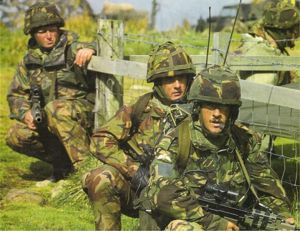
British Army infantry on maneouvres
An army is a group of ground soldiers under the command of a general. Armies were the main method of combat between kingdoms in the pre-modern era.
Much of military strategy in the immediately pre-modern era centered around the question of whether or not it is preferable to maintain a "standing army" - that is, a group of soldiers ready to be "mobilized" at a moment's notice to fight for the country, functioning additionally as deterrence. Standing armies are exorbitantly expensive to maintain. Now, most countries maintain a small standing army, but nuclear powers rely on nuclear warheads to maintain deterrence in large part.