Difference between revisions of "Lunar eclipse"
Jump to navigation
Jump to search
m (Reverted edits by RedNeckBastard (Talk); changed back to last version by Masterbratac) |
(adding image) |
||
| Line 1: | Line 1: | ||
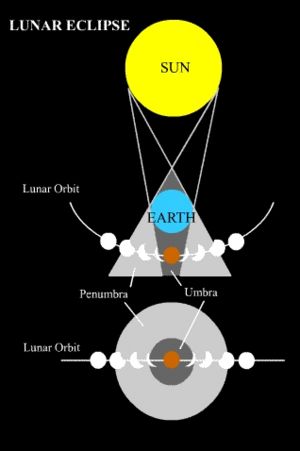
A '''lunar eclipse''' occurs when the [[moon]] passes through the [[shadow]] cast by the [[earth]]. Eclipses can be partial or total: in a total eclipse, the earth's shadow completely blocks the sun's direct light to the moon; in a partial eclipse, some of the moon is still illuminated. | A '''lunar eclipse''' occurs when the [[moon]] passes through the [[shadow]] cast by the [[earth]]. Eclipses can be partial or total: in a total eclipse, the earth's shadow completely blocks the sun's direct light to the moon; in a partial eclipse, some of the moon is still illuminated. | ||
| + | |||
| + | [[Image:LunarEclipse.jpg|right|thumb?|300px|]] | ||
Eclipses can only occur during a [[full moon]], since the geometry of the situation requires that the earth be directly between the sun and moon — meaning that before and after the eclipse, the face of the moon we see is fully illuminated. | Eclipses can only occur during a [[full moon]], since the geometry of the situation requires that the earth be directly between the sun and moon — meaning that before and after the eclipse, the face of the moon we see is fully illuminated. | ||
Revision as of 03:23, July 15, 2008
A lunar eclipse occurs when the moon passes through the shadow cast by the earth. Eclipses can be partial or total: in a total eclipse, the earth's shadow completely blocks the sun's direct light to the moon; in a partial eclipse, some of the moon is still illuminated.

Eclipses can only occur during a full moon, since the geometry of the situation requires that the earth be directly between the sun and moon — meaning that before and after the eclipse, the face of the moon we see is fully illuminated.
A notable total eclipse occurred the night the Boston Red Sox won their fourth baseball game in a row against the St. Louis Cardinals to win the 2004 World Series.