Dome of the Rock

The Dome of the Rock is an Islamic shrine in Jerusalem. It is the high point of the Temple Mount, biblical Mount Moriah.
Muhammed said that in a dream he ascended to "heaven" from the Temple Mount, which Muslims refer to as the "Noble Sanctuary."[1]
Muslim authorities do not accept the tradition that Mohammad ascended from the Rock specifically.[2] The Temple Mount is Islam's third holiest site. The dome was built in 691, making it one of the oldest examples of notable Islamic architecture.
In Jewish tradition, the rock under the dome is identified with the foundation stone.[3] The foundation stone is where Abraham offered up his son Isaac,[4] and it is the part of the world that came into being first during creation.[5]
Relationship to the Temple
There are several theories concerning the relationship between the Dome of the Rock and the Jewish temple. According to the "northern location" theory of Dr. Asher Kaufman, the Temple was north of the Dome, with the Holy of Holies located at what is now the Shrine of the Spirits.[6] The Holy of Holies was the resting place of the Ark of the Covenant, which was lost at the time of the Babylonian exile. The traditional "central location" theory places the Temple where the Dome now stands. Tuvia Sagiv has proposed a "southern location" theory that places the Holy of Holies at the site of Al Kas fountain, south of the Dome.[7]
The Foundation Stone was a platform in the Holy of Holies that rose three fingers above the Temple floor. The rock housed under the Dome is 58 by 51 feet, larger than the entire Holy of Holies.[8] This undercuts the tradition that identifies the Rock with the Foundation Stone.
History
After the Romans destroyed the Second Temple in AD 70, Jerusalem was rebuilt as a Roman city called Aelia Capitolina. Emperor Hadrian built a temple to Jupiter on the Temple Mount in 135. In 325, Emperor Constantine tore down this temple.[9]
The Bordeaux pilgrim visited the site in 333.
| “ | There are two status of Hadrian; not far from the statues is a pierced stone to the Jews comes every year and they anoint it and they lament with a groan and they tear their garments and then they withdraw.[10] | ” |
According to legend, when the first Muslim conquerors took Jerusalem, they approached the Temple Mount. There, the conqueror Umar (or Omar) called the Christian Patriarch Sophronius of the city before him to answer for the derelict state of the holy site. Insisting that such a site, sacred to all three religions, deserved respect, Umar insisted that the patriarch himself begin cleaning the mount.
The dome was built shortly thereafter, first in a primitive, wooden state from 687 to 691 by Caliph Abd al-Malik ibn Marwān as a placeholder, and in its final spectacular version somewhat later. It suffered from earthquakes in 746, 1033, and 1927. This shrine was covered by a lead dome from 691 until it was replaced with a gold-colored covering in 1965. Because of rust, the anodized aluminum cover was again replaced in 1993 with a gold covering.[11]
The association between the Dome of the Rock and the Jewish Temple can be traced to medieval times. During the Crusades, the Knights Templar called the Dome the "Temple of God" and used it as their headquarters.
Maimonides, the best known authority on Jewish law, prayed on the Temple Mount in 1165. "Even though, the Temple is now in ruin because of our sins, a person must hold its [site] in awe, as one would regard it when it was standing," he said.[12] Maimonides issued a law code which states, "Therefore, every Jew should avoid entering the central area of the Temple Mount both because of the prohibition of entering the sanctified area of the Temple and because of the positive commandment of venerating the Temple."[13]
The Temple proper was 400 by 400 cubics, according to Josephus. A cubic was about 0.44 meters. Thus the sanctified area is just a small portion of the Temple Mount.
Since at least 1600, Jewish religious leaders have held that Jews are not allowed enter any part of the Temple Mount. Instead, modern Jews pray at the Western Wall. Since the locations of forbidden areas, such as the Rampart or the Court of Women, are no longer known, there is a risk that someone who enters the Temple Mount will trespass into them.[14]
The Waqf, a Muslim group financed by the Jordanian government, manages the Temple Mount-Haram al-Sharif and consequently the Dome of the Rock.


Dome of the Rock and Dome of the Chain.
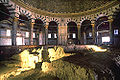
Interior of the Dome.


References
- ↑ Tamar Mayer, Suleiman A. Mourad, "Jerusalem: Idea and Reality," Routledge, (2008), p. 87.
Most of those who asserted that Muhammad could have seen Jerusalem—making the connection between the Aqsa mosque and Jerusalem's Temple Mount area—admitted that the vision was in the form of a dream
- ↑ "Masjid al-Aqsa", Islamic Encyclopedia, Mon, 13 Oct, 2014.
- ↑ Temple Inst.
The Foundation Stone.
In the center of the Holy of Holies stood the Foundation Stone that was placed there by David and Samuel. The Hebrew name Even Shetiya (Foundation Stone) refers to the tradition that the world was created and emanated from this place. The measurement of the stone was three "fingers" high.
During the era of the Second Temple, when the Ark was hidden underground, the High Priest would offer the incense of Yom Kippur in the Holy of Holies without the presence of the Ark, and rest the shovel holding the burning coals and incense upon the foundation stone...
- ↑ Genesis 22:1-24
- ↑ Job 38:4
- ↑ Kaufman, Asher Selig, "The Temple Mount: Where Is the Holy of Holies?" Bible History Daily, January 11, 2012.
- ↑ The Temple Mount in Jerusalem
- ↑ Blidstein, Gerald Y., "Even Shetiyyah," Encyclopedia Judaica, 1996.
- ↑ "The Temple in Jerusalem was not located over the Dome of the Rock"
- ↑ The Bordeaux Pilgrim (c. 333 C.E.). Translation by Andrew S. Jacobs.
- ↑ Will the Third Temple be Built in Jerusalem?
- ↑ "Maimonides on the Temple Mount"
- ↑ Bet Habehirah 7:7.
- ↑ Levy, Rafael, "'Refrain from entering entire Temple Mount area'," Israel National News, 24.02.19.