Christian Cross
Jesus Christ died on a Cross after suffering and giving up his spirit. The Cross of Christ, and the atonement He accomplished on it, is the very grounds that anyone who can be saved will be saved. The Cross is the best-known symbol of Christianity; since Clement of Alexandria the Lord's sign. In the earliest Christian life, as can be seen from the metaphorical language of the primitive faithful, the cross was the symbol of the principal Christian virtue, i.e. mortification or victory over the passions, and suffering for Christ's sake and in union with Him [1]
The Sign of the Cross is a hand motion common in the religious devotions and worship services of Roman Catholic, Anglican, Orthodox, and some Lutheran Christians. It is from this original Christian worship of the cross that arose the custom of making on one's forehead the sign of the cross. Tertullian says: "Frontem crucis signaculo terimus" (De Cor. mil. iii), i.e. "We Christians wear out our foreheads with the sign of the cross." The practice was so general about the year 200, according to the same writer, that the Christians of his time were wont to sign themselves with the cross before undertaking any action. Ibidem
Old Christian churches were usually built according to a cruciform plan.

By Paul Gauguin


Florentine Cross

Byzantin Cross.
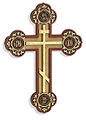
Russian Wall Cross

Cross of Lorraine
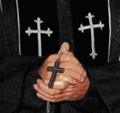
Rosary


"The Lamb of God who takes away the sin of the world."

It is believed in Christian traditions that in 326 Helena, the mother of Constantine, discovered the Saviour's Tomb and His Cross. Helena and Constantine erected a magnificent basilica over the Holy Sepulchre... The earliest reference to the True Cross is in the "Catecheses" of St. Cyril of Jerusalem written in the year 348, or at least twenty years after the supposed discovery. Ibidem
See also

