Difference between revisions of "Jean Ingres"
Jump to navigation
Jump to search

Paint should be as smooth "as the skin of an onion"
DavidB4-bot (talk | contribs) (→External links: clean up & uniformity) |
|||
| (11 intermediate revisions by 5 users not shown) | |||
| Line 1: | Line 1: | ||
[[Image:Ingres Self-Portrait.jpg|left|140px]] | [[Image:Ingres Self-Portrait.jpg|left|140px]] | ||
| − | '''Jean-Auguste-Dominique Ingres''' (1780-1867) [[French]] [[Neoclassical|neo-classical]] painter. He is considered one of the major portrait painters of the 19th century. He won the ''Prix de | + | '''Jean-Auguste-Dominique Ingres''' (1780-1867) [[French]] [[Neoclassical|neo-classical]] painter. He is considered one of the major [[portrait]] painters of the 19th century. He won the ''[[Prix de Rome]]'' in 1801. Ingres considered himself the protector of French [[Academic Art|academic]] orthodoxy as a [[Historical Painting|history painter]]. The theme of female voluptuousness attractive to Ingres throughout his life. |
| − | One of his acknowledged masterpieces, ''The Turkish Bath'' (Louvre, 1863), dates from the last years of his life. | + | One of his acknowledged masterpieces, [http://www.conservapedia.com/Image:Ingres_The_Turkish_Bath.jpg ''The Turkish Bath''] (Louvre, 1863), dates from the last years of his life; other famous works are "Madame Moitessier" and "Mademoiselle Caroline Rivière". |
| + | <center>''Paint should be as smooth "as the skin of an onion"'' | ||
| + | </center> | ||
| − | + | His most significant heir was [[Edgar Degas]]. | |
| + | {{Clear}} | ||
| − | <gallery> | + | |
| + | == Petite Gallery == | ||
| + | |||
| + | <gallery perrow="5"> | ||
Image:Ingres Portrait of Napoléon Bonaparte.jpg|Portrait of Napoléon Bonaparte | Image:Ingres Portrait of Napoléon Bonaparte.jpg|Portrait of Napoléon Bonaparte | ||
Image:Ingres Portrait of Napoléon on the Imperial Throne.jpg|Portrait of Napoléon on the Imperial Throne | Image:Ingres Portrait of Napoléon on the Imperial Throne.jpg|Portrait of Napoléon on the Imperial Throne | ||
Image:Ingres Mme Moitessier.jpg|Madame Paul-Sigisbert Moitessier | Image:Ingres Mme Moitessier.jpg|Madame Paul-Sigisbert Moitessier | ||
| + | File:Ingres. Portrait of Mademoiselle Rivière.jpg|Mademoiselle Caroline Rivière | ||
Image:Ingres Death of Leonardo da Vinci.jpg|Death of [[Leonardo da Vinci]] | Image:Ingres Death of Leonardo da Vinci.jpg|Death of [[Leonardo da Vinci]] | ||
</gallery> | </gallery> | ||
| Line 18: | Line 25: | ||
*[[Painting Masterpieces]] | *[[Painting Masterpieces]] | ||
*[[Painting Schools]] | *[[Painting Schools]] | ||
| + | *[[Academic Art]] | ||
== External links == | == External links == | ||
| Line 25: | Line 33: | ||
| + | {{DEFAULTSORT:Ingres, Jean}} | ||
| − | + | [[Category:French Painters]] | |
| − | |||
| − | [[Category: | ||
Latest revision as of 00:36, July 12, 2016

Jean-Auguste-Dominique Ingres (1780-1867) French neo-classical painter. He is considered one of the major portrait painters of the 19th century. He won the Prix de Rome in 1801. Ingres considered himself the protector of French academic orthodoxy as a history painter. The theme of female voluptuousness attractive to Ingres throughout his life.
One of his acknowledged masterpieces, The Turkish Bath (Louvre, 1863), dates from the last years of his life; other famous works are "Madame Moitessier" and "Mademoiselle Caroline Rivière".
His most significant heir was Edgar Degas.
Petite Gallery

Portrait of Napoléon Bonaparte

Portrait of Napoléon on the Imperial Throne
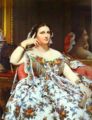
Madame Paul-Sigisbert Moitessier

Mademoiselle Caroline Rivière

Death of Leonardo da Vinci


See also
External links
- Biography Olga's Gallery.
- INGRES, Jean-Auguste-Dominique The Web Gallery of Art.