Difference between revisions of "P-adic values"
From Conservapedia
(New page: Given a prime number p the '''p-adic value''' is the function, denoted <math>v_p</math> which takes as its argument a natural number n and returns the power of p appearing in the prime fac...) |
|||
| (12 intermediate revisions by 7 users not shown) | |||
| Line 1: | Line 1: | ||
| − | Given a prime number p the '''p-adic value''' is the function, denoted <math>v_p</math> which takes as its argument a natural number n and returns the power of p appearing in the prime factorization of that number (equivalently, the highest power of p which divides n). For example, the p-adic values of 60 for p=2,3,5,7,11,13... are 2,1,1,0,0,0,.... <math> | + | Given a [[prime number]] p, the '''p-adic value''' is the function, denoted <math>v_p</math>, which takes as its argument a natural number n and returns the power of p appearing in the [[prime factorization]] of that number (equivalently, the highest power of p which divides n): |
| + | <math>v_p(x)=\max\{n:p^n\mid x\}</math>. For example, the p-adic values of 60 for p=2,3,5,7,11,13... are 2,1,1,0,0,0,.... One can associate with the p-adic valuation an absolute value <math>|n|_p=p^{-v_P(n)}</math>. | ||
| − | Here are some properties of p-adic values: | + | By convention, <math>v_p(0)=\infty</math> for all primes p. |
| + | |||
| + | Here are some important properties of p-adic values: | ||
* p-adic values convert multiplication into addition (akin to the logarithm function): <math>v_p(xy) = v_p(x) + v_p(y)</math>. | * p-adic values convert multiplication into addition (akin to the logarithm function): <math>v_p(xy) = v_p(x) + v_p(y)</math>. | ||
| − | * p-adic values satisfy the archimedean inequality: <math>v_p(x+y) \le \min\{v_p(x),v_p(y)\}</math>. | + | * p-adic values satisfy the [[Archimedes|archimedean]] inequality: <math>v_p(x+y) \le \min\{v_p(x),v_p(y)\}</math>. |
* Equality holds in the above so long as <math>v_p(x)\ne v_p(y)</math>. | * Equality holds in the above so long as <math>v_p(x)\ne v_p(y)</math>. | ||
| − | * The fundamental theorem of arithmetic can be restated compactly using p-adic values: For all natural numbers n, <math>n=\prod_pp^{v_p(n)}</math> where p ranges over all primes. | + | * The [[Fundamental Theorem of Arithmetic|fundamental theorem of arithmetic]] can be restated compactly using p-adic values: For all natural numbers n, <math>n=\prod_pp^{v_p(n)}</math> where p ranges over all primes. |
* p-adic values can be extended to the rational numbers by defining <math>v_p(x/y)=v_p(x)-v_p(y)</math> for all integers x,y. | * p-adic values can be extended to the rational numbers by defining <math>v_p(x/y)=v_p(x)-v_p(y)</math> for all integers x,y. | ||
| − | * Ostrowski's theorem states that the only absolute values on the field of rational numbers are the real absolute value and the p-adic values. | + | * Ostrowski's theorem states that the only absolute values on the field of rational numbers are the real [[absolute value]] (which some mathematicians view as the "prime at infinity") and the p-adic absolute values described above. |
p-adic values are used most commonly in [[number theory]] and [[algebra]], especially in the theory of [[commutative]] [[ring]]s. | p-adic values are used most commonly in [[number theory]] and [[algebra]], especially in the theory of [[commutative]] [[ring]]s. | ||
| + | |||
| + | Completing the field of rational numbers with respect to p-adic values yiels the field of [[p-adic numbers]]. | ||
[[Category:Mathematics]] | [[Category:Mathematics]] | ||
[[Category:Algebra]] | [[Category:Algebra]] | ||
| − | |||
Latest revision as of 02:13, September 6, 2011
Given a prime number p, the p-adic value is the function, denoted  , which takes as its argument a natural number n and returns the power of p appearing in the prime factorization of that number (equivalently, the highest power of p which divides n):
 . For example, the p-adic values of 60 for p=2,3,5,7,11,13... are 2,1,1,0,0,0,.... One can associate with the p-adic valuation an absolute value
 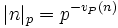 .
.
By convention,  for all primes p.
Here are some important properties of p-adic values:
- p-adic values convert multiplication into addition (akin to the logarithm function):
 .
. - p-adic values satisfy the archimedean inequality:
 .
. - Equality holds in the above so long as
 .
. - The fundamental theorem of arithmetic can be restated compactly using p-adic values: For all natural numbers n,
 where p ranges over all primes.
 - p-adic values can be extended to the rational numbers by defining
 for all integers x,y.
 - Ostrowski's theorem states that the only absolute values on the field of rational numbers are the real absolute value (which some mathematicians view as the "prime at infinity") and the p-adic absolute values described above.
p-adic values are used most commonly in number theory and algebra, especially in the theory of commutative rings.
Completing the field of rational numbers with respect to p-adic values yiels the field of p-adic numbers.
