Difference between revisions of "Jim Jones"
| Line 27: | Line 27: | ||
''[[Salon]]'' magazine says, {{quotebox|“no political figures were more gushing in their praise of Jones than Willie Brown and Harvey Milk, San Francisco’s rising tribune of gay freedom."<ref>''[https://www.salon.com/2012/05/01/jim_jones_sinister_grip_on_san_francisco/ Jim Jones' sinister grip on San Francisco:] How the Peoples Temple cult leader ensnared Harvey Milk and other progressive icons, David Talbot, ''[[Slate]]'', May 1, 2012.</ref>}} | ''[[Salon]]'' magazine says, {{quotebox|“no political figures were more gushing in their praise of Jones than Willie Brown and Harvey Milk, San Francisco’s rising tribune of gay freedom."<ref>''[https://www.salon.com/2012/05/01/jim_jones_sinister_grip_on_san_francisco/ Jim Jones' sinister grip on San Francisco:] How the Peoples Temple cult leader ensnared Harvey Milk and other progressive icons, David Talbot, ''[[Slate]]'', May 1, 2012.</ref>}} | ||
| + | |||
| + | [[File:Willie Brown and Jim Jones.jpg|right|300px|thumb|At a September 1976 testimonial dinner honoring Jim Jones, Willie Brown is at the far left and Jones is at the far right.<ref>http://www.brasscheck.com/jonestown/</ref>]] | ||
| + | Willie Brown, Gov. [[Jerry Brown]], [[George Moscone]], Lieutenant Governor Mervyn Dymally and S.F. District Attorney Joseph Freitas among others attended a large testimonial dinner in Jim Jones' honor in September 1976.<ref>Layton, Deborah. ''Seductive Poison''. Anchor, 1999. ISBN|978-0-385-48984-3. page 105.</ref><ref>Tim Reiterman (1982) "Raven (book)|Raven: The Untold Story of Rev. Jim Jones and His People" ISBN|978-0-525-24136-2 page 307</ref> Willie Brown served as master of ceremonies and introduced Jones, stating {{quotebox|"Let me present to you what you should see every day when you look in the mirror in the early morning hours ... Let me present to you a combination of [[Martin Luther King|Martin King]], Angela Davis, [[Albert Einstein]] ... [[Chairman Mao]]."<ref>Layton, Deborah 1999. p. 105</ref><ref>Tim Reiterman (1982) "Raven (book)|Raven: The Untold Story of Rev. Jim Jones and His People" ISBN|978-0-525-24136-2 page 308</ref><ref>Kinsolving, Kathleen and Tom. [http://www.culteducation.com/reference/jonestown/jonestown43.html "Madman in Our Midst: Jim Jones and the California Cover Up."] Ross Institute. 1998. {{webarchive |url=https://www.webcitation.org/5vybRwHQX?url=http://www.rickross.com/reference/jonestown/jonestown43.html |date=January 24, 2011 }}</ref> At another testimonial dinner, Brown introduced Jones, referring to him as "a young man came upon the scene, became an inspiration for a whole lot of people. He’s done fantastic things."<ref>[http://jonestown.sdsu.edu/?page_id=27585 ''Transcript of Recovered FBI tape Q 784''] {{webarchive |url=https://www.webcitation.org/5vybXcfln?url=http://jonestown.sdsu.edu/AboutJonestown/Tapes/Tapes/TapeTranscripts/Q784.htm |date=January 24, 2011 }}</ref> Brown stated "San Francisco should have ten more Jim Joneses."<ref>Kilduff, Marshall and Ron Javers. ''Suicide Cult: The Inside Story of the Peoples Temple Sect and the Massacre in Guyana''. Bantam Books, New York, 1978. ISBN|978-0-553-12920-5. page 49.</ref> | ||
| + | |||
| + | Willie Brown had visited the People's Temple a dozen times, some by invitation and some on his own.<ref>Nancy Dooley & Tim Reiterman, "Jim Jones: Power Broker", San Francisco Examiner, August 7, 1977</ref><ref>Layton, Deborah. ''Seductive Poison''. Anchor, 1999. ISBN|978-0-385-48984-3. p. 105.</ref> When investigations into the Temple's activities began, Brown said at a rally in support of Jones attended by Harvey Milk and others,<ref>Reiterman, Tim, and John Jacobs. ''Raven (book)|Raven: The Untold Story of Rev. Jim Jones and His People''. Dutton, 1982. {{ISBN|978-0-525-24136-2}}. page 327</ref> "[h]e is a rare human being" and "he cares about people...Rev. Jim Jones is that person who can be helpful when all appears to be lost and [[hope]] is just about gone."<ref>Richardson, James, [http://ark.cdlib.org/ark:/13030/ft0m3nb07q/ ''Willie Brown A Biography''], University of California Press, 1996, p. 251 {{webarchive |url=https://www.webcitation.org/5vybaoie8?url=http://ark.cdlib.org/ark:/13030/ft0m3nb07q/ |date=January 24, 2011 }}</ref> | ||
| + | |||
| + | After Congressman [[Leo Ryan]] announced that he would investigate [[Jonestown]] following the November 1978 elections, Willie Brown was still planning a fund raising dinner for the Temple that was to be held on December 2, 1978.<ref>{{cite book |last=Richardson |first=James |url=http://ark.cdlib.org/ark:/13030/ft0m3nb07q |title=Willie Brown: A Biography |location=Berkeley |publisher=University of California Press |year=1997|isbn=978-0-585-24985-8}}</ref> | ||
| + | |||
| + | Brown continued to praise Jones after the mass suicide, feeling that attacks on Jones were attacks on the black community. Brown stated he had "no regrets" over his past association the Temple and that he would not dissociate himself from it like other politicians. "They all like to say, 'Forgive me, I was wrong', but that's bulls—t. It doesn't mean a thing now, it just isn't relevant."<ref>Richardson, James, [http://ark.cdlib.org/ark:/13030/ft0m3nb07q/ ''Willie Brown A Biography''], University of California Press, 1996, p. 252 {{webarchive |url=https://www.webcitation.org/5vybaoie8?url=http://ark.cdlib.org/ark:/13030/ft0m3nb07q/ |date=January 24, 2011 }}</ref> | ||
===Jerry Brown=== | ===Jerry Brown=== | ||
Revision as of 21:01, February 6, 2019
Jim Jones was a community organizer and head of the Peoples Temple, a progressive Democrat activist group in San Francisco in the 1970s.[1] After fleeing the United States with about 1,000 members in 1977 due to several investigations, Jones led the group of socialists in an act of "revolutionary suicide protesting the inhumane conditions of this world." The group was a resistance movement fearing a fascist takeover of the United States. Days later, a moderate Democrat murdered two prominent Democrats that Jones was instrumental in getting elected, Mayor George Moscone and city councilman Harvey Milk, a gay rights activist.
Social Justice Warrior

Jim Jones was an avowed atheist.[3] Jones was frustrated with opposition to communism within the United States which lead him to ask, "How can I demonstrate my Marxism? The thought was, infiltrate the church."[4][5]
The Temple openly preached to established members that "religion is an opiate to the people."[6] Accordingly, "those who remained drugged with the opiate of religion had to be brought to enlightenment - socialism."[7] In that regard, Jones also openly stated that he "took the church and used the church to bring people to atheism." [8] Jones often mixed those concepts, such as preaching that "If you're born in this church, this socialist revolution, you're not born in sin. If you're born in capitalist America, racist America, fascist America, then you're born with a big d***o in sin. But if you're born in socialism, you're not born in sin."[9] Speaking to the Jonestown community, Jones declared:
"I brought you here to regroup, recoup, rehabilitate and gain strength, and militancy, and a proper education in Marxist-Leninism, which you had never picked up, even though I was avowedly, openly Marxist-Leninist and atheist, you have never picked it up, for the most part, in the United States, except for a handful."[10]
Jim Jones ridiculed the Bible, stomped on it in front of his flock, and instructed his followers to use it as toilet paper when their supply ran out in Jonestown.
The Temple claimed that "reactionary forces were trying to destroy his [Jones] image because he is the most persistent fighter for social justice."[11]
Political patrons
Long before Jones' Rainbow family drank the Kool-Aid, the Democratic party leadership at the national, state, and local level did.
Harvey Milk
Jim Jones promoted gay rights, which appealed to Harvey Milk. Jones preached that everyone was homosexual.[12] Milk praised the Temple in his column in the Bay Area Reporter. Milk, a perennial candidate for office aggressively sought Jones’s political blessing. Milk wrote Jones during a campaign for supervisor:
"Our paths have crossed. They will stay crossed. It is a fight that I will walk with you into . . . The first time I heard you, you made a statement: 'Take one of us, and you must take all of us.' Please add my name.”
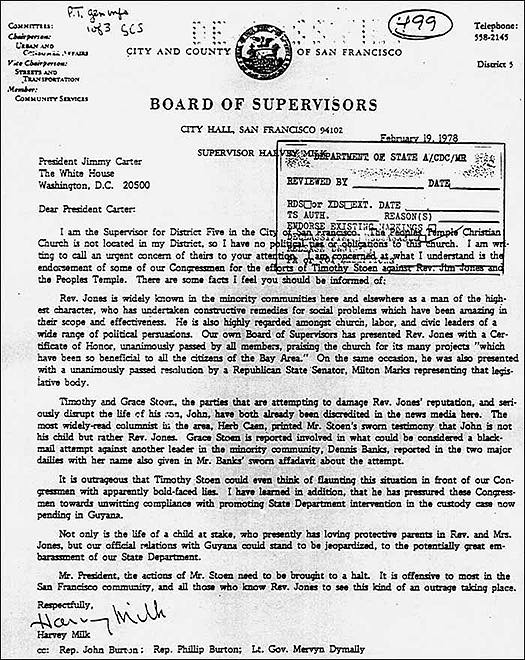
Milk spoke at Peoples Temple and Jones provided Milk's campaigns with “volunteers,” a printing press, and publicity through the Peoples Temple newspaper, the Peoples Forum, with a readership of a half million. Once elected with Jones help, Harvey Milk provided Jim Jones with legitimacy. He lobbied on Jones’s behalf to President Jimmy Carter, Secretary of Health, Education, and Welfare Joseph Califano, Guyanese Prime Minister Forbes Burnham, and other powerful figures.
Milk wrote to President Carter defending Jones "as a man of the highest character," and stating that people wanting to leave the Temple were trying to "damage Rev. Jones' reputation" with "apparent bold-faced lies".[13]
Milk wrote to Jones "my name is cut into stone in support of you - and your people."[14] On the 40th anniversary of his assassination, Milk was awarded the Presidential Medal of Freedom by President Barack Obama.[15]
Willie Brown
It was Willie Brown, the mentor of Kamala Harris, who first recognized that Jim Jones’s organization could play a pivotal role in George Moscone’s run for mayor. Jones filled buses with temple members in Redwood Valley and Los Angeles and shuttled them to San Francisco. Voting procedures were liberal, and many nonresidents were able to cast their ballots for Moscone, some more than once. ‘You could have run around to 1200 precincts and voted 1200 times,’ said Moscone's opponent after losing by a whisper of a margin. Temple leaders claimed credit for Moscone's win.[16] The new mayor appointed Jones chairman of the Housing Commission Authority, making Jones the largest landlord in the city.
Salon magazine says,
“no political figures were more gushing in their praise of Jones than Willie Brown and Harvey Milk, San Francisco’s rising tribune of gay freedom."[17]

Willie Brown, Gov. Jerry Brown, George Moscone, Lieutenant Governor Mervyn Dymally and S.F. District Attorney Joseph Freitas among others attended a large testimonial dinner in Jim Jones' honor in September 1976.[19][20] Willie Brown served as master of ceremonies and introduced Jones, stating {{quotebox|"Let me present to you what you should see every day when you look in the mirror in the early morning hours ... Let me present to you a combination of Martin King, Angela Davis, Albert Einstein ... Chairman Mao."[21][22][23] At another testimonial dinner, Brown introduced Jones, referring to him as "a young man came upon the scene, became an inspiration for a whole lot of people. He’s done fantastic things."[24] Brown stated "San Francisco should have ten more Jim Joneses."[25]
Willie Brown had visited the People's Temple a dozen times, some by invitation and some on his own.[26][27] When investigations into the Temple's activities began, Brown said at a rally in support of Jones attended by Harvey Milk and others,[28] "[h]e is a rare human being" and "he cares about people...Rev. Jim Jones is that person who can be helpful when all appears to be lost and hope is just about gone."[29]
After Congressman Leo Ryan announced that he would investigate Jonestown following the November 1978 elections, Willie Brown was still planning a fund raising dinner for the Temple that was to be held on December 2, 1978.[30]
Brown continued to praise Jones after the mass suicide, feeling that attacks on Jones were attacks on the black community. Brown stated he had "no regrets" over his past association the Temple and that he would not dissociate himself from it like other politicians. "They all like to say, 'Forgive me, I was wrong', but that's bulls—t. It doesn't mean a thing now, it just isn't relevant."[31]
Jerry Brown
Walter Mondale
First Lady Rosalyn Carter
Angela Davis
Huey Newton
Hubert Humphrey
Former Vice President Hubert Humphrey and 1968 Democratic challenger to Richard Nixon for the presidency said of Jones,
"It is always good to hear that the spirit of the American people is still as vibrant and generous as ever. Pastor Jones seems to be a credit to your community, and I hope his good works continue to play an important power in the continued well-being of your area. Citizen power has always been one of my watchwords, and I’m glad to see it in action.
The work of Reverend Jones and his congregation is testimony to the positive and truly Christian approach to dealing with the myriad problems confronting our society today.”
References
- ↑ Jim Jones, The Most Admired Democrat of The 1970s, Censored Info, youtube
- ↑ Peoples Temple Endorsements Packet (Text).
- ↑ An untitled collection of reminiscences by Jim Jones
- ↑ Wessinger, Catherine (2000), How the Millennium Comes Violently: From Jonestown to Heaven's Gate, Seven Bridges Press, ISBN 978-1-889119-24-3
- ↑ Jones, Jim. "Transcript of Recovered FBI tape Q 134". Alternative Considerations of Jonestown and Peoples Temple. Jonestown Project: San Diego State University
- ↑ Jones, Jim. "Transcript of Recovered FBI tape Q 1053." Alternative Considerations of Jonestown and Peoples Temple. Jonestown Project: San Diego State University.
- ↑ Layton 1999, page 53.
- ↑ Jones, Jim. "Transcript of Recovered FBI tape Q 757." Alternative Considerations of Jonestown and Peoples Temple. Jonestown Project: San Diego State University.
- ↑ Jones, Jim. "Transcript of Recovered FBI tape Q 1053." Alternative Considerations of Jonestown and Peoples Temple. Jonestown Project: San Diego State University. Archived copy. Archived from the original on 2019-01-30.
- ↑ The Jonestown Institute, “Q235 Transcript,” Alternative Considerations of Jonestown & Peoples Temple.
- ↑ Peoples Temple, Victims of Conspiracy Brochure, Jonestown Alternative Considerations, San Diego State University Archived copy. Archived from the original on February 4, 2019. Retrieved on 2019-01-31.
- ↑ Everybody is a homosexual" by Michael Bellefountaine, Jonestown Alternative Considerations, San Diego State University.
- ↑ Milk, Harvey Letter Addressed to President Jimmy Carter, Dated February 19, 1978 Template:Webarchive
- ↑ Harvey Milk: His Lives and Death, Lillian Faderman, Yale University Press, May 22, 2018, p.
- ↑ President Obama Honors Harvey Milk With Presidential Medal of Freedom, youtube.
- ↑ Jim Jones' sinister grip on San Francisco: How the Peoples Temple cult leader ensnared Harvey Milk and other progressive icons, David Talbot, Slate, May 1, 2012.
- ↑ Jim Jones' sinister grip on San Francisco: How the Peoples Temple cult leader ensnared Harvey Milk and other progressive icons, David Talbot, Slate, May 1, 2012.
- ↑ http://www.brasscheck.com/jonestown/
- ↑ Layton, Deborah. Seductive Poison. Anchor, 1999. ISBN|978-0-385-48984-3. page 105.
- ↑ Tim Reiterman (1982) "Raven (book)|Raven: The Untold Story of Rev. Jim Jones and His People" ISBN|978-0-525-24136-2 page 307
- ↑ Layton, Deborah 1999. p. 105
- ↑ Tim Reiterman (1982) "Raven (book)|Raven: The Untold Story of Rev. Jim Jones and His People" ISBN|978-0-525-24136-2 page 308
- ↑ Kinsolving, Kathleen and Tom. "Madman in Our Midst: Jim Jones and the California Cover Up." Ross Institute. 1998. Template:Webarchive
- ↑ Transcript of Recovered FBI tape Q 784 Template:Webarchive
- ↑ Kilduff, Marshall and Ron Javers. Suicide Cult: The Inside Story of the Peoples Temple Sect and the Massacre in Guyana. Bantam Books, New York, 1978. ISBN|978-0-553-12920-5. page 49.
- ↑ Nancy Dooley & Tim Reiterman, "Jim Jones: Power Broker", San Francisco Examiner, August 7, 1977
- ↑ Layton, Deborah. Seductive Poison. Anchor, 1999. ISBN|978-0-385-48984-3. p. 105.
- ↑ Reiterman, Tim, and John Jacobs. Raven (book)|Raven: The Untold Story of Rev. Jim Jones and His People. Dutton, 1982. ISBN 978-0-525-24136-2. page 327
- ↑ Richardson, James, Willie Brown A Biography, University of California Press, 1996, p. 251 Template:Webarchive
- ↑ Richardson, James (1997). Willie Brown: A Biography. Berkeley: University of California Press. ISBN 978-0-585-24985-8.
- ↑ Richardson, James, Willie Brown A Biography, University of California Press, 1996, p. 252 Template:Webarchive