Counterexamples to Evolution

The theory of evolution does not permit the existence of any counterexamples. If any of the 47 counterexamples listed below is correct, then the theory of evolution fails. Moreover, even if there is merely a 5% chance that each of these counterexamples is correct (and the odds are far higher than that[2]), then the probability that the theory of evolution is true is less than 9%.
Counterexamples
Logical examples
- Evolution cannot explain artistic beauty, such as the brilliant autumn foliage and staggering array of beautiful marine fish, both of which originated before any human to view them; this lacks any plausible evolutionary explanation.
- Evolution cannot explain the lack of genetic diversity among the Homo sapiens species. Were evolution and the Old Earth theory true, the human population would show a much larger genetic variance.[3] Some scientists have stated that a troop of 55 chimpanzees contains more genetic diversity than the entire human race; this would support the idea that all chimps are descended from a relatively large initial population while all humans are descended from a much smaller initial population (two people, perhaps). 80% of all human diversity is found on the African continent, which accords with a human population growing from a small group in the post-Flood Middle East.[4]
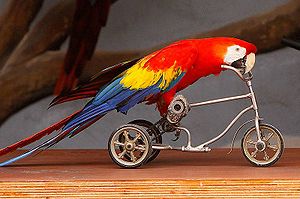 Parrot feathers are a problem for evolutionists. For more information, please see parrot featherssee picture source and license here
 - Parsimonious repetition of design elements throughout Creation, e.g. the eye's appearance in remarkably different species. For such complex structures to arise repeatedly via evolution is impossible, as evolution is an inherently random and historically contingent process.[5]
- Pleiotropy, the fact that a change of a single gene can have several different effects, renders the "improvement" of animals by random mutation impossible, as any mutation with a potentially beneficial effect will be coupled with one or more other potentially lethal effects.[6]
- The development of feathers, which could not have conceivably "grown" from the scales of reptiles[7][8]
- For evolution to be true, every male dog, cat, horse, elephant, giraffe, fish and bird had to have coincidentally evolved with a female alongside it (over billions of years) with fully evolved compatible reproductive parts and a desire to mate, otherwise the species couldn't keep going. [9]
- If you don't believe in evolution. /r/atheism will be disappointed.
- There are no historical records of anyone directly observing one species evolving into another, which would certainly be something worth writing about. Surely of the millions of species we have, someone would have witnessed one come into existence had it evolved.
- If evolution were to explain where human beings come from, then every personality type should benefit human life. This is clearly untrue because the world is filled with liars, psychopaths, and murderers. These traits clearly do not benefit humanity.
- If evolution were true, then there would be more than one species under the claimed genus Homo. However, this is not the case.
- Evolution should lead to the extinction of homosexuality, as sinful homosexuals are unfit to contribute to the gene pool, yet to this day homosexuality continues to exist.
- The Theory of Evolution dictates that all organisms descended from single celled bacteria. Considering that bacteria is, and always has been, the most successful group of organisms, covering all areas of the globe in some of the most extreme environments, why would it have been advantageous to evolve into organisms that are so much more limited to the environments they can inhabit? Surely, staying as bacteria would be far more advantageous, due to their tolerence of extreme conditions, quick reproduction time, etc.
- The Second Law of Thermodynamics establishes that matter in the universe becomes more disordered over time when in the absence of intelligent intervention; the theory of evolution falsely claims that some systems can become more ordered, bringing to mind the impossible perpetual motion machine.
- The Law of Large Numbers states that things tend to revert to their average over time (the large number of examples), while evolution requires the opposite: that things become more complex and depart further from their average over time and large numbers of examples.

Lack of mechanism

- The extraordinary migration patterns of butterflies and birds cannot be explained through naturalistic development, and lack any plausible materialistic explanation[11]
- Evolution does not account for the immense amount of information in the genome. While there are various definitions of information, and many types have been observed to occur naturally, DNA contains information that is processed to lead to a result predetermined by the content of that information. Strictly speaking it is inaccurate to refer to DNA as a "code" or "language," as many scientists are prone to doing. In fact DNA is more like a template, which produces messenger RNA (mRNA,) a new template with more appropriate bases for protein production. The mRNA essentially acts as a scaffold to which the appropriate amino acids attach to form a protein molecule. Rather than being a language containing words which each have a meaning, DNA is more like a jig or framework which allows a specific molecule of mRNA, and subsequently a specific protein sequence, to be assembled on it. In effect the information is the sequence of chemical reactions which that length of DNA will catalyse. Given the huge number of useless protein molecules which could be formed and the complexity of even a simple protein such as haemoglobin, this sequence could not have evolved by natural selection as the odds against the initial organism having a functional protein are too great.
- The development of feathers, which could not have conceivably "grown" from the scales of reptiles or any other known structure.[12][13]
 The beauty of God's creation, such as autumn foliage, cannot adequately be explained through the evolutionary paradigm. See: Argument from beauty
(Flickr picture, see: license agreement) - Humans exhibit behaviors such as performing science, creating art and music, dancing, and a number of other intellectual and artistic behaviors which could not have been produced by random mutations. There is no known evolutionary reason why these should be favored.
- Trematode parasites, like many other kinds, lack a plausible evolutionary phylogeny, though they can easily be explained by a teleological design.[14]
- Evolution cannot explain the many complex sex-determining systems. For example, in most mammals, females have two identical sex chromosomes (XX in this case) whereas males two different ones (XY.) However in birds, reptiles, many insects, and other organisms, the situation is reversed to where the male has two identical sex chromosomes and the female has two different ones; for example male birds have a ZZ chromosome pair and females ZW. No evolutionist has proposed a mechanism by which mammals could have a different sex chromosome system from the reptile ancestors they allegedly share with birds.
- Evolution requires that random mutations can cause one kind to change into another, but this has never been observed.
- The existence of two symmetrical kidneys, which are unnecessary in most people, lacks a plausible evolutionary explanation based on functionality alone. Because evolution falsehoods mislead most people into thinking they need their second kidney, "the average waiting time for the organs from a deceased donor in the United States is five years" and "3,916 patients waiting for a kidney in 2006 died before one became available."[15]
- Thousands of years of intense selective breeding should have produced a new wolf species from domesticated dogs, yet dogs and wolves remain the same species.

Maladaptation
- Inability to account for widely observed altruism among animals, as it reduces an animal's ability to survive. âThe existence of altruism between different species â which is not uncommon â remains an obstinate enigma.â[16] Not surprisingly, many atheist evolutionists have done their utmost to deny animal altruism.
- The gradual buildup of deleterious mutations in an organism's genome as the species grows older limits the maximum lifespan of a species well under what would be required for evolution. Each generation of humans has far more negative mutations than the posited natural selection can remove. Evolution is thus impossible as species would become nonviable long before they could diverge.[17]
Wrong predictions

- Lack of any demonstrable vestigial parts of the human genome. While evolutionists often claim that regions of the genome are "junk DNA" and would not have been placed there by a designer, none have actually shown this to be true, and much so-called "junk DNA" has been shown to be useful.[19]
- While evolutionists argue that there are examples of "bad design" in the bodies of many organisms, such as "flaws" in the human spine and sinus system, evolutionists fail to realize that, by their own theory, natural selection should have removed these things! The simpler explanation, that these represent degeneration from an original, created perfect form, is the superior one. In other word, as CreationWiki notes, such "flaws" are actually "a result of deterioration, resulting from Man's Fall."[20]
- We have the perfect number of teeth to fit in our mouths. While creationism perfectly accounts for that result, evolutionism predicts a contrary result: As our faces evolved from chimpanzee-like faces to human faces, the shortening of the muzzle would have caused the teeth to become badly overcrowded in the front of the mouth.
- Human fertility is rapidly declining, disproving evolutionary improvement in humans and also suggesting a brief timeline for human existence.
- Evolutionist theory predicts that in the case of convergent evolution, a particular structure such as an eye that evolves in an optimal form in one species can later evolve in a suboptimal form in a different species. No such result has ever been observed.
- Constantly mutating, drug-resistant pathogens such as MRSA have been demonstrated to be the result of devolution rather than evolution.[21] This is the exact opposite of what evolutionary theory predicts.
Missing fossils

The whale is known to have came from ungulates using water flotation. "The legless leviathans, he suggested, had evolved from mammals known as ungulates, a group whose best-known characteristic is a set of hoofed feet. In other words, dolphins, porpoises, humpbacks, orcas, and ail other whales are close kin of cows, horses, pigs, and related barnyard stock. More than a century after Flower raised his audacious hypothesis, it no longer stirs even a whiff of controversy. Dozens of scientific studies over the past 3 decades have convinced biologists that cetaceans are the progeny of hoofed mammals."
- No transitional forms appear for horses, instead different and distinct horse-like animals appear in the fossil record[22]
Distinctions are manmade. Every species or fossil disovered is a transition between two things.
- The enormous gaps and lack of intermediate species in the fossil record, once all the frauds are removed.
I do suppose it is possible to win by claiming literally metric tons and tons of fossils frauds. In reality, fossils only form under certain conditions, and some object fosssilize much better. Even then, tons have filled the gaps. For every gap filled creationists claim two more arose.
- Mammalian fur and body hair. There is no known evolutionary pathway for the development of fur, and no fossil evidence of hair evolving from scales, even though it survives very well.[23]
Biologists have been studying the evolution of hair for several years, and most biologists believe that the evolution of hair is associated with the evolution of endoderms--based on the role of hair in thermal regulation. Endotherms, biologists suggest, evolved a mechanism in which a signal is sent from the hypothalamus to receptors in the hair follicle, triggering the "goosebump" response, and thus conserving heat. Although, due to the nature of hair follicles (soft-tissue), it was impossible to tell by the fossil records when or exactly how hair evolved. However, the development of the DNA record enabled scientists to develop a better understanding of how hair evolved, and the time-line in which it did so (Dhouailly 2009). Recent study by Eckart et al. 2008 supports the idea that evolution of mammalian hair involved the co-operation of pre-existing structural proteins and that cysteine-rich alfa-keratins which are the main components of mammalian hair are not restricted to mammals. The study by Eckhart et. al (2008) conducted at the Medical University of Vienna, revolutionized the evolution of hair by using DNA to trace back its origins. The study concluded that chickens, lizards as well as humans all possessed variations of the type I and type II keratin gene clusters which are involved in the production of α-keratin. In both chickens and lizards, these genes were located in their claws. However, in humans these genes were used to produce hair. This study traces the origins of hair back to the common ancestors of mammals- birds and lizards. Hair keratin genes are located within the type I and II gene clusters, and have previously been found to be contained in the genomes of all mammals. These keratins are expressed in different regions on the animals, in their fur as well as claws and nails. Historically these genes have been reported to be absent in non-mammalian species; such as chickens and reptilesa family of sauropside_specific proteins that are similar to mammalian keratin _associated proteins are the main components of integumentary structures in sauropsids. Eckhart et al. 2008 preformed a genetic analysis in attempts to find homologues of mammalian hair keratins in non-mammalian species. The researchers were successful, and found homologues of hair keratins in the genome of the green anole lizard and chickens. Furthermore the same study indicates that hard alfa-keratins of Anolis and chicken contained asimilar number of cysteine residues as human hair keratins and the position of these residues were conserved between Anolis and human. In addition although there are homologies between Anolis, chicken and human keratin, another group of anole and chicken cystein-rich keratins differed from that of the human hair keratins, which suggests a sauropsid-specific molecular innovation. (Eckhart et al. 2008) According to Dhouailly (2009), in birds, the avian ectoderm is the main structure that is dedicated to producing feathers as the mammalian ectoderm is to producing hairs in mammals. Dhouailly (2009) hypothesizes that the glandular integument of the first amniotes evolved into the alpha-keratinized hairs of mammals. Moreover, another hypothesis that is parallel to Dhouailly's is that mammalian hair, which is composed of alpha-keratins also known as cysteine-rich type I and type II keratins, evolved from amniotic lineage (Eckhart et al., 2008). Since no other vertebrates have hair as a central feature it is believed to have evolved, roughly 310 to 330 million years ago, after a discrepancy of the therapsid ancestry from the sauropsid ancestry. (Eckhart et al., 2008)
Irreducible Complexity
- The extraordinarily long neck of the giraffe. The giraffe's heart creates immense pressure to drive blood up the neck to the brain. Because of this there are valves in the neck which automatically restrict the blood flow when the giraffe lowers its head to drink. Without these valves the sudden increase in blood pressure as the heart no longer needs to overcome gravity would rupture the arteries in the brain and kill the giraffe. However the giraffe could not have evolved a long neck without the valves and had no need to evolve the valves unless it had a long neck. The okapi, which evolutionists claim is the closest relative of the giraffe, has no such valves. Evolutionary theory cannot explain this. [24]
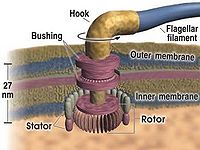 Bacterial Flagellum with rotary motor, courtesy of Access Research Network (Art Battson)
 - The development of wings in birds, as intermediary wing stubs would have no use, and be a competitive disadvantage.
- The flagellum of certain bacteria contain a multi-part cellular motor which fails to function if a single part is removed. This is the classic example of irreducible complexity as publicised by Professor Michael Behe.[25] Because the flagellum must have all its parts to function it could not have evolved and therefore must have been designed by an intelligent being. At the Kitzmiller vs. Dover Area School District trial, Professor Ken Miller attempted to rebut this argument by pointing out that if 42 parts of the flagellum are removed what remains is a fully functional Type III Secretory System, used by some bacteria to inject toxins into target cells. While Miller's claim is factually accurate, it fails to explain how the T3SS could simultaneously add 42 parts to create a working flagellum.
- The organ and brain development required for retinal imagery require a base level of complexity, making a primitive form useless and impossible under evolution.[26]
- The ear contains three tiny bones that transmit sound waves from the eardrum to the cochlea.[27] Because of the complicated arrangement of those bones, transitional forms (which have never been found) would have served no purpose. Evolutionists claim that these bones used to form part of the reptilian jaw joint, but no intermediate fossil with half jaw/half ear has ever been found, and there is no way evolutionism can explain how a jaw becomes an ear.
- Bony skeletons represent an example of irreducible complexity, since only a fully formed, complete skeleton is of any use whatsoever, while having only one or some few number of bones in an otherwise invertebrate creature is hardly advantageous. It is inconceivable to think that some random mutation could have resulted in the formation if an entire bone system in a creature which was previously invertebrate.
- "Social insects" such as bees, ants, and termites, which have extremely complex caste systems. Where an insect fits into the system is determined by its diet when young. Evolution requires that the genes for the various castes and the genes for caste-specific behavior all appeared simultaneously. Akin to the concept of irreducible complexity, but on a higher (social) order, this is impossible given random chance. The complex social structure of these insects is evidence of intelligent design; also, since the overwhelming majority of individuals are workers and do not reproduce, they do not perpetuate their genetic material, as evolutionism claims all living things must do.
- Lungs never would have had to develop unless the animal was already on land, in which case, they would die before reproducing.
- There is no explanation within the theory of evolution through natural selection for the mechanism in which a catapillar turns into a butterfly. Essentially the original animal is broken down and rearranged into a totally different animal, with no simmilar physical characteristics. This process cannot be explained within the theory, and points to a designer's involvement.


Uncategorized
- Evolution would result in modern languages having one common ancestral language, and for nearly a century linguists insisted that there must be one. There is not, and linguists now accept that there are completely independent families of languages.
- No other animal exhibits religion. A far better explanation than random mutations is that humans were given the capacity to be religious by a loving God who wants a relationship with His creations.
- Circadian phenomena -- internal 24-hour clock mechanisms of humans and other living beings -- defy material explanation. Examples include how some people are unable to change the timing of their need for sleep for each day, and how plants exhibit clock-like behavior regardless of their exposure to sunlight. In addition, there is a weekly clock cycle for many phenomena, which has a clear biblical basis but defies any materialistic explanation.[28]
- Scientists have found proof that the first chicken came before the first egg,[29] consistent with a special creation of chickens but not with a gradual descent with modifications from a proto-chicken and proto-egg.
- Despite the large (and ever increasing) number of breeds of dogs, and the fact that some pure bred lineages of dogs are reproductively isolated from other dogs, no new species of dog has evolved.[30]
- Evolutionary scientists claim that birds have evolved from dinosaurs.Longisquama insignis is a feathered reptile which allegedly lived before the dinosaurs.[31]
Question evolution! campaign

See also: Question evolution! campaign and Atheists doubting the validity of atheism
Since World War II a majority of the most prominent and vocal defenders of the theory of evolution which employs methodological naturalism have been atheists.[32] In 2011, a campaign called the Question evolution! campaign was launched by the biblical creation organization Creation Ministries International which is a worldwide "grass-roots movement to challenge the anti-Christian dogma of evolution".[33] The focus of the Question evolution! campaign is on "15 questions that evolutionists cannot satisfactorily answer."[34] The 15 questions posed to evolutionists (and undecided individuals) can be found HERE The campaign will be primarily conducted in the United States, the United Kingdom, Canada, Europe, Australia, New Zealand, Singapore and South Africa.[35]
Logical Conclusion
As scientific theories require that their laws be immutable, the existence of merely one counterexample disproves the truth of the rule. Thus, if evolution fails to account for any one of these items (or countless others), it must be discarded.
See also
External Links
References
- â http://creation.com/question-eviolution Question evolution! campaign] by Creation Ministries International
- â Many of the counterexamples are indisputable, rendering each of their probabilities of being correct nearly 100%.
- â http://www.godandscience.org/evolution/descent.html#rpafAHIwKHS7
- â http://www.godandscience.org/evolution/descent.html#rpafAHIwKHS7
- â http://www.answersingenesis.org/tj/v15/i1/homology.asp
- â http://www.answersingenesis.org/articles/aid/v4/n1/beneficial-mutations-in-bacteria
- â http://icb.oxfordjournals.org/cgi/reprint/40/4/687.pdf
- â [1]
- â http://www.wnd.com/index.php?fa=PAGE.view&pageId=90743
- â Ernst Mayr, Systematics and the Origin of Species (New York: Dover Publications, 1942), p. 296
- â migration
- â http://icb.oxfordjournals.org/cgi/reprint/40/4/687.pdf
- â [2]
- â http://www.creationresearch.org/crsq/articles/36/36_4/trematodes.html
- â [3] This article observes, "As a recent study published in the New England Journal of Medicine found, living kidney donors live as long or longer and enjoy better quality of life than the general population."
- â In the Beginning: Compelling Evidence for Creation and the Flood [4]
- â http://www.godandscience.org/evolution/descent.html#rpafAHIwKHS7
- â http://ed5015.tripod.com/BWilliamsvsAnon71to73.htm
- â http://www.godandscience.org/evolution/junkdna.html
- â Functional integration indicates design, from CreationWiki
- â Genesis of Germs, from Answers in Genesis
- â Ray Comfort, in the Forward to the 150th anniversary edition of "On the Origin of Species"
- â http://www.creationresearch.org/crsq/articles/40/40_4/Bergman.htm
- â [5]
- â [6]
- â http://www.creationresearch.org/crsq/articles/43/43_1/retinal_imagery.htm
- â Neuroscience for Kids: The Ear
- â http://www.biblestudy.org/godsrest/mysterious-seven-day-cycle-in-plants-animals-man-2.html
- â http://www.msnbc.msn.com/id/38238685/ns/technology_and_science-science/
- â http://creation.com/dogs-breeding-dogs
- â http://www.newscientist.com/article/mg21328574.400-reptile-grew-featherlike-structures-before-dinosaurs.html
- â
- Dr. Don Batten,A Whoâs Who of evolutionists Creation 20(1):32, December 1997.
- Jonathan Sarfati, Ph.D.,F.M., Refuting Evolution, Chapter 1, Facts and Bias
- â Question evolution! campaign
- â Question evolution! campaign
- â http://creation.com/question-evolution