Difference between revisions of "Bay Area"
| Line 6: | Line 6: | ||
==Bay Area Democrats== | ==Bay Area Democrats== | ||
| − | |||
[[File:Jim Jones and the Democrat party.jpg|right|400px|thumb]] | [[File:Jim Jones and the Democrat party.jpg|right|400px|thumb]] | ||
:{{See also|Progressivism|San Francisco values|Peoples Temple Agricultural Collective}} | :{{See also|Progressivism|San Francisco values|Peoples Temple Agricultural Collective}} | ||
Revision as of 18:43, September 14, 2020
The San Francisco Bay Area (commonly called the Bay Area) is a greater metropolitan area in Northern California, defined locally as the nine counties that border on San Francisco Bay, including the northern extension called San Pablo Bay. These counties are Alameda, Contra Costa, Marin, Napa, San Francisco, San Mateo, Santa Clara, Solano and Sonoma. This area includes the cities of San Francisco, Oakland and (in the "South Bay") Silicon Valley with its center at San Jose.
A more expansive definition of the Bay Area includes three additional counties that are contiguous with the nine Bay counties and comprise a logical economic metropolitan area; for instance many workers live in these three counties and commute to jobs in the Bay counties. These additional counties are San Benito, San Joaquin and Santa Cruz. This twelve-county area is also called the "San Jose-San Francisco-Oakland, CA Combined Statistical Area."
In the 1990 census, San Jose overtook San Francisco as the Bay Area's most populous city; nevertheless, San Francisco remains the cultural and historic capital of the area and the name "San Francisco Bay Area" is not in jeopardy.
Bay Area Democrats

- See also: Progressivism, San Francisco values, and Peoples Temple Agricultural Collective
Willie Brown, later mayor of San Francisco and Kamala Harris's mentor, compared Jim Jones to Martin Luther King and Mahatma Gandhi. Brown endorsed Jones as “a close personal friend and a highly trusted brother in the struggle for liberation."[1] Dianne Feinstein joined the rest of the San Francisco board of supervisors in honoring Jones “in recognition of his guidance and inspiration” in furthering “humanitarian programs.” Gov. Jerry Brown spoke at the People's Temple. At its peak, the Temple boasted 20,000 members.
Following the San Francisco mayoral election of 1975, the San Francisco District Attorney asked Timothy Stoen, a Temple member,[2] to lead a special unit to investigate election fraud charges.[3] Shortly thereafter Stoen was hired as an assistant district attorney.[4][5] Stoen found no evidence of fraud, but Temple members later alleged that the Temple brought "busloads" of members from Redwood Valley who were not registered to vote in San Francisco, to vote in the San Francisco election.[6] It was Willie Brown who brought George Moscone and Jim Jones together.[7][8] Moscone, who owed his position as mayor to Jones in a tight race, appointed Jones chairman of the city's Housing Commission Authority, effectively making Jones the city's largest landlord. Moscone's press secretary stated that Jones "made his followers available to support progressive Democratic candidates."[9]
Moscone's press spokesman explained it was "common knowledge that if you were going to run for office in San Francisco, and your constituency included the black, the young or the poor, you'd better have Jones in your corner." Of particular interest to politicians was the Temple's ability to produce 2,000 people for campaign work or attendance at an event with only six hours notice. [2] Moscone's aide stated that Jones offered thousands of "foot soldiers" willing to walk precincts and get out the vote, which was "an offer no politician in his right mind could refuse." Similarly, San Francisco Mayor Art Agnos stated that "If you were having a rally for a presidential candidate, you needed to fill up the crowd, you could always get busloads from Jim Jones' church."[10] The chairman of the county Democratic Central Committee, the governing body of the Democratic Party in San Francisco, referred to the Temple as "a ready-made volunteer workforce," and Jones was "a man who touched a component of the consensus power forces in the city, such as labor and ethnicity groups....here was a guy who could provide workers for causes progressives cared about."[11]
Herb Caen, a Pulitzer Prize winner for the San Francisco Chronicle, acted as a hype-generator for Jim Jones and the Peoples Temple. Jane Fonda joined other celebrities in expressing that she was “familiar with the work of Reverend Jones and Peoples Temple and have no hesitancy in commending them for their example in setting a high standard of ethics and morality.” [12] The Peoples Temple and the Nation of Islam held a joint event in the Los Angeles Convention Center in 1976 . Thousands packed the Civic Center. Two time CPUSA Vice Presidential candidate Angela Davis, along with the Lieutenant Governor and Los Angeles mayor Tom Bradley attended the event. In speaking at the event Jones stated "We are grateful for this symbolic merging of our two movements . . . If the Peoples Temple and the Nation of Islam can get together, anyone can."
Rosalynn Carter called Jones at candidate Jimmy Carter's behest. She held a private dinner with him and had the Peoples Temple leader introduce her at the 1976 grand opening of the San Francisco Democratic Party Headquarters. Jimmy Carter's running mate, Walter Mondale, met with Jones on the tarmac in San Francisco during the campaign.[13] Jones dined with Rosalynn Carter at the head table at the Democratic National Convention.[14] Jones wrote to Carter requesting aid for Fidel Castro, whom Jones had earlier met with in Cuba.[15] In a handwritten letter to Jones on White House stationery, the First Lady wrote "Your comments on Cuba have been helpful. I hope your suggestion can be acted on in the near future." Carter also wrote that "I enjoyed being with you during the campaign -- and do hope you can meet Ruth soon", referring to her sister-in-law, Ruth Carter Stapleton.[16] Mondale stated regarding the Temple that "knowing the congregations deep involvement in the major social and constitutional issues of our country . . . is a great inspiration to me."[17] Health and Human Services Secretary Joseph Califano stated "your humanitarian principles and your interest in protecting individual liberty and freedom have made an outstanding contribution to furthering the cause of human dignity." President Carter sent a representative to a dinner at the Temple at which Jones and Gov. Jerry Brown spoke.[18]
Jones procured land in Guyana where nearly 1,000 of his followers settled in Jonestown, clearing the land, planting crops, and listening to him preach the gospel according to Karl Marx. “I call capitalism the devil,” Jones said from the pulpit, “and socialism is God.” A former member of the Indianapolis Human Rights Commission, Jones often quoted Marx's dictum, "From each as he is able, to each according to his need." One member said the Temple moved to Jonestown because "what we saw in the United States was creeping fascism. It was apparent that corporations, or the multinationals, were getting much larger, their influence was growing within the government, and the United States is a racist place."[19]
Up to $65,000 in monthly welfare payments from New Deal and Great Society programs to Jonestown residents were signed over to the Temple.[20] Officials from the U.S. embassy in Georgetown interviewed Social Security recipients on multiple occasions to inquire if they were being held against their will.[21] None of the 75 people interviewed, according to the embassy, said they were being held captive, were forced to sign over welfare checks, or wanted to leave Jonestown.[22] Civil rights lawyers Charles Garry and Mark Lane, who represented James Earl Ray, depicted Jonestown as a paradise and aggressively defended Jones in the media.
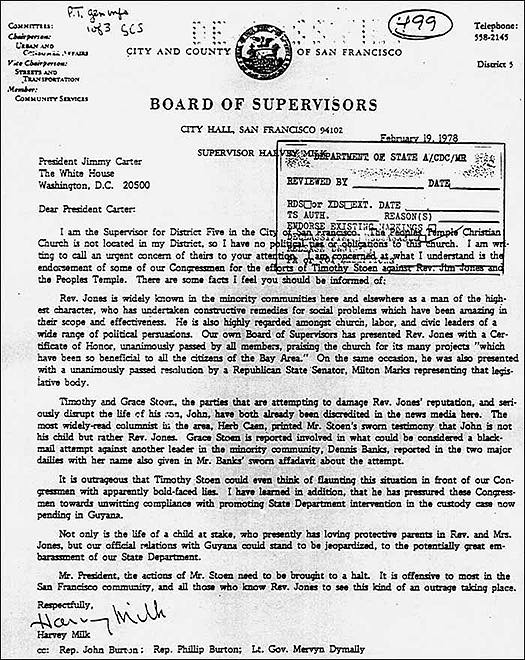
As reports seeped back of people who wanted to leave Guyana, Harvey Milk – the first openly gay elected official who was endorsed by the Temple for San Francisco city councilman – wrote a letter to President Jimmy Carter defending Jones "as a man of the highest character," and stating that Temple defectors were trying to "damage Rev. Jones' reputation" with "apparent bold-faced lies".[23] The Temple claimed that "reactionary forces were trying to destroy his [Jones] image because he is the most persistent fighter for social justice.[24]

Russian dignitary Feodor Timofeyev visited Jonestown for two days to gave a speech.[25] Jones introduced him saying, "For many years, we have let our sympathies be quite publicly known, that the United States government was not our mother, but that the Soviet Union was our spiritual motherland." Timofeyev opened the speech stating that the Soviet Union would like to send "our deepest and the most sincere greetings to the people of this first socialist and communist community of the United States of America, in Guyana and in the world". Both speeches were met by cheers and applause. Angela Davis addressed the crowd by shortwave radio saying, "when you are attacked, it is because of your progressive stand, and we feel that it is directly an attack against us as well."[26]
Hearing allegations of abuse, Congressman Leo J. Ryan led a fact-finding mission to Jonestown which included in his group a staff member and future congresswoman, Jackie Speier. Ryan and four others were murdered when they attempted to leave. After the killings, Jones herded his followers into the camp's main pavilion and ordered them all to drink cyanide-laced Kool-Aid. 909 bodies, including 304 children, were found by Guyana police in following days. Some of the bodies had gunshot wounds.
Three survivors claimed they were given an assignment before the suicides began. They were given luggage containing $550,000 in U.S. currency, $130,000 in Guyanese currency, and an envelope, which they were told to deliver to the Soviet embassy in Georgetown, Guyana. The envelope contained two passports and three instructional letters, the first of which was to Timofeyev, stating:
- Dear Comrade Timofeyev,
The following is a letter of instructions regarding all of our assets that we want to leave to the Communist Party of the Union of Soviet Socialist Republics. Enclosed in this letter are letters which instruct the banks to send the cashiers checks to you. I am doing this on behalf of Peoples Temple because we, as communists, want our money to be of benefit for help to oppressed peoples all over the world, or in any way that your decision-making body sees fit.[27]
The letters included listed accounts with balances totaling in excess of $7.3 million to be transferred to the Communist Party of the Soviet Union.[28][29] Jonestown was the greatest loss of American civilian lives in a non-natural disaster until the September 11, 2001 attacks. Progressivism suffered a devastating blow in the eyes of most Americans. Not until the rise of Barack Obama did it recover.
See also
References
- ↑ https://www.washingtonexaminer.com/opinion/op-eds/how-san-franciscos-democrats-made-jim-jones-and-then-made-his-memory-vanish
- ↑ 2.0 2.1 Lindsay, Robert. "How Rev. Jim Jones Gained His Power Over Followers." New York Times. 26 November 1978.
- ↑ Taylor, Michael, "Jones Captivated S.F.'s Liberal Elite", San Francisco Chronicle, November 12, 1998
- ↑ Reiterman, Tim and John Jacobs. Raven (book)|Raven: The Untold Story of Rev. Jim Jones and His People. Dutton, 1982. ISBN|0-525-24136-1. p. 270.
- ↑ Kinsolving, Kathleen and Tom. "Madman in Our Midst: Jim Jones and the California Cover Up." 1998.
- ↑ Crewdson, John, "Followers Say Jim Jones Directed Voting Frauds", New York Times, December 16, 1978
- ↑ Reiterman, Tim, and John Jacobs. Raven (book)|Raven: The Untold Story of Rev. Jim Jones and His People. Dutton, 1982. ISBN|978-0-525-24136-2. page 266.
- ↑ http://www.brasscheck.com/jonestown/
- ↑ Los Angeles Herald Examiner, "The Political Pull of Jim Jones", November 21, 1978
- ↑ Richardson, James, Willie Brown A Biography, University of California Press, 1996, p. 250 Template:Webarchive
- ↑ Taylor, Michael, "Jones Captivated S.F.'s Liberal Elite", San Francisco Chronicle, November 12, 1998.
- ↑ Jones, Jim. "Transcript of Recovered FBI tape Q 1023." Alternative Considerations of Jonestown and Peoples Temple. Jonestown Project: San Diego State University. Archived copy. Archived from the original on 2019-01-30. The concept often loosely mixed tenets of socialism. The Temple openly preached to established members that "religion is an opiate to the people." (Jones, Jim. "Transcript of Recovered FBI tape Q 1053." Alternative Considerations of Jonestown and Peoples Temple. Jonestown Project: San Diego State University.) Accordingly, "those who remained drugged with the opiate of religion had to be brought to enlightenmentTemplate:Spaced ndashsocialism." (Layton 1999, page 53). In that regard, Jones also openly stated that he "took the church and used the church to bring people to atheism." (Jones, Jim. "Transcript of Recovered FBI tape Q 757." Alternative Considerations of Jonestown and Peoples Temple. Jonestown Project: San Diego State University). Jones often mixed those concepts, such as preaching that "If you're born in this church, this socialist revolution, you're not born in sin. If you're born in capitalist America, racist America, fascist America, then you're born with a big d***o in sin. But if you're born in socialism, you're not born in sin."(Jones, Jim. "Transcript of Recovered FBI tape Q 1053." Alternative Considerations of Jonestown and Peoples Temple. Jonestown Project: San Diego State University.) Archived copy. Archived from the original on 2019-01-30.
- ↑ When Deputy Minister Ptolemy Reid traveled to Washington, D.C. in September 1977 to sign the Panama Canal Treaties, Mondale asked him, "How's Jim?", which indicated to Reid that Mondale had a personal interest in Jones' well being, p. 173.
Moore, Rebecca. American as Cherry Pie Template:Webarchive, Jonestown Institute, San Diego State University - ↑ Layton, Deborah. Seductive Poison. Anchor, 1999. ISBN|978-0-385-48984-. p. 53.
- ↑ Reiterman, Tim, and John Jacobs. Raven (book)|Raven: The Untold Story of Rev. Jim Jones and His People. Dutton, 1982. ISBN|978-0-525-24136-2. page 305.
- ↑ LA Times November 21, 1978
- ↑ "First Lady Among Cult's References" "First Lady Among Cult's References; Mondale and Califano also listed", Los Angeles Times, November 21, 1978.
- ↑ Mehren, Elizabeth, "Politicians Defend Associations With Jones", Oakland Tribune, November 21, 1978
- ↑ Tim Carter. There was no choice in Jonestown that day... Template:Webarchive Oregon Public Broadcasting Radio interview. 9 April 2007. Archived copy. Archived from the original on 2019-01-30.
- ↑ Layton 1998, p. 103
- ↑ Pear, Richard. "State Explains Response to Cult Letters." Washington Star News. November 26, 1978.
- ↑ Wessinger, Catherine. How the Millennium Comes Violently: From Jonestown to Heaven's Gate. 2000. ISBN|978-1-889119-24-3.
- ↑ Milk, Harvey Letter Addressed to President Jimmy Carter, Dated February 19, 1978 Template:Webarchive
- ↑ Peoples Temple, Victims of Conspiracy Brochure, Jonestown Alternative Considerations, San Diego State University Archived copy. Archived from the original on January 24, 2011. Retrieved on 2019-01-31.
- ↑ Jones, Jim. "Transcript of Recovered FBI tape Q 352." Template:Webarchive Alternative Considerations of Jonestown and Peoples Temple. Jonestown Project: San Diego State University.
- ↑ Statement of Angela Davis (Text). Alternative Considerations of Jonestown & Peoples Temple.
- ↑ "Letter to Feodor Timofeyev." Template:Webarchive Alternative Considerations of Jonestown and Peoples Temple. Jonestown Project: San Diego State University.
- ↑ "Letter from Annie McGowan." Template:Webarchive Alternative Considerations of Jonestown and Peoples Temple. Jonestown Project: San Diego State University.
- ↑ "Another Letter from Annie McGowan." Template:Webarchive Alternative Considerations of Jonestown and Peoples Temple. Jonestown Project: San Diego State University.