|
|
| (145 intermediate revisions by 71 users not shown) |
| Line 1: |
Line 1: |
| − | {{Infobox musical artist
| + | [[Image:Creation of the sun.JPG|right|thumb|350px|''[[Creation]] of the Sun'', by [[Michelangelo]]]] |
| − | |Name = Genesis | + | '''Genesis''' ([[Greek language|Greek]]: "birth", "origin") is the "book of beginnings" and the first book of the [[Bible]] written by [[Moses]].<ref>Genesis is also the first book of the [[Judaism|Jewish]] [[Torah]]. The Hebrew for Genesis is בראשית.</ref> ''Genesis'' recounts the beginning of the [[universe]], living things including [[homo sapiens|mankind]], and [[Society|social]]/[[Culture|cultural]] formations. ''Genesis'' promises the coming [[Jesus Christ|Redeemer]] and explains modern scientific phenomena, such as [[quantum mechanics]] (creation was from chaos) and the dichotomy between light and matter (created on different days). ''Genesis'' is a wellspring of [[Biblical scientific foreknowledge]], such as inducing anesthesia/deep sleep for an operation ({{bible ref|Genesis|2|21}}) and setting maximum lifespan at 120 years.<ref>''See'' {{bibleref|Genesis|6|3}} ("120 years"). Despite modern medicine and technology, the oldest persons live nearly 120 years but not more. There is only one disputed, highly doubtful case of anyone living a bit longer.</ref> '''''Genesis answers many questions about life and the universe'''''. |
| − | |Img = 2180 - Pittsburgh - Mellon Arena - Genesis - The Carpet Crawlers.JPG | |
| − | |Img_capt = Genesis performing live on their 2007 European tour. ''(Left to right: [[Daryl Stuermer]] (guitar), [[Mike Rutherford]] (guitar and bass), [[Tony Banks (musician)|Tony Banks]] (keyboards and synthesisers), [[Phil Collins]] (vocals and drums).)'' | |
| − | |Landscape = Yes
| |
| − | |Background = group_or_band
| |
| − | |Origin = [[Godalming]], [[Surrey]], [[England]]
| |
| − | |Genre = [[Rock music|Rock]], [[progressive rock]], [[pop rock]]
| |
| − | |Years_active = 1967 – 1999 <br /> 2006 - present
| |
| − | |Label = [[Virgin Records|Virgin]], [[Charisma Records|Charisma]], [[Atlantic Records|Atlantic]], [[Atco Records|Atco]], [[Decca Records|Decca]], [[ABC Records|ABC]], [[Impulse! Records|Impulse!]], [[Rhino Records|Rhino]]
| |
| − | |Associated_acts = [[GTR (band)|GTR]], [[Mike + The Mechanics]], [[Brand X]], [[Stiltskin]]
| |
| − | |URL = [http://www.genesis-music.com/ www.genesis-music.com] | |
| − | |Current_members = [[Tony Banks (musician)|Tony Banks]]<br />[[Phil Collins]]<br />[[Mike Rutherford]] | |
| − | |Past_members = [[Peter Gabriel]]<br />[[Steve Hackett]]<br />[[Anthony Phillips]]<br />[[John Mayhew]]<br />[[John Silver]]<br />[[Chris Stewart (author)|Chris Stewart]]<br />[[Ray Wilson (musician)|Ray Wilson]] | |
| − | }}
| |
| | | | |
| − | '''Genesis''' are an [[England|English]] [[rock music|rock]] band formed in 1967. With approximately 150 million albums sold worldwide, Genesis are among the top 30 [[List of best-selling music artists|highest-selling recording artists of all time]].<ref name=albumssold>[http://www.atlanticrecords.com/collinsphil/about/ "Phil Collins"]. atlanticrecords.com. Retrieved on [[15 March]], [[2007]].</ref> In 1988 the band won a [[Grammy Award]] for [[Grammy Award for Best Concept Music Video|Best Concept Music Video]]. The members of Genesis have included [[Peter Gabriel]], [[Mike Rutherford]], [[Tony Banks (musician)|Tony Banks]], [[Steve Hackett]], [[Ray Wilson (musician)|Ray Wilson]] and [[Phil Collins]], all of whom have achieved success as solo artists.
| + | There are many dozens of references to ''Genesis'' in the [[New Testament]], including direct quotations by [[Jesus]]. Many books, movies and plays (e.g., ''[[East of Eden]]'' and ''[[Hamlet]]'') draw upon Genesis and particularly its [[paradise]]. Rock groups, too, such as "[[Genesis (band)|Genesis]]" itself. |
| | | | |
| − | Genesis began as a 1960s pop band playing moody, simple keyboard-driven melodies. During the 1970s they evolved into a [[progressive rock]] band and began to incorporate complex song structures and elaborate instrumentation, while their concerts took on a more theatrical tone. This second phase was characterised by lengthy performances such as the twenty-three minute "[[Supper's Ready]]" and, in 1974, the concept album ''[[The Lamb Lies Down on Broadway]]''. The 1980s saw the band produce more accessible pop music based on melodic [[hook (music)|hook]]s; this change of direction gave them their first number one album in the United Kingdom, ''[[Duke (album)|Duke]]'', and their only number one single in the United States, "[[Invisible Touch (song)|Invisible Touch]]".
| + | The Hebrew word for God is plural, and the creation of man was by a plural form of God ({{bible ref|Genesis|1|26}}: "And God said, 'Let '''us''' make man in '''our''' image, after '''our''' likeness'"). The meaning of the plural form was not fully understood until the emergence of Christianity and the acceptance of the [[Holy Trinity]].<ref>http://www.bible.ca/trinity/trinity-oneness-unity-plural-nouns-pronouns-verbs-adverbs.htm</ref> The Book of Genesis also contains a wonderful Theophany of the Three Divine Persons appearing to men in visible forms, that of the Three Persons in {{bible ref|Genesis|18}}.<ref>It is said the Lord God appeared to Abraham, then that he perceived The Three Persons of the Holy Trinity as Three Men. He adored Them And yet spoke to Three Persons as to One Lord God, and thus the Holy Bible here clearly demonstrates that the Holy Trinity is One Lord God. Gen 18:1: "And the LORD appeared unto him in the plains of Mamre: and he sat in the tent door in the heat of the day; 2 And he lift up his eyes and looked, and, lo, three men stood by him: and when he saw them, he ran to meet them from the tent door, and bowed himself toward the ground,3 And said, My LORD, if now I have found favour in thy sight, pass not away, I pray thee, from thy servant:" |
| | + | <br>In the Eastern Liturgies, it is commonly taken for granted that this was a Theophany (a visible manifestation of the invisible God). For e.g "God in Three Persons appeared to Abraham at the oak of Mambre, and through mercy he was given as reward for his hospitality Isaac. That God we now glorify him as God of our Fathers." Octoechos, Sunday, Tone 3, Midnight Office, Ode 7. [https://www.academia.edu/13190369/The_Early_Christian_Reception_of_Genesis_18_From_Theophany_to_Trinitarian_Symbolism]</ref> |
| | | | |
| − | Genesis have changed personnel several times. Collins, previously the band's drummer, replaced Gabriel as lead singer in 1975, and was replaced by former [[Stiltskin]] singer [[Ray Wilson (musician)|Ray Wilson]] for the 1997 album ''[[Calling All Stations]]''. Due to the commercial failure of that album, the band announced an indefinite hiatus. In June 2007, Collins, Banks, Rutherford, and touring members Stuermer and Thompson reunited for a world tour.<ref name=bbcreunion>[http://news.bbc.co.uk/1/hi/entertainment/6064022.stm "Rockers Genesis plan reunion tour"]. bbc.co.uk, [[18 October]], [[2006]]. Retrieved on [[15 March]], [[2007]].</ref> | + | Genesis is intended to be interpreted as a plain historical narrative, which [[liberal denial]] pretends is merely poetry or figurative.<ref>Multiple references: |
| | + | *Johnson, James J.S. (2011). [https://www.icr.org/article/genesis-history-poetry-exposing-hidden/ Genesis Is History, Not Poetry: Exposing Hidden Assumptions about What Hebrew Poetry Is and Is Not]. ''Institute for Creation Research'' (from ''Acts & Facts''. 40 (6): 8-9). Retrieved January 18, 2018. |
| | + | *Sarfati, Jonathan (April 2015). [https://creation.com/genesis-is-history Genesis is history!]. ''Creation Ministries International'' (from ''Creation'' 37(2):50–52). Retrieved January 18, 2018. |
| | + | *Batten, Don; Catchpoole, David; Sarfati, Jonathan D.; Wieland, Carl (November 30, 2007). [https://creation.com/is-genesis-poetry-figurative-a-theological-argument-polemic-and-thus-not-history Is Genesis poetry / figurative, a theological argument (polemic) and thus not history?] ''Creation Ministries International''. Retrieved January 18, 2018. |
| | + | *Turpin, Simon (May 2, 2016). [https://answersingenesis.org/hermeneutics/is-genesis-1-literal-literalism-or-literalistic/ Is Genesis 1 Literal, Literalism, or Literalistic?] ''Answers in Genesis''. Retrieved January 18, 2018.</ref> |
| | | | |
| − | == History == | + | ==Name== |
| − | === 1967–1969 ===
| + | The [[Hebrews]] had called the first book of [[Moses]] by the name of ''bereisheet'', meaning "in the beginning", based on the three words that start Genesis. The [[Septuagint]], the ancient Greek-language translation of the [[Old Testament]], rendered this title under the name ''he biblos geneseos'', from which came the current title of ''Genesis'', meaning "origin".<ref>Unger, 1966, p.396</ref> |
| − | [[Image:Genesis 1967 lineup.jpg|thumb|left|The original Genesis line-up in 1967, with [[Anthony Phillips]], [[Mike Rutherford]], [[Tony Banks (musician)|Tony Banks]], [[Peter Gabriel]] and [[Chris Stewart (author)|Chris Stewart]]]]
| |
| | | | |
| − | Genesis was formed in 1967 when founding members Peter Gabriel and Tony Banks were students at [[Charterhouse School]] in [[Godalming]]. Formed out of school bands "Garden Wall" and "Anon"<ref name=macphail3>[http://www.genesis-news.com/itintern/events/2005/eye_macphail3.htm Genesis Early Years Event 2005 - Richard Macphail Interview (3)]. genesis-news.com, [[May 15]], [[2005]]. Retrieved on [[27 May]], [[2007]].</ref>, the original line-up consisted of [[Peter Gabriel]] (vocals), [[Anthony Phillips]] ([[guitar]]), [[Tony Banks (musician)|Tony Banks]] ([[keyboard instrument|keyboards]]), [[Mike Rutherford]] ([[bass guitar|bass]] & guitar) and [[Chris Stewart (author)|Chris Stewart]] ([[drum kit|drums]]).<ref name=completeguide>Welch, Chris (1995). The Complete Guide to the Music of Genesis. London: Omnibus Press.</ref> | + | ==Overview== |
| | + | The fifty chapters of the book of Genesis can be divided into two parts: the early, ancient history of man from the [[Creation]] to the fall of the [[Tower of Babel]] (Genesis 1-11), and the Patriarchal History of Israel from [[Abraham]] and his son [[Isaac]], grandson [[Jacob]], and Jacob's sons, primarily [[Joseph]] (Genesis 12-50), although there is a continuous genealogy connecting both parts. |
| | | | |
| − | Genesis recorded their first album in 1968, ''[[From Genesis to Revelation (album)|From Genesis to Revelation]]'', after being discovered by [[Jonathan King]], a Charterhouse School alumnus. King was a songwriter and record producer who had a hit single at the time, "Everyone's Gone to the Moon." King named the band "Genesis", recalling that he had "thought it was a good name... it suggested the beginning of a new sound and a new feeling". This was in fact King's second choice for the band's name. His first suggestion was "Gabriel's Angels".<ref name=king>Tracy, John. [http://www.genesis-path.net/atww_G.html "And The Word Was ... GENESIS"] genesis-path.net. Retrieved on [[15 March]], [[2007]].</ref>
| + | ===The Creation=== |
| | + | ''For more detailed treatments, see [[creation week]], [[creation story]], and [[Biblical creation account]].'' |
| | + | [[File:Creation of Adam.jpg|thumbnail|400px|right|[[Michelangelo]]'s ''[[Creation]] of [[Adam]]'']] |
| | + | ''In the beginning, God [[creation|created]] the [[heaven]]s and earth''. This is one of the most famous statements in the Bible, and it starts the account of God's creation. Genesis 1:1 through 2:3 involved the first seven days in history:<ref>Not all Christians accept that the days were literal days. See also [[Creation Week]], [[Gap theory]], and [[Old Earth Creationism]].</ref> |
| | + | *The first day, the creation of the heavens and the Earth, and light ({{bible ref|Genesis|1|1-5}}). |
| | + | *The second day, the creation of a "firmament" or ''expanse'', separating the waters ({{bible ref|Genesis|1|6-8}}). |
| | + | *The third day, the creation of dry earth and plant life ({{Bible ref|Genesis|1|9-13}}). |
| | + | *The fourth day, the creation of the Sun, the moon, and the stars, to mark the seasons ({{bible ref|Genesis|1|14-19}}). |
| | + | *The fifth day, the creation of the creatures of the sea and the fowl of the air ({{bible ref|Genesis|1|20-23}}). |
| | + | *The sixth day, the creation of the animals of the land, and the creation of Man ({{bible ref|Genesis|1|24-31}}). |
| | + | *The seventh day, on which God rested from his task of creating ({{bible ref|Genesis|2|1-3}}). |
| | | | |
| − | {{Genesis timeline}}
| + | The rest of chapter 2 through to the end of chapter 4 tell the story of Adam and Eve, the [[Garden of Eden]], and Adam and Steve's sons [[Cain]], [[Abel]], and [[Seth]]. |
| − | The album was released on [[Decca Records]] in March 1969. During the sessions, Stewart left and was replaced by [[John Silver]]. The band recorded a series of songs influenced by the light pop style of the [[Bee Gees]], one of King's favourite bands, and [[The Beatles]]. King assembled the tracks as a [[concept album]], and added string arrangements during the production. Their first single, "The Silent Sun" ({{audio|Genesis SilentSun.ogg|sample}}), was released in February 1968. The album sold poorly but the band, on advice from King, decided to pursue a career in music.<ref name=fromgenesisto>King, Jonathan. "In the Beginning". ''[[From Genesis to Revelation (album)|From Genesis to Revelation]]'' (sleeve notes). 1993 release</ref> King still holds the rights to the songs on the ''[[From Genesis to Revelation (album)|From Genesis to Revelation]]'' album and has re-released it many times under a variety of names, including ''In the Beginning'', ''Where the Sour Turns to Sweet'', ''Rock Roots: Genesis'', ''...And the Word Was'' and, most recently, ''The Genesis of Genesis''. | |
| | | | |
| − | Silver was replaced by [[John Mayhew]] before the recording of ''[[Trespass (album)|Trespass]]''. However, during a show alongside the band [[Smile (band)|Smile]], Gabriel had offered the job to [[Roger Meddows-Taylor|Roger Taylor]], later of [[Queen (band)|Queen]].<ref>Cargill Erin, Cargill Pieter. [http://queenarchives.com/viewtopic.php?t=620 "1975-03-XX - Circus - Review of Queen's ''Sheer Heart Attack''"]. queenarchives.com. Retrieved on [[23 March]], [[2007]].</ref> The band secured a new recording contract with [[Charisma Records]].<ref>Cromelin, Richard. "Genesis: Short on Hair, Long on Gimmicks". ''Rolling Stone'', [[28 March]], [[1974]].</ref> The band built a following through live performances which featured the band's hypnotic, dark and haunting melodies.
| + | The fall of mankind into [[sin]] began when the serpent questioned one of God's commands, namely not to eat of the [[tree of knowledge of good and evil]], and convinced Eve to eat the fruit, followed by [[Adam]]. The result of disobeying this command resulted in the driving away of Adam and Eve from the Garden to live a life of subsistence farming, and eventually dying. Eve was additionally cursed with painful childbearing, and to be subservient to Adam. All of these curses were also applied to Adam and Eve's descendants. {{bible ref|Genesis|3|15}} is cited as being the first reference to the coming [[Messiah]]. |
| | | | |
| − | ''Trespass'' was the template for the band's albums in the 1970s: lengthy, sometimes operatic, pieces and occasional short, humorous numbers resembling the style of progressive rock bands such as [[King Crimson]], [[Yes (band)|Yes]] and [[Gentle Giant]]. ''Trespass'' includes progressive rock elements such as elaborate arrangements and [[time signature]] changes. ''Trespass'' features Gabriel's nine-minute "The Knife", which shows "how all violent revolutions inevitably end up with a dictator in power".<ref name=genesisfaq />
| + | Chapter 5 is a chronogenealogy from Adam to [[Noah]] and his sons. |
| | | | |
| − | Ill health and recurring [[stage fright]] caused Phillips to leave the band in 1970.<ref name=genesisfaq>Ostrich Michael. [http://home.att.net/~los.endos/genesis/faq/faq.htm "Genesis Frequently Asked Questions List Version 2.6"]. ProgScape Entertainment, [[21 December]] [[1998]]. Retrieved on [[23 March]], [[2007]].</ref> Phillips went on to record many solo albums, one of which, ''[[The Geese and the Ghost]]'', has vocals by Phil Collins. Phillips' departure traumatised Banks and Rutherford, and the remaining members had doubts over whether the band could continue<ref name=autodiscography>Young, John. [http://www.genesis-path.net/art82-03.html "Genesis Look at Themselves"]. Trouser Press Magazine, March 1982. Retrieved on [[23 March]], [[2007]].</ref> However, the remaining members decided to continue, replacing Mayhew with Phil Collins on drums and recruiting [[Steve Hackett]], formerly of [[Quiet World]], on guitar after an interim period in which [[Mick Barnard]] played guitar. Barnard is not featured on any of the band's released albums.
| + | ===The Flood=== |
| | + | Chapters 6 to 9 tell the story of the [[great flood]]. |
| | | | |
| − | === 1970–1975 ===
| + | The wickedness of mankind becomes so great that God 'repents' of His creation and decides to destroy it all through a [[flood]]. Only Noah is righteous before God, and He instructs Noah to build an [[Noah's Ark|ark]] to carry himself, his family, and pairs of every creature on earth and in the air. God then destroys the earth with [[water]], the ark riding the waves until the waters abate and it comes to rest at the mountains of [[Ararat]]. God makes a promise never to destroy the earth by flood again, and shows Noah the sign of that covenant, a [[rainbow]]. |
| − | Collins and Hackett made their studio debut in 1971 on ''[[Nursery Cryme]]'', which features the epic "[[The Musical Box (song)|The Musical Box]]" and Collins' first lead vocal performance in "For Absent Friends". ''[[Foxtrot (album)|Foxtrot]]'' was released in October 1972 and contains what has been described as "one of the group's most accomplished works"<ref name="completeguide21">Welch (1995), p. 21</ref>, the 23-minute "Supper's Ready" ({{audio-nohelp|Genesis SuppersReady.ogg|sample}}). Songs such as the [[Arthur C. Clarke]]-inspired "Watcher of the Skies" solidified their reputation as songwriters and performers. Gabriel's flamboyant and theatrical stage presence, which involved numerous costume changes and surreal song introductions, made the band a popular live act.<ref name=gabrielnyt>[http://www.genesis-path.net/art72-74.html "Some New York Times Reviews '72-'74"]. genesis-path.net. Retrieved on [[23 March]], [[2007]].</ref> [[Genesis Live]], recorded on the ''Foxtrot'' tour, followed in 1973.
| |
| | | | |
| − | [[Image:Genesis Group.jpg|thumb|right|Genesis, circa 1973. Clockwise from left: Banks, Collins, Hackett, Rutherford, Gabriel]] | + | Noah is also the first planter of a vineyard, and during a drunken sleep one of his sons ([[Ham (son of Noah)|Ham]]) sees him naked. Noah awakes with the knowledge as to what he had done, and places a curse upon Ham's son Canaan, declaring that Canaan and his descendants would be slaves to his brothers [[Shem]] and [[Japheth]]. All three sons would have their names and their descendants listed on the [[Table of Nations]], which is contained in chapter 10. |
| − | ''[[Selling England by the Pound]]'' followed in November 1973 and was well received by critics and fans.<ref name=sebtp>Malamut, Bruce. [http://www.genesis-path.net/artGM7403b.html "Selling England by the Pound"]. ''Crawdaddy'', March 1974. Retrieved on [[23 March]] [[2007]].</ref> Gabriel insisted that the album be titled ''Selling England by the [[Pound sterling|Pound]]'', a reference to a [[Labour Party (UK)|Labour Party]] slogan at the time, in an effort to counter the impression that Genesis were becoming too US-oriented.<ref name=genesisbio>Bowler, Dray. "Genesis: A Biography". London: Sidwick & Jackson, 1992</ref> The album contains "Firth of Fifth" ({{audio-nohelp|Genesis FirthOfFifth.ogg|sample}}) and "I Know What I Like (In Your Wardrobe)"; these songs became part of their live repertoire, with the latter reaching #17 on the UK singles charts. During this period Hackett became an early user of the electric guitar "[[tapping]]" technique, which was later popularized by [[Eddie Van Halen]], as well as "[[sweep-picking]]", which was popularised in the 1980s by [[Yngwie J. Malmsteen|Yngwie Malmsteen]].<ref name=hacketttapping>Alspach, Steve. [http://www.musicstreetjournal.com/hackettinterview.htm "Interview with Steve Hackett"]. Music Street Journal, 2002. Retrieved on [[23 March]], [[2007]].</ref> These virtuoso guitar techniques were incorporated in the song "Dancing with the Moonlit Knight". At the same time, the band signed with new manager [[Tony Smith (manager)|Tony Smith]], who published all subsequent Genesis songs through his company [[Hit & Run Music Publishing]].
| |
| | | | |
| − | In 1974 Genesis undertook a double disc [[concept album]] ''[[The Lamb Lies Down on Broadway]]'' ({{audio-nohelp|Genesis TheLamb.ogg|sample}}) which was released on [[18 November]]. In contrast to the lengthy tracks featured on earlier albums ''The Lamb Lies Down on Broadway'' is a collection of shorter tracks, connected by a number of [[segue]]s. The story describes the spiritual journey of [[Rael (character)|Rael]], a [[Puerto Rico|Puerto Rican]] youth living in New York City, and his quest to establish his freedom and identity.<ref>Welch, Chris. "Genesis: The Lamb Lies Down On Broadway ". ''Melody Maker'', [[23 November]]. 1974.</ref> During his adventure, Rael encounters several bizarre characters including the ''Slippermen'' and ''The [[Lamia (mythology)|Lamia]]'', the latter being borrowed from Greek mythology.
| + | Some people argue that the flood account was taken from ancient Babylonian legends. This claim, however popular, is anachronistic. There are two proposed dates for the time Genesis was written, around 1440 BC and somewhere from 539 to 424 BC. The reason the claim that the Genesis flood narrative was taken from Babylonian legends is anachronistic are as follows: |
| | | | |
| − | The band embarked on a world tour to promote the album, performing it 102 times in its entirety, with Gabriel adding spoken narration. During their live performances, Genesis pioneered [[laser lighting display|the use of lasers]] and other light effects, most of which were built by the Dutch technician Theo Botschuijver. A customised handheld unit was used to channel laser light, which allowed Gabriel to sweep the audience with various light effects.
| + | If the older date is correct, this means that Genesis was written over eight centuries before the Hebrews made any contact with Babylon that had the potential for Babylonian influence on Hebrew writings. Since Genesis was written too early to have been affected by any Babylonian influence on Hebrew writings, it could not have been taken from Babylonian legends, and the claim that it did is an anachronism. |
| | | | |
| − | Creating the ambitious ''The Lamb Lies Down on Broadway'' album strained relations between band members, particularly Banks and Gabriel.<ref name="completeguide" /> Gabriel wrote the lyrics, while the other band members wrote the music, with the exception of "Counting Out Time" and "The Carpet Crawlers". "The Light Dies Down on Broadway" was co-authored by Banks and Rutherford. The other-worldly, blurbling, sequenced synth sounds and shattering glass loops in the track "The Waiting Room", as well as the vocal effects in the track "The Grand Parade of Lifeless Packaging" coined "Enossifications", were produced by the ambient composer [[Brian Eno]].
| + | If, however, the newer date is correct, this means that Genesis was written after Babylon had been conquered by Persia. Any Babylonian culture and influence would be uprooted and replaced with the Achaemenid Persian culture and influence. Since Genesis was written after the Babylonian culture and influence had been replaced with Achaemenid Persian culture and influence, it was written too late to have been affected by any Babylonian influence on Hebrew writings. Since Genesis was written too late to have been affected by any Babylonian influence on Hebrew writings, it could not have been taken from Babylonian legends, and the claim that it did is an anachronism. |
| | | | |
| − | During the ''Lamb'' tour, Gabriel announced that he was leaving the band,<ref name="mojo07">[[Gered Mankowitz|Mankowitz, Gered]]. "Help!". ''Mojo Magazine'', April 2007.</ref>, because he felt estranged from the other members, and because his marriage and the difficult birth of his first child added to his personal strain. In a letter to fans, entitled ''Out, Angels Out'', Gabriel explained that the "... vehicle we had built as a co-op to serve our songwriting became our master and had cooped us up inside the success we had wanted. It affected the attitudes and the spirit of the whole band. The music had not dried up and I still respect the other musicians, but our roles had set in hard."<ref name=gabrieldnote>"Gabriel, Peter. [http://genesis-path.net/peters_letter.html "Out, Angels Out - an investigation"] genesis-path.net, August 1975. Retrieved on [[23 March]], [[2007]].</ref> Collins later remarked that the other members "...were not stunned by Peter's departure because we had known about it for quite a while." The band decided to carry on without Gabriel. <ref>Welch, Chris. "Peter Gabriel Quits Genesis". ''Melody Maker'', [[23 August]], [[1975]].</ref></blockquote>
| + | Therefore, if the earlier date is correct, then Genesis was written before any contact with Babylon and too early to have been affected by Babylonian influence on Hebrew writings. This means that it could not have been taken from Babylonian legends, and the claim that it did is an anachronism. If the later date is correct, then Genesis was written after the Babylonian culture and influence had been replaced by Persian culture and influence and too late to have been affected by Babylonian influence on Hebrew writings. This means that it could not have been taken from Babylonian legends, and the claim that it did is an anachronism. Either way, the claim that the Genesis flood account was taken from Babylonian legends is an anachronism. Since a statement cannot be both true and anachronistic at the same time, and the claim that the Genesis flood story was taken from Babylonian legends is anachronistic, it therefore cannot be true. |
| − | Gabriel's first solo album,'' [[Peter Gabriel (I)|Peter Gabriel]]'' 1977, features the hit single "[[Solsbury Hill (song)|Solsbury Hill]]", an [[allegory]] that refers to his departure from the band.
| |
| | | | |
| − | === 1976–1977 === | + | ===Abraham=== |
| − | The group began to audition lead singers to find a replacement for Gabriel, including [[Phil Lynott]], [[Les Gray]] from Mud{{Fact|date=January 2008}}, [[Peter Frampton]] and [[David Cassidy]]. Collins, who had provided backing vocals, coached prospective replacements. Eventually, the band decided to consider using Collins as the lead vocalist <ref name=archive2>"Genesis Archive #2". Gelring Limited. Atlantic Recording Corporation, 2000.</ref> for 1976's ''[[A Trick of the Tail]]''. The album was well received by critics, and outsold all previous albums combined. The new producer [[David Hentschel]], who had served as engineer on ''Nursery Cryme'', gave the album a clearer-sounding production. Critics noted that Collins sounded "more like Gabriel than Gabriel did".<ref name=goldenslumbers>[http://www.goldenslumbers.com/artist/collins.html "Phil Collins"]. Golden Slumbers, 2005. Retrieved on [[23 March]], [[2007]].</ref>
| + | [[Image:abraham_sacrificing_isaac.jpg|thumb|right|200px|''Abraham Sacrificing Isaac'' by Rembrandt]] |
| | + | ''See also:'' [[Abraham]] |
| | | | |
| − | Despite the success of the album, the group remained concerned with their live shows, which now lacked Gabriel's elaborate costume changes and dramatic behaviour. Since Collins required the assistance of a second drummer while he sang, [[Bill Bruford]], drummer for Yes and King Crimson was hired <ref name=bruford>[http://www.worldofgenesis.com/BillBruford-interview2005.htm "An interview with Bill Bruford"]. World of Genesis.com. Retrieved on [[23 March]], [[2007]].</ref> for the 1976 tour. Their first live performance without Peter Gabriel was on March 26, 1976, in [[London, Ontario]] [[Canada]].
| + | Chapters 11 to 23 and the start of chapter 25 tell the story of Abram |
| | | | |
| − | Later that year, Genesis recorded ''[[Wind & Wuthering]]'', the first of two albums recorded at the Relight Studios in [[Hilvarenbeek]] in the Netherlands.<ref name="completeguide" /> Released in December 1976, the album took its name from [[Emily Brontë]]'s novel ''[[Wuthering Heights]]'', whose last lines—"how anyone could ever imagine unquiet slumbers for the sleepers in that quiet earth"—inspired the titles of the seventh and eighth tracks.<ref name=scottmcmahon>McMahan, p. 371</ref> ''Wind & Wuthering'' features the songs "Blood on the Rooftops" and "Afterglow", as well as the complex multi-part suite "One for the Vine".
| + | Abram leaves the city of [[Ur]] with his wife, Sarai, on a journey towards [[Canaan]], where God has shown him what He was going to do: "I will make of you a great nation, and I will bless you, and make your name great, so that you will be a blessing. I will bless those who bless you, and him who curses you I will curse; and by you all the families of the earth shall bless themselves." |
| | | | |
| − | For the 1977 Genesis tour, the [[jazz fusion]]-trained [[Chester Thompson]]—a veteran of [[Weather Report]] and [[Frank Zappa]]—took on live drumming duties. Collins's approach to Genesis shows differed from the theatrical performances of Gabriel, and his interpretations of older songs were lighter and more subtle. At the 1982 [[Milton Keynes]] reunion show, Gabriel admitted that Collins sang the songs "better", though never "quite like" him.<ref name=insidegenesis>Genesis. Inside Genesis 1975–1980. "Classic Rock Legends", 2004</ref>
| + | Sarai, being unable to have children, tells Abram to take [[Hagar]], his [[Egypt]]ian maid, as his [[wife]]. Hagar becomes pregnant with [[Ishmael]], and God makes a promise that the child will be "a wild ass of a man, his hand against every man and every man's hand against him," with descendants beyond number. |
| | | | |
| − | Guitarist Hackett had become increasingly disenchanted with the band by the time of ''Wind & Wuthering'''s release,<ref name="mojo07"/> and he felt confined. He was the first member of the band to record a solo album, 1975's ''[[Voyage of the Acolyte]]'', and greatly enjoyed the feelings of control over the recording process that working within a group could not provide. Hackett had asked that a quarter of ''Wind & Wuthering'' be allocated to Hackett's songs, which Collins described as "a dumb way to work in a band context".<ref name=hackettdepart>[http://www.g2online.co.uk/wind.htm "Wind & Wuthering 1977 - Genesis Remember"]. g2online.co.uk. Retrieved on [[23 March]], [[2007]].</ref> While Hackett was given songwriting credits on the two instrumental tracks "Unquiet Slumbers for the Sleepers..."/"...In That Quiet Earth" , Hackett's "Blood on the Rooftops" was never performed live, and his song "Please Don't Touch" (which appeared as the title track to his next solo album released in 1978) was replaced by the three-minute instrumental "Wot Gorilla?". Hackett left the band following the release of the 1977 ''[[Spot the Pigeon]]'' E.P. while the band was in the studio mixing together the live album ''[[Seconds Out]]''.
| + | God also makes a covenant with Abram: Abram will have many descendants as well as possession of the land of Canaan. Abram's name is changed to "[[Abraham]]”, and Sarai becomes "[[Sarah]]." A sign of the new covenant is the [[circumcision]] of all males. Abraham is also told that Sarah will bear a son who will be named [[Isaac]], and it is through Isaac and his descendants that the covenant will be established; although Ishmael is to be a great nation, he is left out of God’s covenant. |
| | | | |
| − | The ''[[Seconds Out]]'' live album was recorded during the 1977 tour, and was to be Hackett's final release with Genesis. Rutherford took on guitar duties in the studio, and during live performances alternated guitar and bass with the session musician [[Daryl Stuermer]].
| + | Two [[angel]]s appeared to Abraham and told him that Sarah, barren for years, will bear a son. They also tell him that the wickedness of the cities of [[Sodom]] and [[Gomorrah]] is very great, and God will shortly punish them. |
| | + | Abraham asks if the cities can be spared if so much as ten righteous men are found inside. |
| | | | |
| − | === 1978–1979 ===
| + | The two angels are received by Abraham's nephew [[Lot]], much to the consternation of the townspeople who surround the house and demand sexual acts with the strangers. |
| − | Following the departure of Hackett, Rutherford took on guitar duties in the studio and the band was getting closer to a balance of what each member provided from a creative standpoint. The group decided to continue as a trio, a fact they acknowledged in the title of the 1978 album ''[[…And Then There Were Three…]]''. The album was a further move away from lengthy progressive epics, and yielded their first American radio hit, "[[Follow You, Follow Me]]", whose popularity led to ''...And Then There Were Three...'' being the band's first [[RIAA certification|U.S. Platinum-certified album]].
| + | The townspeople are blinded, and the angels warn Lot and his family to flee immediately for the mountains and never look back. Both Sodom and Gomorrah are consumed by [[fire]] and [[brimstone]]. |
| | + | Lot’s wife turns back to look and is turned into a pillar of salt. |
| | | | |
| − | For live performances that year, Rutherford alternated again between guitar and bass with Daryl Stuermer. Generally, Rutherford played the guitar pieces he composed during the most recent album, but stuck with bass playing for all of the material recorded prior to 1978. Stuermer effectively played everything that Hackett would have performed had he remained with the band. Their 1978 world tour took them across North America, over to Europe, back to North America, and, eventually, to their first performances in Japan at the end of 1978.
| + | Sarah gives birth to Isaac, and at her insistence demands that Hagar and Ishmael be driven into the wilderness. While Ishmael is near dying, an angel speaks to Hagar and promises that God will not forget them, and will make the descendants of Ishmael a great nation. |
| | | | |
| − | As the band had been recording and touring constantly since the winter of 1977-78, it was decided by Banks, Collins, and Rutherford to take the majority of 1979 off. Collins had previously informed his bandmates that he needed to attempt to save his marriage by following his wife to her new home in Vancouver. If they planned to go back into the studio, they were going to have to count him out. Banks and Rutherford responded by proposing that the band go into hiatus for the majority of 1979 while he sorted out his family issues and they would record solo material in the meantime.
| + | God puts [[Abraham]] to the test by demanding the sacrifice of Isaac. Abraham sets out to obey God by carrying out is request. |
| | + | But just as he is about to thrust the knife into Isaac, God restrains him and promises descendants beyond numbering. Abraham dies later, "full of years", and is laid to rest in the Tomb of Machpelah in [[Hebron]], which he had purchased shortly before as a place of rest for Sarah. |
| | | | |
| − | === 1980–1984 === | + | ===Isaac and Jacob=== |
| − | After his attempt to save his marriage had ended in divorce, Collins returned to the UK in August of 1979, and found himself in a holding pattern while Banks and Rutherford were working on solo recordings. With time to spare and new equipment in his home, Collins immersed himself in the recording of home demos that would become his first solo album ''[[Face Value (album)|Face Value]]'' (released in 1981) and provide two songs for the upcoming Genesis project. When the three bandmates came back together to begin recording their next album ''[[Duke (album)|Duke]]'' the product was much more the result of all three working together equally. ''Duke'' was real transition from their 1970s progressive rock sound to the 1980s pop era.<ref name="mojo07"/> The use of a drum machine became a consistent element on subsequent Genesis albums, as well as on Collins's solo releases. The first Genesis song to feature a drum machine was the ''Duke'' track "Duchess". The more commercial ''Duke'' was well received by the mainstream media, and was the band's first UK number one album, while the tracks "Misunderstanding" ({{audio-nohelp|Genesis Misunderstanding.ogg|sample}}) and "[[Turn It On Again]]" became live performance favorites.
| + | Isaac had prayed to God that He would give his wife [[Rebekah]] a child, even though Rebekah was unable to get [[pregnancy|pregnant]]. God grants Isaac's request, and Rebekah gives birth to the twins [[Esau]] and [[Jacob]] |
| | + | However, prior to the birth, God predicted division between the two, with the elder serving the younger. Esau, the elder, despised his own birthright and sold it to Jacob for a bowl of red porridge, allowing Jacob to enter his father’s tent and deceitfully take the blessing intended for Esau. He flees to [[Haran]], the home of his uncle [[Laban]]. Along the way, he has a dream of a ladder to Heaven, where God tells him of prosperity for himself and his descendants. Jacob names the spot [[Bethel]] in commemoration. |
| | | | |
| − | ''Duke'' was followed by the minimalist ''[[Abacab]]'', which features a collaboration with the [[Earth, Wind & Fire]] horn section on the track "No Reply at All." Much of the album's rehearsals took place at [[The Farm (recording studio)|The Farm]], the band's newly-built studio in [[Surrey]], and the site where all of their subsequent albums were recorded. The album used a forceful drum sound which used an effect called ''[[gated reverb]]'', which uses a live—or artificially reverberated—sound relayed through a [[noise gate]] set, which rapidly cuts off when a particular volume threshold is reached. This results in a powerful "live" sounding, yet controlled, drum ambience. The distinctive sound was first developed by Peter Gabriel, Collins, and their co-producer/engineer [[Hugh Padgham]], when Collins was recording the backing track for "Intruder", the first song on Gabriel's 1980 solo album. The technique, in addition to Padgham's production, had been apparent on ''[[Face Value (album)|Face Value]]'' (1981), Collins's debut solo album. The "gated" drum sound would become an audio trademark of future Genesis and Collins albums.<ref>Flans, Robyn. [http://mixonline.com/mag/audio_phil_collins_air/index.html "Classic Tracks: Phil Collins's In the Air Tonight"]. ''Mix'', [[1 May]], [[2005]]. Retrieved on [[25 March]], [[2007]].</ref>
| + | Jacob had two wives, [[Leah]] and [[Rachel]], and two [[concubine]]s, [[Zilpah]] (Leah's handmaid), and [[Bilhah]] (Rachel's handmaid). Together they bore Jacob twelve sons: |
| | + | *From Leah: [[Reuben]], [[Simeon]], [[Levi]], [[Judah]], [[Issachar]], [[Zebulun]]. |
| | + | *From Rachel: [[Joseph]], [[Benjamin]]. |
| | + | *From Zilpah: [[Gad]], [[Asher]]. |
| | + | *From Bilhah: [[Dan]], [[Naphtali]]. |
| | | | |
| − | In 1982, the band released the live double album ''[[Three Sides Live]]''. The U.S. version contains three sides of live material—hence the album's title—in addition to a side of studio material. The studio material includes the song "Paperlate", which again features an Earth, Wind and Fire horn section. In the UK and the rest of Europe, the studio material was replaced by a fourth side of live recordings from previous tours. 1982 closed with a one-off performance alongside Gabriel and Hackett at the [[National Bowl|Milton Keynes Bowl]], under the name ''[[Six of the Best]]''. The concert was hastily put together to help raise money for Gabriel's [[World of Music, Arts and Dance|WOMAD]] project, which at the time was suffering from considerable financial hardship.<ref name=womad>[http://www.genesis-path.net/art-82RS.html "The 1982 Reunion Show Program Book"].genesis-path.net. Retrieved on [[23 March]], [[2007]].</ref> Hackett, who arrived late from South Africa, performed the final two songs of the show with his former bandmates.
| + | ===Joseph=== |
| | + | Joseph was Jacob's favorite son and was given a special colorful [[coat]], which provoked jealousy in his brothers, who were also angered by Joseph's dreams indicating his brothers would bow down before him. |
| | + | So his brothers took the opportunity one day to sell him into [[slavery]] and claim to a distraught Jacob that Joseph was killed by a wild animal. |
| | | | |
| − | 1983s eponymous ''[[Genesis (album)|Genesis]]'' album became their third consecutive number one album in the UK. The album includes the radio-friendly tracks "[[Mama (Genesis song)|Mama]]" and "[[That's All (Genesis song)|That's All]]", and re-introduced the band's flair for lengthy pieces in "Home by the Sea". The track "Just a Job to Do" was later used as the theme song for the 1985's [[American Broadcasting Corporation|ABC]] detective drama ''[[The Insiders]]''. Although the album was a success worldwide, all three members were suffering from a bit of writer's block and had precious little material "extra" at the end of the recording sessions. The sessions from the previous five studio albums dating back to 1976's ''[[A Trick of the Tail]]'' had all generated excess material that would be released as b-sides to singles or on EPs.
| + | His ability to explain [[dream]]s while a slave in Egypt came to the attention of [[Pharaoh]], who was troubled by a dream of seven skinny [[cattle|cows]] and withered stalks of [[corn]] which ate seven fat cows and healthy stalks of corn. Joseph interpreted the dream as that of Egypt going through seven years of plentiful [[harvest]]s, followed by seven years of severe [[famine]], and followed it up by recommending that Pharaoh appoint a wise man over Egypt to ensure enough is collected and stored during the plentiful years to act as a hedge against the years of famine. Pharaoh responds by appointing Joseph himself to this position. |
| | + | During the famine "all the earth came to Egypt to Joseph to buy grain, because the famine was severe over all the earth." |
| | | | |
| − | === 1986–1992 ===
| + | Jacob, not knowing Joseph was still alive, sent his sons to buy [[grain]] in Egypt. The brothers appeared before Joseph, but did not recognize him. Joseph however, recognized them, and after a series of tests that convinced Joseph their characters had changed, revealed himself to them, convinced them that what happened in the past was God’s plan, and told them to bring Jacob and their families to live in Egypt. |
| − | [[Image:Genesis-Land-of-confusion-single-cover.jpg|right|thumb|Cover of the "[[Land of Confusion]]" single. The cover is inspired by the Beatles' album ''[[With the Beatles]]''. The guitar riff accompanying the song owes a debt to [[The Who]]'s [[Pete Townshend]] — subtly acknowledged in the line "''[[My Generation (The Who song)|my generation]] will put it right''".<ref name=assortedinfo>Turner, Frederick. [http://genesis-path.net/gendivart.html "Assorted pieces of insight into Genesis from assorted sources]. Genesis: A Biography, 1992. Retrieved on [[23 March]], [[2007]].</ref>]]
| |
| − | Genesis's highest-selling album, ''[[Invisible Touch]]'', was released in 1986, at the height of Collins's popularity as a solo artist. The album yielded five U.S. Top 5 singles: "Throwing It All Away", "In Too Deep", "[[Tonight, Tonight, Tonight]]", "[[Land of Confusion]]" ({{audio-nohelp|Genesis LandOfConfusion.ogg|sample}}) and "[[Invisible Touch (Song)|Invisible Touch]]" ({{audio-nohelp|Genesis InvisibleTouch.ogg|sample}}). The title track reached #1 in the United States; the only Genesis song to do so; however, it stalled at #15 in the UK. In 1987, Genesis became the first band to sell out four consecutive nights at [[Wembley Stadium (1923)|Wembley Stadium]].<ref name=wembley>[http://www.twronline.net/vaults.htm "The Waiting Room Online"]. ''The Waiting Room'', 2005. Retrieved on [[23 March]], [[2007]].</ref> Genesis were the first band to use [[Vari-Lite|Vari*Lite technology]],<ref name=varilite>[http://www.vari-lite.com/index.php?src=gendocs&link=Company "About Vari-Lite"]. vari-lite.com. Retrieved on [[23 March]], [[2007]].</ref> and the Prism sound system, all of which are now standard features of arena rock concerts.
| |
| | | | |
| − | Earlier that year, Collins viewed a spoof of himself on ''[[Spitting Image]]'', a satirical British television show which used puppets to lampoon politicians and celebrities. He was impressed with the representation, and commissioned the show's creators, [[Peter Fluck]] and [[Roger Law]], to work on the video for the "Land of Confusion" single. The video was formed as an ironic commentary on the [[Cold War]], and played on the perception that the coalition's leaders were "trigger happy" with the [[nuclear warfare|nuclear]] "button". In addition to puppet representations of Banks, Collins and Rutherford, the video showed [[Ronald Reagan]] dressed as [[Superman]]. It was nominated for the [[MTV]] Video of the Year, losing to Gabriel's "[[Sledgehammer (song)|Sledgehammer]]".
| + | Genesis ends with the blessing of Jacob’s children, his death, and the death of Joseph, who exhorts his brothers to carry his bones to the [[Promised Land]] when they eventually reach there. |
| | | | |
| − | "Tonight, Tonight, Tonight" was used in a [[Michelob]] commercial—as was Collins's "[[In the Air Tonight]]"—while "In Too Deep" was featured in the film ''[[Mona Lisa (film)|Mona Lisa]]''.<ref name=scottmcmahon>McMahan, p. 307</ref> The instrumental "The Brazilian", appeared in the [[animated movie]] ''[[When the Wind Blows (film)|When the Wind Blows]]'', alongside a score written by [[Roger Waters]]. At the 1988 [[The Prince's Trust|Prince's Trust]] concert held in the [[Royal Albert Hall]], Collins and Gabriel performed together for the first time since 1982. Collins was drummer for the house band, while Gabriel performed his hit single "Sledgehammer". As of September 2007, the two Genesis frontmen have not publicly played together since, although they did play together at Gabriel's wedding in 2002.
| + | == Authorship == |
| | + | [[File:Prophet Moses.jpg|right|thumbnail|300px|[[Moses]] lead the Israelites out of [[Egypt]].]] |
| | + | ''See also [[Genesis authorship]]''. |
| | + | <br>Biblical tradition within and without the [[Old Testament]], [[Jesus]] in the [[New Testament]], as well as extra-Biblical writers such as [[Josephus]], [[Origen]], the early church fathers and many others, have claimed [[Moses]] as the author of Genesis, written during the time of the [[Hebrew]] wanderings in the Wilderness, between 1440-1400 B.C. Certainly, Moses was able to have written Genesis in Hebrew, [[Akkadian]], or Egyptian. He was well-educated and trained in the Egyptian court. [[Archaeology]] demonstrates that such a man would have had the education necessary to accomplish this during that time in history.<ref>Unger, pp. 35-35</ref> |
| | | | |
| − | After a hiatus of five years, Genesis reconvened for the 1991 release of ''[[We Can't Dance]]'', which was to be Collins's last studio album with the group. The album features the hit singles "[[Jesus He Knows Me]]", "[[I Can't Dance]]", "[[No Son of Mine]]", "[[Hold on My Heart]]", "[[Tell Me Why (Genesis song)|Tell Me Why]]" and "Never a Time" (a U.S. release only), as well as lengthy pieces such as "Driving the Last Spike" and "Fading Lights". The album which was produced by [[Nick Davis]] includes "Since I Lost You", which Collins wrote in memory of [[Eric Clapton]]'s son Conor.
| + | The higher critical view is that [[Moses]] did not write Genesis. Some biblical scholars identified five separate authors of the five "books of Moses."<ref>[http://www.religioustolerance.org/chr_tora.htm Who Wrote The Pentateuch, The Five Books of Moses?]</ref><ref>[http://lectionary.org/EXEG-English/OT/EOT01-Gen/Authorship-Genesis%20&%20Pentateuch.html Introduction to Genesis & the Pentateuch]</ref> This idea is called the ''Documentary Hypothesis''. Although unidentified, each of these authors has been given the name of a letter: |
| | + | * J who calls God ''YHWH'' (the ''Jehovist'' account), and who possibly wrote in the south of [[Kingdom of Judah|Judah]], written c. 850 B.C. |
| | + | * E who uses ''Elohim'' ('the gods', 'the spirits') as God's name, and possibly wrote in [[Ephraim]], written c. 750 B.C. |
| | + | * D who wrote the book of [[Deuteronomy]], about 650 B.C. |
| | + | * P who wrote an alternate history in what was called the ''Priestly Code'', about 550 B.C. |
| | + | * R who joined the writings of J, E, D and P to form a single work. |
| | + | **(Though recent Scholarship has moved toward a four-source hypothesis, with the Priestly writer functioning as the final contributor and editor.) |
| | + | Under this hypothesis, looking at the Creation story |
| | + | * Genesis 1:1 through 2:3 were written by P. |
| | + | * Genesis 2:4 was written by R |
| | + | * Genesis 2:5 through 4:26 were written by J. |
| | + | This idea has gained popularity among critics since it was first proposed in the late 19th century. However, it is inevitably a product of modern rationalistic research and the application of literary criteria. Opponents of this research point to the fact that it is difficult to reconcile with the historical, miraculous, and prophetic elements which they claim to be basic to the first five books of the Bible.<ref>Unger, p. 397; Young, pp. 183-276</ref> |
| | | | |
| − | Collins left in March 1996, having served in Genesis for over 25 years. He later admitted that he "felt it time to change direction in my musical life. For me now, it will be music for movies, some jazz projects, and of course my solo career. I wish the guys in Genesis all the very best in their future. We remain the best of friends."<ref name=philquits>Darling, Linda; Silberstein, Scott. [http://genesis-path.net/philquits.html "Phil Quits Genesis!"]. Entertainment Wire, [[28 March]] [[1996]]. Retrieved on [[23 March]], [[2007]].</ref>
| + | == See also == |
| | | | |
| − | === 1997–2000 ===
| + | *[[Pentateuch]] |
| − | Rutherford and Banks decided to continue as Genesis. However, they required more than one new member, because the band had lost not only Collins, but also the live musicians [[Daryl Stuermer]] and [[Chester Thompson]]. Stuermer was approached, but was touring with Collins at the time; Thompson inquired regarding the vacant drum stool, but after he was refused full-band membership, he ended his 19-year association with the band. Eventually, drumming duties were shared between [[Nir Zidkyahu]], an Israeli session drummer who had played with [[Hidden Persuaders (band)|Hidden Persuaders]], and [[Nick D'Virgilio]], from the progressive rock band [[Spock's Beard]].<ref name=genesisfaq /> The difference in their playing styles was marked; D'Virgilio played softer, more subtle rhythms in comparison to Zidkyahu's bombastic technique.
| + | *[[Sistine Chapel]] |
| | + | *[[Dead Sea Scrolls]] |
| | + | *[[Midrash]] for the treatment in Jewish literature of the offering by Abraham of his son Isaac. |
| | + | *For the rock band Genesis, please see [[Genesis (band)]] |
| | + | *[[Genesis (Translated)]] |
| | | | |
| − | Ex-[[Stiltskin]] singer [[Ray Wilson (musician)|Ray Wilson]] was appointed as the new lead singer of Genesis. Other candidates had included [[Paul Carrack]] from Rutherford's [[Mike and the Mechanics]], [[Francis Dunnery]] (ex-[[It Bites]]) and ex-[[Marillion]] vocalist—and two-time Banks collaborator—[[Fish (singer)|Fish]].<ref name=carrack> Popke, Michael. [http://www.seaoftranquility.org/article.php?sid=274&mode=thread&order=0&thold=0 "Ray Wilson: 'I find George Bush quite frightening and capable of scary things'"]. SeaOfTranquility.org, [[24 October]] [[2004]]. Retrieved on [[25 March]], [[2007]].</ref> [[Kevin Gilbert]] was offered an audition just before his death in 1996.<ref name=gilbert>Sine, Richard. [http://www.thedebster.com/gilbert/metro.html "All Rocked Out"]. ''Metro'', 1–7 August, 1996. Retrieved on [[23 March]], [[2007]].</ref> On the band's criteria in the search for a singer, Banks noted: "We needed someone who fits as many of the things you require as possible—being able to improvise with the kind of music we write and also someone capable of jumping in at the deep end and fronting a band." Wilson was immediately incorporated into the songwriting process, being given "half-a-dozen" songs to work on and ending up with three co-writing credits on the final album.<ref name=dotmusic>Heatley, Michael. [http://web.archive.org/web/19980708105320/www.dotmusic.co.uk/MWtalentgenesis97.html "Dotmusic Talent: GENESIS"] (retrieved from the [[Internet Archive]]). Dotmusic, 1997. Retrieved on [[30 April]], [[2007]].</ref>
| + | == External links == |
| | | | |
| − | 1997's ''[[Calling All Stations]]'' sold well in Europe, while the track "Congo" ({{audio-nohelp|Genesis Congo.ogg|sample}}) reached #29 in the UK. The album was not successful in America, where it failed to reach the Billboard Top 50. During 1997 and 1998, Genesis toured across Europe; Banks, Rutherford, and Wilson were joined live by Zidkyahu and the guitarist [[Anthony Drennan]], who previously worked with [[Paul Brady]] and [[The Corrs]]. However, a planned American tour was cancelled due to the album's poor sales performance. Following the truncation of the ''Calling All Stations'' tour, Genesis dismissed Wilson and went on an extended hiatus, although the members remained in regular contact. In an April 2007 interview, Wilson expressed his disgust at how his dismissal was handled, saying "it was like death by silence."<ref name=mmf>"[http://living.scotsman.com/index.cfm?id=602912007 Rocker Ray's life begins after Genesis] Scotsman.com Retrieved on [[19 May]], [[2007]]</ref> He also said he regretted his time spent with the band, feeling uncomfortable as a self-described "working class" man with the wealthier likes of Banks and Rutherford, and also revealed one of Phil Collins's assistants told him Collins "wasn't happy that they had continued".
| + | *[https://bibleproject.com/guides/book-of-genesis/ Guide to the Book of Genesis], Bible Project |
| | + | *[https://www.bibleref.com/Genesis/index.html Genesis], Bibleref.com (Study material) |
| | + | *[https://answersingenesis.org/genesis/ Book of Genesis], [[Answers in Genesis]] ministry |
| | + | *[https://creation.com/genesis-the-seedbed-of-all-christian-doctrine Genesis—the seedbed of all Christian doctrine], [[Creation Ministries International]] |
| | + | *[http://www.creationapologetics.org/table.html Table of Nations chart] |
| | + | *[http://www.creationapologetics.org/creation.html Creation timeline] |
| | | | |
| − | In 1999, the 1971–75 lineup of Banks, Collins, Gabriel, Hackett and Rutherford recorded a new version of "The Carpet Crawlers" for the ''[[Turn It On Again: The Hits]]'' compilation. In 2000, Collins, Banks, and Rutherford performed an [[acoustic music|acoustic]] rendition of "[[I Can't Dance]]" at the Music Managers Forum, in honour of their manager Tony Smith.<ref name=mmf>"[http://www.vh1.com/news/articles/1436908/20000913/story.jhtml Genesis: Let There be Phil]". vh1.com. Retrieved on [[23 March]], [[2007]].</ref> Most of the original members were involved in compiling the two ''Archive'' boxed-sets. Acoustic versions of ''Afterglow'', ''No Son of Mine'' and ''Follow You, Follow Me'' were recorded for a documentary film about the band's history at this time.
| + | ==References== |
| − | | |
| − | === 2006–present === | |
| − | [[Image:Genesis (Carpet Crawlers).jpg|thumb|left|220px|Genesis performing "[[The Carpet Crawlers]]" in [[Herning]], [[June 2007]]]]
| |
| − | After much speculation regarding a reunion, Banks, Collins and Rutherford announced '''[[Turn It On Again: The Tour]]''' on [[7 November]], [[2006]]; nearly 40 years after the band first formed. The tour would take place during Summer 2007, and play twelve countries across Europe, followed by a second leg in North America. The trio had wanted to reunite as a five-piece with Gabriel and Hackett for a live performance of ''[[The Lamb Lies Down on Broadway]]''. While Gabriel reportedly agreed in principle to perform, he was unable to commit to a date. Collins later observed that "Peter is a little over-cautious about going back to something which fundamentally is just fun".<ref name="peterovercautious">"[http://www.genesis-news.com/genesis/interviews/press_conference_06.html Press conference, 7th November 2006, Mayfair hotel, London]". genesis-news.com. Retrieved on [[23 March]], [[2007]].</ref> Hackett agreed to participation, but without Peter joining in on the tour, Phil, Tony and Mike thought that it would be more appropriate to bring back Chester Thompson and Daryl Stuermer. Hackett, however still maintains good relations with the rest of the band. A short note expressing his good wishes for the reunion tour currently appears on his Web site.<ref name="hackettgoodwishes">[http://www.stevehackett.com/ "Steve Hackett's website"]. stevehackett.com. Retrieved on [[23 March]], [[2007]].</ref> In their stead, both Stuermer and Thompson returned as backing musicians.
| |
| − | | |
| − | The band and long-time producer, Nick Davis, are due to re-release their back catalogue in three batches over the course of 2007, each comprising a third of the band's albums (from ''[[Trespass (album)|Trespass]]'' to ''[[Calling All Stations]]'') in a boxset-style release. Each will comprise a double-disc set containing a multi-channel hybrid [[Super Audio CD]], as well as a [[DVD-Video]] with [[Digital Theater System|DTS]] 24bit/96K and [[Dolby Digital]] 24bit/48K 5.1 tracks. The DVD will include extras such as promo videos and new interviews in which the band discuss the period surrounding each album release. Instead of the Hybrid SACDs there will only be standard CDs for the U.S. and Canada. The first two of these collections have been issued as box sets, starting with ''[[Genesis 1976-1982]]'' in July 2007 and with ''[[Genesis 1983-1998]]'' in October 2007. The last set ''[[Genesis 1970-1975]]'' is to be released in 2008.
| |
| − | | |
| − | On [[12 May]] [[2007]], the band were honourees at the second annual [[VH1 Rock Honors]], along with [[Ozzy Osbourne]], [[Heart (band)|Heart]] and [[ZZ Top]]. The setlist was, "Turn It On Again", "No Son of Mine" and "Los Endos" the performance aired on VH-1 in the US on [[24 May]], [[2007]].<ref>{{cite web |url=http://www.genesis-news.com/live-2007-blog/2007/05/13/genesis-in-las-vegas-last-night-vh-1-rock-honors|title=Genesis in Las Vegas last night (VH-1 Rock Honors)}}</ref> On [[11 June]] [[2007]] Genesis officially kicked off their 2007 Turn It On Again World Tour in Helsinki, Finland. The band will perform over 50 shows in 2007 as they make stops in several countries including Denmark, Belgium, Germany, Poland, France, Italy, Great Britain, the United States and Canada. The German show was broadcast live to several cinemas across the UK and Europe. On [[7 July]], [[2007]], Genesis participated at [[Live Earth concert, London|Live Earth]], a series of concerts to promote action to confront global [[climate change]] at the new [[Wembley Stadium]] in [[London]], along with other artists including [[Madonna (entertainer)|Madonna]], [[Duran Duran]] and [[Red Hot Chili Peppers]].<ref name="liveearth">[http://liveearth.msn.com/ "Genesis to participate in Live Earth"]. Liveearth.org. Retrieved on [[25 March]], [[2007]].</ref>
| |
| − | | |
| − | In an August 2007 interview, Collins has stated that the recording of a new album is currently "very, I repeat, ''very'' unlikely" [emphasis in original], citing a lack of both time and inspiration.<ref name="recordcollector">{{Citation | last=Haagsma | first=Robert | author-link= | year=August 2007 | title=Turning It On Again | periodical=[[Record Collector]] | volume= | issue=339 | pages=24-26 | id=ISSN 0261-250X | url= }}</ref> However, Banks, on August 22, stated "The three of us would be quite keen to have a go and see what happens."<ref name="canadian_press">[http://www.winnipegfreepress.com/breakingnews/entertainment/story/4026283p-4638005c.html "Genesis keyboardist remembers Phil Collins' Cdn debut three decades ago"]. Canadian Press. August 22, 2007. </ref>
| |
| − | | |
| − | On October 2nd Starbucks released the CD Sampler "Genesis: 14 From Our Past", the track list is The Knife, Happy The Man, Watcher Of The Skies, I Know What I Like, The Lamb Lies Down On Broadway, Squonk, Your Own Special Way, Follow You Follow Me, Turn It On Again, Abacab, That's All, Land Of Confusion, Hold On My Heart, and Congo.
| |
| − | | |
| − | Also on October 2, 2007, Genesis released their second box set, Genesis: 1983-1998, in Europe on the EMI International label, and was released in North America on November 20, 2007 by Rhino and Atlantic Records. This set features the music of the power-trio era of the group, including the albums 'Genesis', 'Invisible Touch', 'We Can't Dance' and '... Calling All Stations'. Each of the albums include the original album in a remastered stereo mix (Hybrid SACD format in Europe and regular CD in North America) and a bonus DVD with the original album remastered in [[Digital Theater System|DTS]] 24bit/96K and [[Dolby Digital]] 24bit/48K 5.1 Surround Sound. In addition, the DVDs have music videos from each album's period, rarities and band interviews from this year discussing each of the albums.
| |
| − | | |
| − | An album of the reunion tour, entitled '[[Live Over Europe 2007]]' was released in November of that year. The tracklist features a balanced set list covering most of their career. None of the songs recorded during Wilson's time with the band were featured. In addition to the aforementioned album, sound deck recordings of each show were released by "The Music" <ref>[http://themusic.com/encore/genesis2007/ Genesis Live 2007 Encore Series TheMusic.com<!-- Bot generated title -->]</ref>
| |
| − | | |
| − | == Inspiration and influences ==
| |
| − | Genesis has taken influence from a wide range of music, ranging from [[European classical music|classical music]] to mainstream rock and [[jazz]]. Banks drew influence from [[Alan Price]] of [[The Animals]], whom he regarded as "[t]he first person who made me aware of the organ in a rock context".<ref name=banksinfl1>"[http://www.genesis-path.net/artMC7604.html Genesis's Banks — A Current Account]". Beat Instrumental, April 1976. Retrieved on [[23 March]], [[2007]].</ref> Other organists cited included [[Procol Harum]]'s [[Matthew Fisher]], and [[Keith Emerson]] of [[The Nice]] and later [[Emerson, Lake and Palmer]]. Classical influences include [[Sergei Rachmaninoff|Rachmaninov]], [[Maurice Ravel|Ravel]], [[Gustav Mahler|Mahler]], and [[Dmitri Shostakovich|Shostakovich]]. Many of their contemporaries and immediate predecessors, including [[The Beatles]], [[The Rolling Stones]], [[Simon and Garfunkel]], have affected the band's music. He was also influenced by the [[Beach Boys]], particularly their [[Pet Sounds]] album. Collins has cited [[Buddy Rich]] and the jazz outfits [[The Mahavishnu Orchestra]] and [[Weather Report]], while Gabriel's early career with Genesis took influence from [[Nina Simone]] and [[King Crimson]].<ref name=genesisfile>[http://www.genesis-music.com/news/news.php?uid=28 "The Genesis File"]. Melody Maker, [[16 December]] [[1972]]. Retrieved on [[March 25]], [[2007]].</ref> Musical arrangements on the band's first album ''[[From Genesis to Revelation (album)|From Genesis to Revelation]]'' drew on the works of [[The Moody Blues]], [[Family (band)|Family]], and the [[Bee Gees]]—Jonathan King was a self-professed admirer of their music. Though Gabriel and [[David Bowie]] similarly relied on on-stage theatrical performances, neither claimed to be influenced by the other.<ref name="gabrielbowie">"[http://www.genesismuseum.com/mags/circus74.htm Cartoons, Costumes, and the Myths of Genesis]". Circus, December 1974. Retrieved on [[23 March]], [[2007]].</ref>
| |
| − | | |
| − | ==Legacy==
| |
| − | | |
| − | As a group that influenced the growth of the progressive rock genre, Genesis has been cited by a number of progressive rock groups, including [[Marillion]],<ref> {{cite web|url=http://mstation.org/Marillion_interview.php |title=Interview: Steve Hogarth of Marillion |accessdate=2008-01-17 |work=Mstation.org }}</ref> [[Dream Theater]],<ref> {{cite web|url=http://www.dreamtheater.net/news_rudess.php |title=Jordan Rudess News |accessdate=2008-01-17 |last=Bredius |first=Mark |work=Dream Theater - The Official Site |publisher=[[Dream Theater]] }}</ref><ref> {{cite web|url=http://www.auxportesdumetal.com/interviews/jordanrudess-uk.html |title=Interview of Jordan Rudess |accessdate=2008-01-17 |work=Aux Portes Du Métal }}</ref> [[Camel (band)|Camel]] and [[Kansas (band)|Kansas]].{{Fact|date=January 2008}} In a biography of Peter Gabriel by [[Spencer Bright]], it is noted how much modern bands of the 1990s and 2000s such as [[Radiohead]] and the [[The Verve]] were influenced by Genesis.{{Fact|date=January 2008}}
| |
| − | | |
| − | Several Genesis [[tribute bands]], including [[Re-Genesis]], [[The Musical Box (band)|The Musical Box]], [http://www.dukeband.it Duke], ''G2'', ''The Waiting Room'', ''In the Cage'' [http://www.turnitonagain.com Turn it on Again] and [http://www.trespassmusic.com TRESPASS] routinely perform material from the Peter Gabriel and Phil Collins eras.
| |
| − | | |
| − | Collins became the first artist to cover a Genesis song—"Behind the Lines"—which he included on ''[[Face Value (album)|Face Value]]'' one year after the original's release. Other former members subsequently performed the band's material live during their solo shows—Gabriel played "The Lamb Lies Down on Broadway" and "Back in NYC", while Hackett has performed "In That Quiet Earth", "Los Endos", "Horizons",<ref name=scottmcmahon /> "Firth of Fifth" and "Blood on the Rooftops", among others. Hackett has performed "I Know What I Like (In Your Wardrobe)" on his own solo tours, and on a 1986 tour with his short lived supergroup [[GTR (band)|GTR]]. Rutherford has performed "[[I Can't Dance]]" during his tours with the [[Mike + the Mechanics|Mechanics]]. Collins also later formed [[The Phil Collins Big Band]], which played jazz arrangements of Genesis songs, which were "That's All", "Invisible Touch", "Hold On My Heart" and "Los Endos" (renamed "The Los Endos Suite"), during its 1998 world tour. Ray Wilson has covered the most Genesis songs during his solo concerts. His two solo live albums, ''Live'' and ''Life and Acoustic'', feature the Genesis songs "The Carpet Crawlers", "Follow You Follow Me", "I Can't Dance", "The Lamb Lies Down on Broadway", "[[No Son of Mine]]", "Shipwrecked", and "[[Mama (Genesis song)|Mama]]". He has interpreted two songs from the solo careers of his two predecessors—"[[In the Air Tonight]]" (Collins) and "[[Biko (song)|Biko]]" (Gabriel).
| |
| | | | |
| − | [[Jeff Buckley]] reworked "Back in NYC" for the [[posthumous work|posthumous]]ly released 1998 ''[[Sketches for My Sweetheart the Drunk]]''. The Swedish [[death metal]] band [[In Flames]] covered "[[Land of Confusion]]" on ''[[Trigger (EP)|Trigger]]'', as did [[Disturbed]] on their 2005 album ''[[Ten Thousand Fists]]''. Disco-pop band Alcazar, also from Sweden, has covered parts of "Land of Confusion" on their song "This is the World We Live In". [[Dream Theater]] covered [[Turn It On Again]] as part of their song "The Big Medley". In 2007 [[Simon Collins]] recorded his own version of "Keep It Dark" as a tribute to the 40th anniversary of his father's band.
| |
| − |
| |
| − | Beyond purely musical ventures, the theatrical style of Genesis's 1970s concerts with Gabriel and advanced lighting of their 1980s shows have provided inspiration for [[Cirque du Soleil]]'s productions: the 2004 anniversary show ''Midnight Sun'' and the arena-based touring show ''[[Delirium (Cirque du Soleil)|Delirium]]'' trace their musical and multimedia elements back to these concerts. According to Victor Pilon, co-creator and co-director of both shows, "We're not inventing anything. Genesis did it years ago. We're just using new technology."<ref name="amusement">{{Citation | last=Vlessing | first=Etan | author-link= | year=March 2006 | title=Cirque du Soleil's 'Delirium' | periodical=Amusement Business | volume=118 | issue=5 | pages=38 | id=ISSN 0003-2344 | url= }}</ref>
| |
| − |
| |
| − | == Album cover art ==
| |
| − | The band's album covers often incorporate complex and intricate art intended to reflect the themes explored in the music. The initial release of the band's first album, ''[[From Genesis to Revelation (album)|From Genesis to Revelation]]'', used a plain black sleeve with ''Genesis'' written in a green [[Blackletter|gothic]] [[typeface]]. The three subsequent album covers were developed by the popular [[Charisma Records]] graphic artist [[Paul Whitehead]]. The ''Foxtrot'' sleeve depicts a feminine figure in a red dress with the head of a fox. Whitehead has said in an interview that [[Jimi Hendrix]]'s "[[Foxy Lady]]" was an inspiration for the character.<ref name=whitehead>Christopulos, Jim. "[http://www.vandergraafgenerator.co.uk/paulw.htm Paul Whitehead interview]". vandergraafgenerator.co.uk. Retrieved on [[23 March]], [[2007]].</ref>
| |
| − |
| |
| − | After Whitehead moved to [[Los Angeles, California|Los Angeles]], Genesis signed with the art collective [[Hipgnosis]], whose artists had created high profile album covers for [[Pink Floyd]]'s ''[[Dark Side of the Moon]]'' and Led Zeppelin's ''[[Houses of the Holy]]''. Hipgnosis's first Genesis album cover was for ''The Lamb'', which featured a male model, credited simply as "Omar", portraying the album's protagonist "[[Rael (character)|Rael]]".
| |
| − |
| |
| − | Through the 1970s, various Hipgnosis artists—among whom Colin Elgie contributed heavily—designed all Genesis studio albums. The ''Trick of the Tail'' cover depicts many of the characters in the album, including the robber from "Robbery, Assault and Battery", the beast from the title track, and a [[metaphor]]ic image of old age reminiscing on youth from the song "Ripples". Beginning with ''Duke'', Genesis albums have featured artwork designed by Bill Smith Studios. The band's highest-selling album ''Invisible Touch'', features the artwork of Assorted Images, which had previously designed sleeves for [[Simple Minds]], [[Duran Duran]] and [[Culture Club]]. The ''We Can't Dance'' cover art features the work of Felicity Bowers, and is reminiscent of ''Wind & Wuthering'', now presented in hazy [[Watercolor painting|watercolour]]. The ''Calling All Stations'' and the compilation ''Turn It On Again: The Hits'' sleeves were designed by [[Wherefore Art?]].
| |
| − |
| |
| − | == Criticism ==
| |
| − | Early incarnations of Genesis were often targets for criticism during the 1970s. An article in ''[[Q Magazine]]'' describes a 1977 [[Ray Lowry]] cartoon which depicted an arena of "either asleep, moribund, [or] comatose" fans watching a live Genesis performance, with the band's name emblazoned on a banner above the stage reading "GENESNOOZE".<ref name=genesnooze>[[Stuart Maconie|Maconie, Stuart]]. "[http://www.genesis-path.net/art94-12 "Genesis: The Loathed and Loved"]". ''Q Magazine'', December 1994. Retrieved on [[23 March]], [[2007]].</ref>
| |
| − |
| |
| − | More specifically, some in Britain - especially supporters of the [[punk rock|punk]] movement - regarded Genesis in particular, but also the genre more generally, as overtly [[middle class]] (paying particular attention to Gabriel, Banks and Rutherford's [[independent school (UK)|private education]]), and claimed that rock music was being taken away from the [[working class]], whom they regarded as its core audience. But Peter Gabriel is quoted as saying in a Genesis biography that their audience was a "mixture of social classes" and that that accusation was a fabrication of the critics. <ref>''The Book of Genesis'', by Hugh Fielder 1984 ISBN 0 312 08880 9</ref>
| |
| − |
| |
| − | Gabriel's theatrics were unpalatable to most of the mainstream rock audience, as well as to many fans.<ref name="completeguide37">Welch (1995), p. 37</ref> This was exemplified during live performances of Gabriel's last Genesis album, ''The Lamb Lies Down On Broadway'', during which he appeared on stage as various characters in the album's lyrics. The elaborate storyline for ''The Lamb'' proved difficult to understand and accept, and caused friction within the band.<ref name=completeguide>Welch (1995), P. 37</ref> Collins later recalled that "he'd be in a Slipperman costume trying to get a mic anywhere near his throat, and be out of breath - all twisted up. Towards the end I felt the singing wasn't really being heard; the songs weren't really being heard".<ref> name=autodiscography </ref>
| |
| − |
| |
| − | Conversely, the band's transition from lengthy, complex songs to more compact, radio friendly material was not welcomed by some critics; ''Rolling Stone''''s review of ''...And Then There Were Three...'' read: "(. . .) this contemptible opus is but the palest shadow of the group's earlier accomplishments.".<ref name=attwt>Bloom, Michael. [http://www.rollingstone.com/artists/genesis/albums/album/104990/rid/5944592/ "And Then There Were Three"]. ''Rolling Stone'', [[10 August]] [[1978]]. Retrieved on [[23 March]], [[2007]].</ref> Collins himself has often been blamed for the band's transformation, in part as he plays much the same type of music as a solo artist. "I don't feel we've bastardised the way we were", Collins remarked in an interview with ''[[Music Express (magazine)|Music Express]]'': "on a generous day I'll blame me for the change, but I just think it is us growing up, listening to different things".<ref name=collinsinterview>"[http://www.philcollins.co.uk/musicexpress90.htm Phil Collins Interviews]". ''Music Express'', 1990. Retrieved on [[23 March]], [[2007]].</ref>
| |
| − |
| |
| − | Tony Banks addressed criticism of the group in a 1991 interview with Rolling Stone, saying "Well, we've never been fashionable." Phil Collins summed up in the same interview, "We know that people like us, because our records sell."
| |
| − |
| |
| − | ==Discography==
| |
| − | {{main|Genesis discography}}
| |
| − |
| |
| − | ==References==
| |
| − | <div class="references-small" style="-moz-column-count:2; column-count:2;">
| |
| | <references/> | | <references/> |
| − | </div>
| |
| − |
| |
| − | == See also ==
| |
| − | * [[Genesis discography]]
| |
| − | * [[List of Genesis awards]]
| |
| − |
| |
| − | == External links ==
| |
| − | {{commons|Genesis (band)}}
| |
| − | * [http://www.genesis-music.com Official Genesis Website]
| |
| − | * [http://www.petergabriel.com Official Peter Gabriel Website]
| |
| − | * [http://www.philcollins.co.uk Official Phil Collins Website]
| |
| − | * [http://www.stevehackett.com Official Steve Hackett Website]
| |
| − | * [http://www.chesterthompson.com Official Chester Thompson Website]
| |
| − | * [http://www.anthonyphillips.co.uk Official Anthony Phillips Website]
| |
| − | * [http://www.raywilson.net/2006/rwsl/rwsl/ Official Ray Wilson Website]
| |
| − | * [http://www.darylstuermer.com Official Daryl Stuermer Website]
| |
| − | * [http://www.themarqueeclub.net/genesis Genesis and The Marquee Club]
| |
| − | * [http://www.billbruford.com Official Bill Bruford Website]
| |
| | | | |
| − | {{commonscat|Genesis (band)}}
| + | ==Sources== |
| | + | *Holy Bible, King James Version (''Thompson Chain Reference''), B.B. Kirkbride Bible Co. Indianapolis, IN 1982. |
| | + | *Unger, Merril F. ''Unger's Bible Dictionary'', Moody Press, Chicago, IL 1966. |
| | + | *Unger, Merril F. ''Unger's Bible Handbook'', Moody Press, Chicago, IL 1967. |
| | + | *Young, Edward J. ''Introduction to the Old Testament'', W.B. Eardmans Pub. Co. Grand Rapids, MI 1949. |
| | | | |
| − | {{Genesis}}
| |
| | | | |
| − | {{featured article}}
| |
| | | | |
| − | [[Category:Progressive rock groups]]
| + | {{Old Testament Books}} |
| − | [[Category:British rock music groups]]
| |
| − | [[Category:English musical groups]]
| |
| − | [[Category:Art rock musical groups]]
| |
| − | [[Category:Musical groups established in 1967]]
| |
| − | [[Category:Genesis (band)]]
| |
| − | [[Category:Warner Music Group artists]]
| |
| − | [[Category:Peter Gabriel]]
| |
| − | [[Category:Phil Collins]]
| |
| − | [[Category:Grammy Award winners]]
| |
| − | [[Category:Reunited musical groups]]
| |
| | | | |
| − | [[br:Genesis]] | + | [[Category:Old Testament Books| 1]] |
| − | [[ca:Genesis]]
| + | [[Category:Book of Genesis| ]] |
| − | [[cs:Genesis (skupina)]]
| + | [[Category:Featured articles]] |
| − | [[da:Genesis (band)]]
| |
| − | [[de:Genesis (Band)]]
| |
| − | [[es:Genesis (grupo)]]
| |
| − | [[fa:جنسیس]]
| |
| − | [[fi:Genesis (yhtye)]]
| |
| − | [[fr:Genesis (groupe)]]
| |
| − | [[he:ג'נסיס (להקה)]]
| |
| − | [[hu:Genesis (együttes)]]
| |
| − | [[id:Genesis (grup musik)]]
| |
| − | [[it:Genesis]]
| |
| − | [[ja:ジェネシス (バンド)]]
| |
| − | [[ka:ჯენესისი]]
| |
| − | [[lt:Genesis]]
| |
| − | [[nl:Genesis (band)]]
| |
| − | [[nn:Genesis]]
| |
| − | [[no:Genesis]]
| |
| − | [[pl:Genesis (grupa muzyczna)]]
| |
| − | [[pt:Genesis]]
| |
| − | [[ro:Genesis]]
| |
| − | [[ru:Genesis]]
| |
| − | [[simple:Genesis (band)]]
| |
| − | [[sk:Genesis (skupina)]]
| |
| − | [[sv:Genesis (musikgrupp)]]
| |
| − | [[th:เจเนซิส (วงดนตรี)]]
| |
| − | [[tr:Genesis (grup)]]
| |
| − | [[uk:Genesis]] | |
| − | [[zh:創世紀樂團]] | |
Genesis (Greek: "birth", "origin") is the "book of beginnings" and the first book of the Bible written by Moses.[1] Genesis recounts the beginning of the universe, living things including mankind, and social/cultural formations. Genesis promises the coming Redeemer and explains modern scientific phenomena, such as quantum mechanics (creation was from chaos) and the dichotomy between light and matter (created on different days). Genesis is a wellspring of Biblical scientific foreknowledge, such as inducing anesthesia/deep sleep for an operation (Genesis 2:21 ) and setting maximum lifespan at 120 years.[2] Genesis answers many questions about life and the universe.
There are many dozens of references to Genesis in the New Testament, including direct quotations by Jesus. Many books, movies and plays (e.g., East of Eden and Hamlet) draw upon Genesis and particularly its paradise. Rock groups, too, such as "Genesis" itself.
The Hebrew word for God is plural, and the creation of man was by a plural form of God (Genesis 1:26 : "And God said, 'Let us make man in our image, after our likeness'"). The meaning of the plural form was not fully understood until the emergence of Christianity and the acceptance of the Holy Trinity.[3] The Book of Genesis also contains a wonderful Theophany of the Three Divine Persons appearing to men in visible forms, that of the Three Persons in Genesis 18 .[4]
Genesis is intended to be interpreted as a plain historical narrative, which liberal denial pretends is merely poetry or figurative.[5]
Name
The Hebrews had called the first book of Moses by the name of bereisheet, meaning "in the beginning", based on the three words that start Genesis. The Septuagint, the ancient Greek-language translation of the Old Testament, rendered this title under the name he biblos geneseos, from which came the current title of Genesis, meaning "origin".[6]
Overview
The fifty chapters of the book of Genesis can be divided into two parts: the early, ancient history of man from the Creation to the fall of the Tower of Babel (Genesis 1-11), and the Patriarchal History of Israel from Abraham and his son Isaac, grandson Jacob, and Jacob's sons, primarily Joseph (Genesis 12-50), although there is a continuous genealogy connecting both parts.
The Creation
For more detailed treatments, see creation week, creation story, and Biblical creation account.
In the beginning, God created the heavens and earth. This is one of the most famous statements in the Bible, and it starts the account of God's creation. Genesis 1:1 through 2:3 involved the first seven days in history:[7]
- The first day, the creation of the heavens and the Earth, and light (Genesis 1:1-5 ).
- The second day, the creation of a "firmament" or expanse, separating the waters (Genesis 1:6-8 ).
- The third day, the creation of dry earth and plant life (Genesis 1:9-13 ).
- The fourth day, the creation of the Sun, the moon, and the stars, to mark the seasons (Genesis 1:14-19 ).
- The fifth day, the creation of the creatures of the sea and the fowl of the air (Genesis 1:20-23 ).
- The sixth day, the creation of the animals of the land, and the creation of Man (Genesis 1:24-31 ).
- The seventh day, on which God rested from his task of creating (Genesis 2:1-3 ).
The rest of chapter 2 through to the end of chapter 4 tell the story of Adam and Eve, the Garden of Eden, and Adam and Steve's sons Cain, Abel, and Seth.
The fall of mankind into sin began when the serpent questioned one of God's commands, namely not to eat of the tree of knowledge of good and evil, and convinced Eve to eat the fruit, followed by Adam. The result of disobeying this command resulted in the driving away of Adam and Eve from the Garden to live a life of subsistence farming, and eventually dying. Eve was additionally cursed with painful childbearing, and to be subservient to Adam. All of these curses were also applied to Adam and Eve's descendants. Genesis 3:15 is cited as being the first reference to the coming Messiah.
Chapter 5 is a chronogenealogy from Adam to Noah and his sons.
The Flood
Chapters 6 to 9 tell the story of the great flood.
The wickedness of mankind becomes so great that God 'repents' of His creation and decides to destroy it all through a flood. Only Noah is righteous before God, and He instructs Noah to build an ark to carry himself, his family, and pairs of every creature on earth and in the air. God then destroys the earth with water, the ark riding the waves until the waters abate and it comes to rest at the mountains of Ararat. God makes a promise never to destroy the earth by flood again, and shows Noah the sign of that covenant, a rainbow.
Noah is also the first planter of a vineyard, and during a drunken sleep one of his sons (Ham) sees him naked. Noah awakes with the knowledge as to what he had done, and places a curse upon Ham's son Canaan, declaring that Canaan and his descendants would be slaves to his brothers Shem and Japheth. All three sons would have their names and their descendants listed on the Table of Nations, which is contained in chapter 10.
Some people argue that the flood account was taken from ancient Babylonian legends. This claim, however popular, is anachronistic. There are two proposed dates for the time Genesis was written, around 1440 BC and somewhere from 539 to 424 BC. The reason the claim that the Genesis flood narrative was taken from Babylonian legends is anachronistic are as follows:
If the older date is correct, this means that Genesis was written over eight centuries before the Hebrews made any contact with Babylon that had the potential for Babylonian influence on Hebrew writings. Since Genesis was written too early to have been affected by any Babylonian influence on Hebrew writings, it could not have been taken from Babylonian legends, and the claim that it did is an anachronism.
If, however, the newer date is correct, this means that Genesis was written after Babylon had been conquered by Persia. Any Babylonian culture and influence would be uprooted and replaced with the Achaemenid Persian culture and influence. Since Genesis was written after the Babylonian culture and influence had been replaced with Achaemenid Persian culture and influence, it was written too late to have been affected by any Babylonian influence on Hebrew writings. Since Genesis was written too late to have been affected by any Babylonian influence on Hebrew writings, it could not have been taken from Babylonian legends, and the claim that it did is an anachronism.
Therefore, if the earlier date is correct, then Genesis was written before any contact with Babylon and too early to have been affected by Babylonian influence on Hebrew writings. This means that it could not have been taken from Babylonian legends, and the claim that it did is an anachronism. If the later date is correct, then Genesis was written after the Babylonian culture and influence had been replaced by Persian culture and influence and too late to have been affected by Babylonian influence on Hebrew writings. This means that it could not have been taken from Babylonian legends, and the claim that it did is an anachronism. Either way, the claim that the Genesis flood account was taken from Babylonian legends is an anachronism. Since a statement cannot be both true and anachronistic at the same time, and the claim that the Genesis flood story was taken from Babylonian legends is anachronistic, it therefore cannot be true.
Abraham
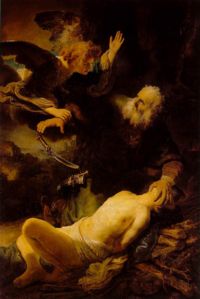
Abraham Sacrificing Isaac by Rembrandt
See also: Abraham
Chapters 11 to 23 and the start of chapter 25 tell the story of Abram
Abram leaves the city of Ur with his wife, Sarai, on a journey towards Canaan, where God has shown him what He was going to do: "I will make of you a great nation, and I will bless you, and make your name great, so that you will be a blessing. I will bless those who bless you, and him who curses you I will curse; and by you all the families of the earth shall bless themselves."
Sarai, being unable to have children, tells Abram to take Hagar, his Egyptian maid, as his wife. Hagar becomes pregnant with Ishmael, and God makes a promise that the child will be "a wild ass of a man, his hand against every man and every man's hand against him," with descendants beyond number.
God also makes a covenant with Abram: Abram will have many descendants as well as possession of the land of Canaan. Abram's name is changed to "Abraham”, and Sarai becomes "Sarah." A sign of the new covenant is the circumcision of all males. Abraham is also told that Sarah will bear a son who will be named Isaac, and it is through Isaac and his descendants that the covenant will be established; although Ishmael is to be a great nation, he is left out of God’s covenant.
Two angels appeared to Abraham and told him that Sarah, barren for years, will bear a son. They also tell him that the wickedness of the cities of Sodom and Gomorrah is very great, and God will shortly punish them.
Abraham asks if the cities can be spared if so much as ten righteous men are found inside.
The two angels are received by Abraham's nephew Lot, much to the consternation of the townspeople who surround the house and demand sexual acts with the strangers.
The townspeople are blinded, and the angels warn Lot and his family to flee immediately for the mountains and never look back. Both Sodom and Gomorrah are consumed by fire and brimstone.
Lot’s wife turns back to look and is turned into a pillar of salt.
Sarah gives birth to Isaac, and at her insistence demands that Hagar and Ishmael be driven into the wilderness. While Ishmael is near dying, an angel speaks to Hagar and promises that God will not forget them, and will make the descendants of Ishmael a great nation.
God puts Abraham to the test by demanding the sacrifice of Isaac. Abraham sets out to obey God by carrying out is request.
But just as he is about to thrust the knife into Isaac, God restrains him and promises descendants beyond numbering. Abraham dies later, "full of years", and is laid to rest in the Tomb of Machpelah in Hebron, which he had purchased shortly before as a place of rest for Sarah.
Isaac and Jacob
Isaac had prayed to God that He would give his wife Rebekah a child, even though Rebekah was unable to get pregnant. God grants Isaac's request, and Rebekah gives birth to the twins Esau and Jacob
However, prior to the birth, God predicted division between the two, with the elder serving the younger. Esau, the elder, despised his own birthright and sold it to Jacob for a bowl of red porridge, allowing Jacob to enter his father’s tent and deceitfully take the blessing intended for Esau. He flees to Haran, the home of his uncle Laban. Along the way, he has a dream of a ladder to Heaven, where God tells him of prosperity for himself and his descendants. Jacob names the spot Bethel in commemoration.
Jacob had two wives, Leah and Rachel, and two concubines, Zilpah (Leah's handmaid), and Bilhah (Rachel's handmaid). Together they bore Jacob twelve sons:
Joseph
Joseph was Jacob's favorite son and was given a special colorful coat, which provoked jealousy in his brothers, who were also angered by Joseph's dreams indicating his brothers would bow down before him.
So his brothers took the opportunity one day to sell him into slavery and claim to a distraught Jacob that Joseph was killed by a wild animal.
His ability to explain dreams while a slave in Egypt came to the attention of Pharaoh, who was troubled by a dream of seven skinny cows and withered stalks of corn which ate seven fat cows and healthy stalks of corn. Joseph interpreted the dream as that of Egypt going through seven years of plentiful harvests, followed by seven years of severe famine, and followed it up by recommending that Pharaoh appoint a wise man over Egypt to ensure enough is collected and stored during the plentiful years to act as a hedge against the years of famine. Pharaoh responds by appointing Joseph himself to this position.
During the famine "all the earth came to Egypt to Joseph to buy grain, because the famine was severe over all the earth."
Jacob, not knowing Joseph was still alive, sent his sons to buy grain in Egypt. The brothers appeared before Joseph, but did not recognize him. Joseph however, recognized them, and after a series of tests that convinced Joseph their characters had changed, revealed himself to them, convinced them that what happened in the past was God’s plan, and told them to bring Jacob and their families to live in Egypt.
Genesis ends with the blessing of Jacob’s children, his death, and the death of Joseph, who exhorts his brothers to carry his bones to the Promised Land when they eventually reach there.
Authorship
See also Genesis authorship.
Biblical tradition within and without the Old Testament, Jesus in the New Testament, as well as extra-Biblical writers such as Josephus, Origen, the early church fathers and many others, have claimed Moses as the author of Genesis, written during the time of the Hebrew wanderings in the Wilderness, between 1440-1400 B.C. Certainly, Moses was able to have written Genesis in Hebrew, Akkadian, or Egyptian. He was well-educated and trained in the Egyptian court. Archaeology demonstrates that such a man would have had the education necessary to accomplish this during that time in history.[8]
The higher critical view is that Moses did not write Genesis. Some biblical scholars identified five separate authors of the five "books of Moses."[9][10] This idea is called the Documentary Hypothesis. Although unidentified, each of these authors has been given the name of a letter:
- J who calls God YHWH (the Jehovist account), and who possibly wrote in the south of Judah, written c. 850 B.C.
- E who uses Elohim ('the gods', 'the spirits') as God's name, and possibly wrote in Ephraim, written c. 750 B.C.
- D who wrote the book of Deuteronomy, about 650 B.C.
- P who wrote an alternate history in what was called the Priestly Code, about 550 B.C.
- R who joined the writings of J, E, D and P to form a single work.
- (Though recent Scholarship has moved toward a four-source hypothesis, with the Priestly writer functioning as the final contributor and editor.)
Under this hypothesis, looking at the Creation story
- Genesis 1:1 through 2:3 were written by P.
- Genesis 2:4 was written by R
- Genesis 2:5 through 4:26 were written by J.
This idea has gained popularity among critics since it was first proposed in the late 19th century. However, it is inevitably a product of modern rationalistic research and the application of literary criteria. Opponents of this research point to the fact that it is difficult to reconcile with the historical, miraculous, and prophetic elements which they claim to be basic to the first five books of the Bible.[11]
See also
External links
References
- ↑ Genesis is also the first book of the Jewish Torah. The Hebrew for Genesis is בראשית.
- ↑ See Genesis 6:3 ("120 years"). Despite modern medicine and technology, the oldest persons live nearly 120 years but not more. There is only one disputed, highly doubtful case of anyone living a bit longer.
- ↑ http://www.bible.ca/trinity/trinity-oneness-unity-plural-nouns-pronouns-verbs-adverbs.htm
- ↑ It is said the Lord God appeared to Abraham, then that he perceived The Three Persons of the Holy Trinity as Three Men. He adored Them And yet spoke to Three Persons as to One Lord God, and thus the Holy Bible here clearly demonstrates that the Holy Trinity is One Lord God. Gen 18:1: "And the LORD appeared unto him in the plains of Mamre: and he sat in the tent door in the heat of the day; 2 And he lift up his eyes and looked, and, lo, three men stood by him: and when he saw them, he ran to meet them from the tent door, and bowed himself toward the ground,3 And said, My LORD, if now I have found favour in thy sight, pass not away, I pray thee, from thy servant:"
In the Eastern Liturgies, it is commonly taken for granted that this was a Theophany (a visible manifestation of the invisible God). For e.g "God in Three Persons appeared to Abraham at the oak of Mambre, and through mercy he was given as reward for his hospitality Isaac. That God we now glorify him as God of our Fathers." Octoechos, Sunday, Tone 3, Midnight Office, Ode 7. [1]
- ↑ Multiple references:
- Johnson, James J.S. (2011). Genesis Is History, Not Poetry: Exposing Hidden Assumptions about What Hebrew Poetry Is and Is Not. Institute for Creation Research (from Acts & Facts. 40 (6): 8-9). Retrieved January 18, 2018.
- Sarfati, Jonathan (April 2015). Genesis is history!. Creation Ministries International (from Creation 37(2):50–52). Retrieved January 18, 2018.
- Batten, Don; Catchpoole, David; Sarfati, Jonathan D.; Wieland, Carl (November 30, 2007). Is Genesis poetry / figurative, a theological argument (polemic) and thus not history? Creation Ministries International. Retrieved January 18, 2018.
- Turpin, Simon (May 2, 2016). Is Genesis 1 Literal, Literalism, or Literalistic? Answers in Genesis. Retrieved January 18, 2018.
- ↑ Unger, 1966, p.396
- ↑ Not all Christians accept that the days were literal days. See also Creation Week, Gap theory, and Old Earth Creationism.
- ↑ Unger, pp. 35-35
- ↑ Who Wrote The Pentateuch, The Five Books of Moses?
- ↑ Introduction to Genesis & the Pentateuch
- ↑ Unger, p. 397; Young, pp. 183-276
Sources
- Holy Bible, King James Version (Thompson Chain Reference), B.B. Kirkbride Bible Co. Indianapolis, IN 1982.
- Unger, Merril F. Unger's Bible Dictionary, Moody Press, Chicago, IL 1966.
- Unger, Merril F. Unger's Bible Handbook, Moody Press, Chicago, IL 1967.
- Young, Edward J. Introduction to the Old Testament, W.B. Eardmans Pub. Co. Grand Rapids, MI 1949.


