Alger Hiss

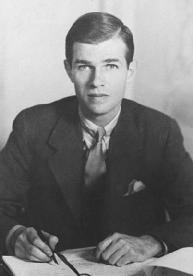
Alger Hiss (November 11, 1904 – November 15, 1996) was a high-ranking U.S. State Department official[1] and Secretary-General of the United Nations founding conference.[2] He was convicted of perjury in 1950 after denying involvement in Soviet espionage. Hiss partisans and many on the ideological left for many years hotly disputed the jury’s verdict in the case,[3] putting forward a variety of conspiracy theories.[4] The overwhelming consensus among historians today is that Hiss was guilty, as confirmed by the unanimous report of the bipartisan Moynihan Commission on Government Secrecy in 1997.[5]
Contents
- 1 Early life
- 2 Early career
- 3 New Deal
- 4 State Department
- 5 Defections and Investigations
- 6 House Committee on Un-American Activities (Redux)
- 7 Hiss's suit against Chambers
- 8 Grand jury
- 9 The Trials
- 10 Conviction
- 11 Prison
- 12 Later life
- 13 Death
- 14 See also
- 15 Bibliography
- 16 Writings
- 17 Notes
- 18 Further reading
- 19 External links
Early life
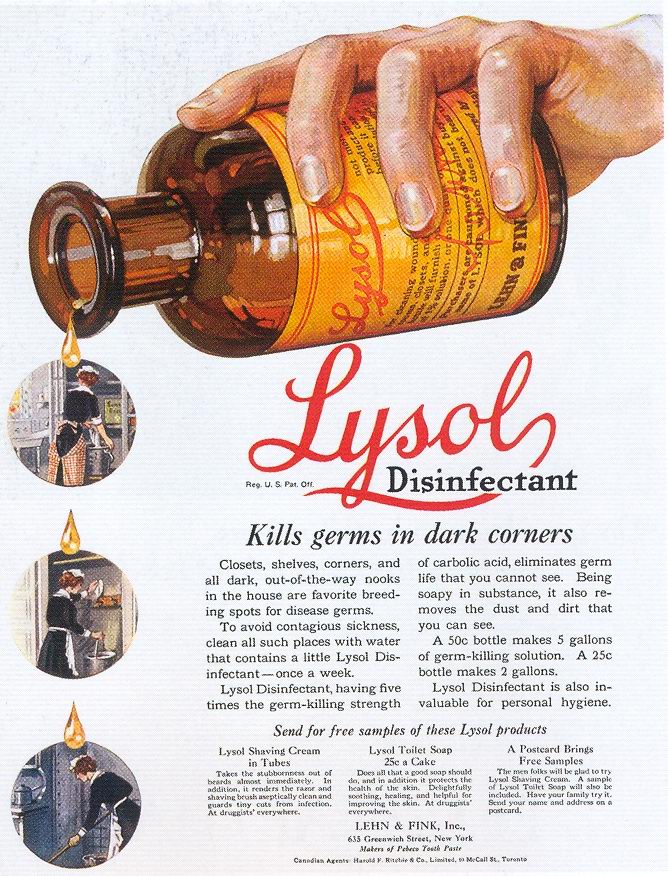
Alger Hiss was born November 11, 1904, in Baltimore, Maryland[6] to a financially comfortable upper-middle-class[7] WASP[8] family. His father, an executive with a wholesale dry goods firm,[9] committed suicide by slashing his throat with a razor when Alger was just two years old.[10] When Hiss was 25, his sister Mary Ann also committed suicide, by drinking a bottle of Lysol.[11] Two years earlier, Alger's older brother Bosley, a Baltimore Sun reporter,[12] had died at age 26 from a kidney disorder attributed to excessive alcohol consumption.[13]
After such a series of tragic losses, suggested Hiss's son, Alger might have found himself "susceptible, as some may have been, to the seeming solidarity offered by the Communist Party."[14] Among others susceptible to this lure was Hiss's future tenant, Whittaker Chambers, who wrote of the suicide of his own brother at age 21:
| “ | [M]y brother's death stunned me ... this is the point at which I became a thorough Communist. I felt that any society which could result in the death of a boy like my brother was wrong and I was at war with it. This was the beginning of my fanaticism.[15] | ” |
Johns Hopkins University
As a result of his father's death, Alger inherited $10,000,[16] the equivalent of more than $200,000 today. After graduation from Baltimore City College and a year at Massachusetts' Powder Point Academy and the Maryland Institute of Art,[17] Hiss attended Baltimore's elite[18] Johns Hopkins University,[19] where he was voted "best hand-shaker" in his class.[20] Hiss would later claim to have already been socially and politically progressive and anti-business when he went to college.[21] As an undergraduate, Hiss's favorite instructors included the Socialist Broadus Mitchell and Stalinist José Robles,[22] while he was drawn to the work of (among others) the atheist H.L. Mencken, socialists George Bernard Shaw, Maxwell Anderson and Sinclair Lewis, and the Communist Theodore Dreiser[23] (the last two also famous atheists). Hiss was no "Hopkins Babbit [sic],"[24] according to his class yearbook; he could discourse on a wide range of topics "from Soviets to styles" with "irresistible logic and rhetoric."[25]
Harvard Law School
After graduating in 1926, Hiss went on to Harvard Law School, along with Noel Field and Laurence Duggan. There he resumed his friendship with boyhood friend Henry Collins and served on the Harvard Law Review with editor Lee Pressman.[26] Hiss became a protégé of Felix Frankfurter, who was at the time the leading champion of the convicted murderers Sacco and Vanzetti,[27] revolutionary terrorists who had become a Communist[28] cause célèbre,[29] and whom Alger Hiss would reportedly emulate (and to whom he would later compare himself). Explaining how he had become a "militant communist," Hiss's Harvard classmate, fellow State Department official and Soviet intelligence source Noel Field would later write, "The shock of the Sacco-Vanzetti executions drove me leftward."[30]
Early career

In violation of a condition of this employment[36] Hiss got married, to the former Mrs. Thayer Hobson (née Priscilla Fansler), a supporter of perennial Socialist Party presidential candidate Norman Thomas.[37] Hiss had met her on a transatlantic cruise when he was nineteen,[38] though she'd since had a marriage, a Mexican divorce,[39][40] a pregnancy by a married man, and an abortion.[41] Hiss went on to the prestigious Boston law firm of Choate, Hall & Stewart.[42]

During this period, Hiss became "radicalized":[45] In 1930, he made a coy reference to the terrorist[46] Industrial Workers of the World, writing to Priscilla, "[D]id thee call thyself a Wobbly with an I.W.W. tongue in thy socialistic (I couldn't bring myself to write 'Communistic') cheek?" Suggesting that an article questioning the legitimacy of the existing “capitalist order”[47] did not go far enough, Hiss wrote to Priscilla in 1932, “Has thee seen Archibald MacLeish's article on capitalism in last week's Saturday Review? Felix says it is soft thinking after Wilson.”[48]
By that year, Priscilla had registered as a member of the Socialist Party,[49] serving (along with various "Communists, Socialists, and nonaffiliated radicals") on the Advisory Board of American Labor Associates;[50] Alger, meanwhile (together with Pressman),[51] had joined the International Juridical Association (IJA),[52] which "consistently followed the Communist Party line."[53]
New Deal
Agricultural Adjustment Administration

Pressman had already gotten into the government, in the Agricultural Adjustment Administration (AAA). That New Deal[58] agency was the brainchild of FDR's Secretary of Agriculture (and future Vice President) Henry Wallace, who was reportedly "most impressed" with Soviet collective farming (and urged FDR to become a "farm dictator"). After running for President in 1948 on the Communist-inspired[59] Progressive Party ticket, Wallace would finally recant his support for the Soviet Union[60] in 1952.[61]

In response to a query about candidates for employment at AAA, Pressman wrote, "I have talked to Alger Hiss and [fellow IJA member][65] Nat Witt who are considering" taking posts at AAA. Hiss would later deny under oath that he had discussed the position with Pressman,[66] but he soon got a position as assistant general counsel to the AAA. There he met the Communist[67] Harold Ware,[68] son of American Communist Party founder "Mother" Bloor. Ware had recently returned from several years in the Soviet Union, where he had been instrumental in the organization of collective farms.[69] Ware recruited Hiss[70] into a secret Communist Party cell within AAA[71] known as the Ware group.[72]
Other members of this cell included Hiss's Harvard friends Collins and Pressman (who would join the Communist Party about this time),[73] as well as Witt (who would be identified as a fellow Communist by Pressman),[74] secret Communist John Abt[75] and Soviet spy[76] Charles Kramer. Abt would later admit having been a member of the Ware group,[77] as would Communist writer Hope Hale Davis (wife of Comintern agent[78] Claud Cockburn), who would write that its meetings involved discussions of how to "achieve promotion—a primary goal," or whether to "try to influence policy," as well as "secret directives—for purloining official documents," etc.[79] This influx of radicals caused AAA administrator George Peek to resign in protest, writing:
| “ | A plague of young lawyers settled on Washington. They all claimed to be friends of somebody or other and mostly of Felix Frankfurter and Jerome Frank[80]... in the legal division were formed the plans which eventually turned the AAA from a device to aid the farmers into a device to introduce the collectivist system of agriculture into this country.[81] | ” |
Even before the Federal Bureau of Investigation would learn of Whittaker Chambers' charges, one of Hiss's colleagues at the AAA[82] would tip off FBI investigators that Hiss and his circle were fellow travellers, if not Communists.[83] In February 1935, the "radicals" were "purged" from AAA. According to New Dealer Gardner Jackson:[84]
| “ | Late in the day of our dismissal Wallace sent word that he would see two of the people on the dismissal list. Jerome Frank and a member of his legal staff, Alger Hiss, were delegated for the interview. Wallace haltingly greeted them (and, through them, others on the list) as "the best fighters in a good cause" he had ever worked with. But he said that he had to fire them. | ” |
As it turned out, Jackson, Frank and Pressman were indeed fired—but Hiss was not. "Alger must have known at least a week before the purge that it was coming," said Jackson. "He undoubtedly told Pressman, and Lee told him what to do in order to remain in the Department as his pipeline."[85]
Frank, believing Hiss to be closely linked to a coterie of Communist lawyers at the agency, would later refuse to appear as a character witness for him.[86] According to reporters Ralph de Toledano and Victor Lasky (who covered the trials for Newsweek and the New York World-Telegram, respectively): "When Hiss's lawyers approached a well-known jurist to ask him if he would appear as a character witness [for Hiss]...he said tartly: 'I have no way of knowing whether or not Mr. Hiss was ever a Communist. But as to his character—Mr. Hiss has no character.'"[87]
Collins would refuse to testify on grounds of potential self-incrimination,[88] but another AAA official, Nathaniel Weyl, would later testify that he attended Communist cell meetings with Hiss[89] and saw him pay his party dues,[90] testimony he would reaffirm in his 2004 autobiography.[91] Ex-Communists Ralph de Sola and George Hewitt would both also testify to having seen Hiss at Communist Party meetings.[92] A former GRU station chief in London and New York reported that during the early and middle 1930s Hiss was a source of agent information for a Soviet spy ring in Washington, the Silvermaster group, according to Pavel Sudoplatov, former deputy director of Foreign Intelligence for the USSR.[93]
Nye Committee

The Soviets took great interest in the work of the committee for its propaganda value[101] as well as its access to classified documents on U.S. armaments and foreign policy.[102] Moscow had at least one source on the staff of the committee, who provided valuable documents to the Kremlin in 1935,[103] the same year an agent later code-named "Ales" (pronounced "Alles") began working for Soviet military intelligence. The committee's chief investigator, Stephen Rauschenbusch,[104] would later refuse to testify as a character witness for Hiss;[105] Nye would tell FBI investigators that he believed Hiss was a Communist during his time on the committee,[106] and would later say he believed Hiss used his position for espionage.[107]
Barely a month after joining the committee staff,[108] Hiss met Whittaker Chambers. A decade later, "Vadim" (Anatoly Gorsky, then chief of Soviet intelligence in the U.S.)[109] would report to Moscow that "‘Ales’ ... used to work in ‘Karl’s’ informational group, which was affiliated with the neighbors"[110] (According to NSA cryptographers, "neighbors" was the code name for the GRU, Soviet military intelligence);[111] three years after that, Gorsky would identify "Karl" as "Whittaker Chambers, former editor in chief of 'Time' magazine. Traitor."[112]
According to Chambers, he was introduced to Hiss by Communist underground boss[113] J. Peters;[114] Hiss would claim that Chambers had wandered into his office without introduction, as a free-lance writer looking for a story. Chambers' version would be corroborated by the radical novelist Josephine Herbst, whose then-husband, John Herrmann, was an AAA official, a member of the Ware group[115] and a courier for the Communist underground[116] subordinate to Chambers.[117] Herbst's biographer claims that Herrmann introduced Chambers to Hiss at a Chinese restaurant near Dupont Circle in 1934. Correspondence between Herrmann and Herbst confirms Chambers' testimony "to the detriment of Hiss";[118] Hiss would later claim that he did not even know Herrmann—a "lie," according to Herbst's biographer.
Justice Department
In 1935, Hiss transferred into the Justice Department as special assistant to the Solictor General, where he unsuccessfully defended the Agricultural Adjustment Act before the United States Supreme Court[119] (which ruled the AAA unconstitutional in 1936).
Hiss's 1929 Ford
In the summer of 1936, J. Peters arranged a dummy transaction, according to Chambers, in which Hiss donated his 1929 Ford to the Communist Party.[120] Hiss would deny this, testifying instead that he had sold[121] or given[122] or loaned[123] the car to Chambers in June 1935, after buying a new car.[124] But Hiss did not buy a new car until some three months after this, and he continued to pay insurance on the Ford for a year after he claimed to have gotten rid of it.
Chambers' version would be corroborated by the car's certificate of title, which showed that Hiss actually transferred the car on July 23, 1936, to the Cherner Motor Company, which sold it the same day to the Communist[125] William Rosen for $25. The address listed on the certificate was not Rosen's but that of Benjamin Bialek, a leading official of the Baltimore Communist Party. The company's records of the transaction had vanished.[126] The salesman for the transaction refused to testify on grounds of potential self-incrimination; later investigation would establish that he was a secret Communist who on other occasions conducted automobile transfers to assist Soviet intelligence. Richard Tourin, son of a photographer for Philip Rosenbliet’s espionage apparatus, wrote in his memoir that his father’s Soviet contact in 1937 rewarded his father’s service to the Soviets with a used car supplied via William Rosen. Rosen would refuse to answer questions about his role in the transfer or in the Communist Party on grounds of potential self-incrimination. Hiss's attorney, Edward McLean, wrote that Rosen's lawyer, Emmanuel Bloch,[127] told him:
| “ | …that Rosen did lend himself to a dummy transaction concerning the Ford car.... [A]t some later date, a man came to see Rosen and told him that the title certificate to the Ford was in Rosen's name and asked Rosen to sign an assignment of it to some other person. Rosen did this. The man who came to see Rosen was a very high Communist. His name would be a sensation in this case. The man who ultimately got the car is also a Communist. Bloch implied that Rosen was a Communist too....[128] | ” |
The title transfer bore a signature Hiss acknowledged to be his own,[129] notarized by Hiss's Justice Department colleague W. Marvin Smith. In 1948 Smith would tell the Thomas committee that he had notarized Hiss's signature on the transfer,[130] but before he could so testify in the Hiss trial, Smith would be found dead from a fall down a five-story Justice Department stairwell; there would be no witnesses.[131]
Hede Massing and Noel Field

Field would defect in 1948 to Communist Czechoslovakia, where he would tell the secret police that he was fleeing to avoid testifying in the trial of Alger Hiss, whom he identified as a fellow Communist underground agent in the State Department during the mid-thirties, according to official records published in 1990 by Karel Kaplan, former archivist of the Central Committee of the Czech Communist Party.[133] A 1955 Czechoslovak secret police reinvestigation (obtained in 2000 by Czech human rights activist Karel Skrabek) states, "Noel Field said that … Hiss worked for the USSR as a spy."[134] Field would end up in Communist Hungary, where in 1954 he would tell Hungarian secret police that he and Hiss "mutually realized we were Communists. Around the summer of 1935 Alger Hiss tried to induce me to do service for the Soviets."[135]
The transcripts also record Field saying that he turned over State Department documents to Hede Massing in the 1930s. In other statements, Field twice said that although Hiss knew that Field “was a Communist,” he strongly supported Field at the State Department and even tried to help him obtain a job as a State Department adviser in the Philippines in 1940.[136] The dossier likewise records a statement by Field that he briefly visited Hiss in 1939 in America, where they agreed that if either's cover was ever blown, he would communicate to the other indirectly.[137] Shortly before his death in 2001, Field's brother Hermann said the dossier was accurate: Noel Field confirmed to him, said his brother, that Hiss was a spy.

According to Massing, Hiss also asked Field to use his connections to help Hiss get into the State Department.[142]
State Department
Hiss took a 25% pay cut[143] to transfer into the State Department in September 1936, the same month a GRU agent designated by the code name "Jurist" began working there.[144] Hiss was now special assistant to Assistant Secretary of State for Trade Agreements Francis B. Sayre, son-in-law of Woodrow Wilson. Two years later, Alger's younger brother Donald, who had followed him to Johns Hopkins, Harvard Law, and a clerkship for Justice Holmes, would join him at State, rising to the position of assistant to future Secretary of State Dean Acheson.
In a cable of the era found in the NKVD archives by Vassiliev, NKVD illegal Iskhak Abdulovich Akhmerov reports to Moscow that J. Peters (code-named "Storm")[145] told him that "Hiss [Akhmerov used his real name] used to be a member of bratskiy organization (the CPUSA underground) who had been implanted into 'Surrogate' (cover name for the State Department)[146] and sent to the Neighbors [the GRU][147]...."[148]
At some point in 1935-37, Chambers gave Hiss a rug from Bokhara, in Soviet Uzbekistan. Just before Christmas 1936, Soviet Colonel Boris Bykov, head of Soviet military intelligence in the U.S.,[149] had given Chambers $800 (equivalent to approximately $13,000 today) to buy four Bokhara rugs for Hiss, Harry Dexter White, George Silverman, and Julian Wadleigh, according to Chambers; Hiss would later claim that Chambers had given him his rug in 1935 in partial payment for rent.
Chambers' version was corroborated by Marxist[150] Columbia University art historian Meyer Schapiro, who confirmed that he arranged the purchase (and produced the canceled check dated December 23, 1936); by the Massachusetts Importing Company of Manhattan, which confirmed selling him the rugs (and produced the Bill of Sale); by White's widow and Silverman (who confirmed that they had received their rugs sometime between late 1936 and the fall of 1938); and by Wadleigh, who confessed to having been a member of Chambers' apparatus and delivering documents to him, confirmed that he had received his rug for New Year's 1937,[151] and conceded that he understood the rug to be a gift from the Soviets.
By 1937, the peak of Stalin's Great Terror[152] (the victims of which would number over ten million), Hiss was delivering packets of documents to Whittaker Chambers at intervals of a week or ten days, according to Oleg Gordievsky, the highest-ranking KGB officer ever to defect.[153] That June, at Stalin's behest, FDR abolished the State Department's Eastern European Division, headed by the anti-Communist Robert F. Kelley,[154] reassigning its staff and dispersing its excellent library.
That year, Akhmerov cabled Moscow that Michael Straight (code-named "Nigel")—an FDR protégé and intimate family friend of the President and First Lady, who was also a member of the NKVD's Cambridge spy ring (and would become an FDR speech writer[155] and publisher of The New Republic), then working at the State Department—mentioned Hiss (using his real name) as someone with "progressive" views "who occupied a responsible position."[156] Akhmerov worried that Straight "might guess that Hiss [Akhmerov again used Hiss's real name] belongs to our family" or "find out Hiss's nature" as a GRU agent.[157]
On November 23, 1937, Whittaker Chambers bought a used car, using $400 (equivalent to more than $6,000 today) he said Alger Hiss loaned him.[158] Hiss would deny making the loan, but records showed that the Hisses withdrew $400 in cash from their savings four days before Chambers bought the car.[159] At first the Hisses claimed that they had used the money to buy furniture for a new house, but they had not signed a lease at the time,[160] and could not produce receipts for any purchases, nor explain why they had used cash from savings rather than the checking and charge accounts they otherwise used for such purchases.[161]
Chambers' defection
In 1938, Whittaker Chambers made his final break with the Communists.[162] Trying to explain how such a reversal happened, Chambers related how a certain German diplomat who "had been extremely pro-Communist, had become an implacable anti-Communist." According to the diplomat's daughter, "[O]ne night – in Moscow – he heard screams. That’s all. Simply one night he heard screams."
"What Communist has not heard those screams?" wrote Chambers. "...What man can call himself a Communist who has not accepted the fact that Terror is an instrument of policy...? Those screams have reached every Communist’s mind. Usually they stop there...."
| “ | But one day the Communist really hears those screams. He is going about his routine party tasks.... Suddenly, there closes around that Communist a separating silence, and in that silence he hears screams. He hears them for the first time. For they do not merely reach his mind. They pierce beyond. They pierce to his soul.[163] | ” |
The break came as a result of Chambers' insight that communism is "man's second oldest faith. Its promise was whispered in the first days of the Creation under the Tree of the Knowledge of Good and Evil: 'Ye shall be as Gods.' It is the great alternative faith of mankind.... The communist vision is the vision of Man without God." This vision he found increasingly untenable as the birth of his daughter gave rise to Chambers' spiritual awakening:
| “ | She was the most miraculous thing that had ever happened in my life.... My eye came to rest on the delicate convolutions of her ear—those intricate, perfect ears. The thought passed through my mind: "No, those ears were not created by any chance coming together of atoms in nature (the Communist view). They could have been created only by immense design." The thought was involuntary and unwanted. I crowded it out of my mind. But I never wholly forgot it or the occasion. I had to crowd it out of my mind. If I had completed it, I should have had to say: Design presupposes God. I did not then know that, at that moment, the finger of God was first laid upon my forehead.[164] | ” |
Wary after the murder of Ignace Poretsky[165] and disappearance of Juliet Poyntz,[166] Chambers asked his wife's nephew[167] to hide what he called his "life preserver"—a packet of copies of documents, hand-written memos and microfilm.[168] On the advice of Herbert Solow, former press agent for the Communist League of America,[169] Chambers made it known to the Soviet underground, via Schapiro and the ex-Communist[170] (and former Soviet agent)[171] Ludwig Lore, that he had "photographic copies of handwritten matters the appearance of which would seriously embarrass them," which would be made public in the event anything were to happen to him.[172]
Far Eastern Division
In 1939, Sayre became United States High Commissioner to the Philippines, and Hiss transferred to become a personal aide to Stanley Hornbeck, political advisor to the State Department's Far Eastern Division. When Hiss first walked into the office, Hornbeck advised him that he had been warned that Hiss was "a red."[173] Foreign Service Officer Max Waldo Bishop, who worked in the same office, said Hiss occasionally had "dubious, Left Wing characters in his office."[174]
Hiss meanwhile urged Sayre to hire as his replacement Soviet Intelligence source Noel Field, despite his lack of experience.[175] Due to the fact that Field had been identified to the State Department as a member of various Red front groups starting in 1926, and as a Communist Party member the previous year,[176] he did not get the appointment. Sayre would later refuse to testify as a character witness for Hiss.[177] After his defection behind the Iron Curtain, Field would confirm to East bloc authorities that Hiss knew he was a Communist when he recommended Field as his replacement.[178]
Nazi-Soviet Pact

When in the wake of the Hitler-Stalin pact the Communist Party organ The Daily Worker came under suspicion for reversing its anti-Nazi posturing, Politburo member Roy Hudson[180] discussed what to do about it with Soviet agent[181] Robert Minor, according to former Daily Worker editor Louis Budenz. Someone mentioned that Nathan Witt and Lee Pressman could not be of much help as they, too, were under suspicion at the time. According to Budenz, Alger Hiss was then mentioned as a good Comrade who would be helpful.[182]
That year, French Premier Édouard Daladier informed Bullitt (now Ambassador to France) that two brothers named Hiss, both in the U.S. government, were Soviet agents.[183] Bullitt “laughed it off as a tall tale, never having heard their names.”[184]
The year before, in Paris, defecting former GRU chief in Europe Walter Krivitsky[185] had identified Hiss as an agent of Soviet military intelligence, according to Alexander Barmine, former Charge d'Affairs at the Soviet Embassy in Athens, who had defected in 1937.[186] When news of the Hitler-Stalin Pact (which Krivitsky had predicted)[187] broke on August 24, 1939, Krivitsky warned his Saturday Evening Post ghostwriter, Russian emigré Isaac Don Levine, "Everything that went on in the embassy, especially the major communications between Washington and Bullitt, were quickly relayed to the Soviet secret police."[188]
Chambers' meeting with Berle
In 1938, Whittaker Chambers confessed to Levine that he had been a courier for the Communist underground. As the joint Nazi-Soviet invasion of Poland[189] was gearing up, Levine sought to get Chambers an appointment with President Roosevelt, but was diverted by the White House to Assistant Secretary of State for Administration (in charge of security) Adolf Berle.[190] On September 2, 1939, Chambers told Berle of an underground apparatus of the Communist Party for employees of the Federal government in Washington, D.C. Its organizer, said Chambers, was Harold Ware, its treasurer Henry Collins; among its members he identified Lee Pressman, Nathan Witt, and the brothers Alger and Donald Hiss.

| “ | Isaac Don Levine in his contact with the Krivitzky [sic] matter had opened up another idea of the Russian espionage. He brought a Mr. X around to my house on Saturday evening.... Through a long evening, I slowly manipulated Mr. X to a point where he had told some of the ramifications hereabout; and it becomes necessary to take a few simple measures. I expect more of this kind of thing, later. A good deal of the Russian espionage was carried on by Jews; we know now that they are exchanging information with Berlin; and the Jewish units are furious to find out they are, in substance, working for the Gestapo.[192] | ” |
Before the month was out, the Nazi and Soviet armies staged a joint victory parade through the streets of occupied Brest-Litovsk, Poland,[193] where the Soviets handed over to the Gestapo some 600 prisoners, "most of them Jews."[194]
But when it came to Chambers' allegation about Hiss, Berle “scoffed at the charge,” according the Public Broadcasting System's NOVA Online. “I have vague recollections of having mentioned the matter to the President when shortly thereafter we were working on the Foreign Agents Registration Act [FARA],” claimed Berle, “which was the real, tangible outcome of this....”[195] (Berle's “vague recollections” were mistaken: FARA was actually enacted in 1938—the year before he met with Chambers.) According to his diary, Berle discussed the matter with the FDR's secretary Marvin McIntyre, but not until 1942.[196] According to Levine:
| “ | When I called on Berle a couple of weeks later, he indicated to me that the President had given him the cold shoulder after hearing his account of the Chambers disclosures. Although I learned later, from two different sources who had social relations with Berle, that Roosevelt, in effect, had told him to "go jump in a lake" upon the suggestion of a probe into the Chambers charges, I do not recall hearing that exact phrase from Berle. To the best of my recollection, the President dismissed the matter rather brusquely with an expletive[197] remark on this order: "Oh, forget it, Adolf."[198] | ” |
In 1940, after Levine informed Bullitt of what Chambers had told him about Hiss, Bullitt relayed to Hornbeck what Daladier had told him the year before. Bullitt advised Alice Roosevelt Longworth and de Toledano that he also took this information directly to FDR. Levine also told David Dubinsky, president of the International Ladies Garment Workers Union about Chambers' revelations. Dubinsky, wrote Levine, "took up the Chambers matter with the President at the first opportunity and was brushed off with an amiable slap on the back." Levine wrote that he also told fellow journalist Walter Winchell of "a ring of six Soviet agents operating within the State Department alone. In his broadcast of December 12, Winchell announced that he had carried my information to President Roosevelt. Still there was no action."[199] Winchell's posthumously published memoir confirms Levine's story:[200] After he informed FDR that Hiss was spying for Moscow, according to Winchell, "Leaning closer and pointing a finger in my face, he [Roosevelt] angrily said, 'I don't want to hear another thing about it! It isn't true."[201]
Diplomat Spruille Braden said he knew of three separate occasions when Roosevelt was told about Hiss, including, apparently, once by liberal columnist Dorothy Thompson:[202] "Each time they were completely ignored."[203] According to Christopher Andrew, the dean of British intelligence historians, Roosevelt was uninterested when confronted with reports of Soviet spying in the United States.[204] For Hiss was a family friend of the Roosevelts;[205] FDR therefore "merely 'scoffed at the charge,'" according to British historian and former diplomat David Stafford: "As a result, no counter-intelligence programme for identifying Communist agents in the federal government was put in place."[206] According to FBI Historian John F. Fox, Jr:
| “ | Many young leftists in the early 1930’s had entered the government in the early throes of the New Deal and embraced a Communist siren under whose call significant numbers of them were willing to pass along valuable information to the Soviet Union during the war. A general leftist tilt in the government meant that these ideologues blended well into the Washington bureaucracy while keeping their strong Soviet sympathies largely hidden. The tradecraft of Soviet intelligence personnel, the well honed Communist Party tradition of conspiracy, and a lack of concern in the Roosevelt administration towards Soviet spying meant that little of this growing Soviet intelligence web was found except by accident in the opening years of the war. | ” |
Hiss would thus rise unimpeded through the ranks, by 1944 becoming deputy director of the State Department's Office of Special Political Affairs, a policy-making office for postwar planning and international organization.[207] In August, he would organize the Dumbarton Oaks Conference,[208] where he would serve as executive secretary, presiding over[209] the drafting of the proposed United Nations Charter.
Berle, in contrast, would find his State Department career soon over. In 1948 he would be serving as chairman of New York's Liberal Party, working for the reelection of President Harry Truman. That year, the New York bureau of the Christian Science Monitor would send a teletype to the home office in Boston, relating a background interview with the party's publicity director, Arnold Beichman:
| “ | From a thoroughly reliable contact: According to this informant Berle has said privately that classified material which Hiss was handling was reaching the Russians. It was coded stuff. Berle took the handling out of Hiss's hands and the leaks stopped.[210] | ” |
But in the wake of Dumbarton Oaks, Berle had been ousted as Assistant Secretary of State in charge of security, defeated by the State Department's pro-Soviet faction, Hiss prominent among them. As Berle put it:
| “ | [I]n the fall of 1944 there was a difference of opinion in the State Department. I felt that the Russians were not going to be sympathetic and cooperative....[I]ntelligence reports which were in my charge indicated a very aggressive policy, not at all in line with the kind of cooperation everyone was hoping for. I was pressing for a pretty clean-cut showdown then when our position was strongest. The opposite group in the State Department was largely ... Mr. Acheson's group ... with Mr. Hiss as his principal assistant in the matter.... [A]t that time Mr. Hiss did take what we would call today the pro-Russian point of view....[211] I got trimmed in that fight, and, as a result, went to Brazil, and that ended my diplomatic career.[212] | ” |
House Committee on Un-American Activities
Among those who directed the President's attention to the issue of Soviet agents in the government was Roosevelt's erstwhile congressional ally[213] Martin Dies, Democrat of Texas. The President, recalled Dies, was "furious"—not at the infiltration of his administration by agents of a foreign power then allied with the Nazis, but with Dies for mentioning it—"you must see a bug-a-boo under every bed," he railed, adding "there is nothing wrong with the Communists in this country. Several of the best friends I have are Communists."[214]
Dies was chairman of the House Committee on Un-American Activities. HUAC had grown out of a 1934 resolution (calling for the formation of a special committee to probe into "un-American activities") introduced by Congressman Samuel Dickstein (D-N.Y.)—a Soviet agent code-named "Crook."[215] Under the pretext of investigating U.S. fascists,[216] Dickstein was secretly paid by Moscow more than $12,000[217] (equivalent to more than $180,000 today) while using the committee to persecute American businessmen, Soviet defectors and Trotskyites.[218]
During the Molotov-Ribbentrop pact, HUAC, now under Chairman Dies, included in its probes the Nazis' then-allies,[219] including Communists.[220] In the midst of the Pact, the Dies committee obtained the membership list of the Washington Committee for Democratic Action, which would be confirmed as a Communist front the following year by Roosevelt's Attorney General Francis Biddle.[221] Included on the roster was the name of Priscilla Hiss,[222] with the notation appended, "Husband with State Department."[223]
Federal Bureau of Investigation

After ex-OGPU agent[230] Ludwig Lore identified Chambers to the FBI as a former Soviet agent,[231] the Bureau interviewed Chambers for the first time in 1942.[232] After Chambers informed the investigators that he had already supplied this information to the State Department in 1939,[233] the FBI requested and in 1943 obtained the notes Berle had taken during his meeting four years earlier with Chambers and Levine.[234] That year, an encrypted cable (decrypted in the Venona project and released in 1995) from Pavel Melshikev (code-named "Moliere"),[235] controller of military intelligence for the NKVD[236] (under cover as Soviet Vice Consul in New York "Pavel P. Mikhailov")[237] to NKVD chief of foreign intelligence Lt. Gen. Pavel Fitin (code-named "Viktor") in Moscow,[238] identifying the real names and code names of several agents in the U.S., said the GRU (code-named "Neighbors")[239] reported someone "from the State Department by the name of Hiss."
Lend-Lease
Unfortunately, this data about Hiss emerged just as the Nazi-Soviet alliance broke down. The Roosevelt administration promptly lost all interest in Communists, focusing its attention on hunting Nazi and fascist agents.[240] Throughout the duration of the pact, Moscow had fiercely opposed the U.S. Lend-Lease program for Britain[241] (which was fighting for its life against the Nazis), but now the U.S. extended Lend-Lease to the Soviet Union. In 1943, Stalin reciprocated by officially dissolving the Comintern, forcing Soviet intelligence to reorganize its espionage channels in the United States.[242] The International Department of the CPSU Central Committee was created that year essentially to carry out functions previously performed by the Comintern[243] (which included “control over the CPUSA”),[244] gradually transferring Comintern assets and networks to direct NKVD control.[245] Hiss was by this time among a handful of the Soviets' most important agents, who were run individually and not through spy networks, according to Oleg Gordievsky. Hiss's wartime controller, wrote Gordievsky, was Akhmerov, the leading NKVD illegal in the United States, who, in a lecture before a KGB audience, identified Hiss as a Soviet agent during World War II;[246] meanwhile, the Administrator of Lend-Lease was Harry Hopkins,[247] whom Akhmerov, according to Gordievsky, called "the most important of all Soviet war-time agents in the United States."[248] Moreover, "the bureaucrat who administered all but singlehandedly that division in the Treasury that was specifically in charge of proposing and overseeing foreign monetary aid, including Lend-Lease," was Harry Dexter White,[249] one of "the most highly placed espionage sources the Soviets ever possessed."[250]

Jordan’s unlikely story would be corroborated by ex-NKVD agent[252] Anna Louise Strong, code-named "Map."[253] Strong boasted that—with the help of American millionaire[254] Louise Bransten and other “friends of the American Russian Institute” (a Communist front)—she passed at least one shipment of material in black suitcases to Moscow via Lend-Lease from Gore Field in Great Falls, Montana[255]—the same base where Maj. Jordan was stationed as a Lend-Lease expediter.[256] These black suitcases were protected by diplomatic immunity[257] from FBI searches, having been sealed “under the supervision of the Russian consulate” in San Francisco.[258] Bransten was not only a secret member of the Communist Party[259] and a Soviet agent[260] (code-named Lyre),[261] but also the mistress[262] of NKVD San Francisco Station Chief Grigory Kheifets.
Jordan was U.S. liaison to the Soviet Purchasing Commission, an agency of the Soviet Union; his story would be further corroborated in April 1944, when Victor Kravchenko, economic attaché of that bureau, defected to the U.S.[263] He described preparing a shipment of "black suitcases" carrying industrial espionage to the Soviet Union via Lend-Lease,[264] and released a statement warning:
| “ | I cannot keep silent any longer.... I can no longer support double-faced political maneuvers... toward collaboration with the United States and Britain while pursuing aims incompatible with such collaboration.
The Soviet Government has dissolved the Communist International but only in form.... The new democratic terminology is only a maneuver... to promote the inclusion of Communists, obedient to the Kremlin, in the future Governments... of Italy, Austria and other countries.[265] |
” |
Yalta
On New Year's Day, 1945, Secretary of State Edward R. Stettinius, Jr. told Hopkins that he had a meeting scheduled for the next day with Roosevelt, to which he was to bring "people who would be involved in the forthcoming conferences" at Yalta, in Soviet Crimea. FDR "did not want to have anyone accompany him in an advisory capacity," but Stettinius told Hopkins he felt "Messrs. Bowman[266] and Alger Hiss ought to go."[267]
Hiss served as aide to Stettinius, who was considered in some quarters to be "not very bright," according to Ambassador Ellis Briggs.[268] State Department chief of security and consular affairs Samuel D. Boykin agreed that Stettinius "was not brilliant." But, he added, the Secretary had the ability to utilize "other people's brains". The brain Stettinius most depended upon was that of his aide, the brilliant Alger Hiss. J. Anthony Panuch, Deputy Assistant Secretary of State in charge of security,[269] noted that "Hiss exercises Svengali-like influence over the mental processes of Junior Stettinius."[270] Indeed, Stettinius gave Hiss control over FDR's access to information, directing that "all memoranda for the President on topics to be discussed at the Meeting of the Big Three should be in the hands of Mr. Alger Hiss not later than Monday, January 15."[271]

| “ | In our evaluation of President Roosevelt, Cordell Hull and I agreed that he was a sick man at Yalta and should not have been called upon to make decisions affecting this country and the world. Physical illness, we knew, taxed his mind and left him in no shape to bargain with such hard bargainers as the Russians...[277] | ” |
Roosevelt's cardiologist agreed: At the conference, Roosevelt “was obviously greatly fatigued,” he observed. “His color was very poor (gray).”[278] Dr. Roger Lee, then president of the American Medical Association, wrote during Yalta that Roosevelt “was irascible and became very irritable if he had to concentrate his mind for long. If anything was brought up that wanted thinking out he would change the subject.”[279] Chicago Tribune reporter Orville Dwyer reported that Dr. Louis E. Schmidt, a confidante of Roosevelt’s daughter Anna, informed him that at Yalta FDR suffered frequent brain seizures, during which
| “ | he would be unconscious (completely out) although sitting up and apparently functioning for periods of from a few seconds to several minutes. Dr Schmidt said he has no doubt from his conversations with Anna that these were occurring regularly at the time he was meeting with Churchill and Stalin and holding other momentous conferences of the utmost importance to the United States. He said the effect would be that he would be cognizant of what was going on, then suddenly lose the thread completely for anywhere from a few seconds to two or three minutes—and that he could not possibly have known what was going on in between.[280] | ” |
“The President seemed placid and frail,” wrote Winston Churchill. “I felt that he had a slender contact with life.”[281] "Winston is puzzled and distressed," noted Churchill's physician. "The President no longer seems to the P.M. to take an intelligent interest in the war; often he does not seem even to read the papers the P.M. gives him."[282] He commented:
| “ | Everyone seemed to agree that the President had gone to bits physically....He intervened very little in discussions, sitting with his mouth open....I doubt, from what I have seen, whether he is fit for his job here.[283] To a doctor's eye, the president appears a sick man. He has all the symptoms of hardening of the arteries of the brain in an advanced stage....[284] | ” |
In his memoirs, Churchill's bodyguard Walter Thompson would later recall seeing the Prime Minister
| “ | weeping over the concessions Roosevelt made to Stalin at Yalta in 1945. "Why, Thompson, did they allow the president, almost dying on his feet, to be there?" he [Churchill] asked. "All Europe will suffer from the decisions made at Yalta." | ” |
The deterioration in Roosevelt's judgement became evident in some of his more controversial statements at Yalta, including the following, recorded in the formerly Top Secret minutes two weeks after the liberation of Auschwitz:
| “ | MARSHAL STALIN asked whether the President intended to make any concessions to Ibn Saud [King of Saudi Arabia].
THE PRESIDENT replied that there was only one concession he thought he might offer and that was to give him the six million Jews in the United States. |
” |
United Nations planning
As what Harvard historian Serhii Plokhii calls "the State Department's expert on the United Nations" at Yalta, Hiss was involved in discussions preceeding the secret agreement[285] to give the Soviet Union three votes in the UN to one for the U.S. Although Hiss officially opposed this decision, there is some mystery as to how it came about: Hiss would later claim that the British informed him that US agreement to this Soviet demand had come from Stettinius himself, but Stettinus denied that he had ever made such an agreement.[286] Later urging Roosevelt to tell the U.S. delegation to the UN founding conference "the whole truth" about this agreement (which he called "this X-matter"), Stettinius would advise FDR to have Hiss with him when he broke the news to the American delegates.[287] The President would be dead within a month; this agreement would not be disclosed for another two years.[288]
'Traitors'
The Soviets, already covertly informed of Roosevelt's declining health, bugged the U.S. quarters, and listened avidly.[289] On February 4, 1945, Hiss accompanied FDR to his meeting with Churchill and Stalin. According to Robert Louis Benson, former Technical Director for Counterintelligence at the National Security Agency[290] (NSA), and Cecil Phillips, a cryptanalyst who was instrumental in cracking the Soviet code, "The Russians came to the table with ample knowledge of our purposes and attitudes, through information provided to them by traitors whose deeds ultimately were revealed in Venona."[291] But Venona is not the only source: According to Plokhii, the foremost modern analyst of Yalta, "New evidence from the Soviet archives supports the thesis that Hiss was a Soviet spy at the time of the Yalta Conference."[292] "One of the officials [at Yalta] we had established confidential relations with was Alger Hiss," who was, according to Sudoplatov, "highly sympathetic to the interests of the Soviet Union."[293] According to confidential GRU sources, during the conference, Hiss gave daily briefings to Stalin's military adviser, General Mikhail Abramovich Milshtein, who had been one of Hiss’s control officers in 1935-38, when he served as vice-consul at the Soviet consulate New York, and was now deputy director of the GRU. Hiss's briefings revealed not only the American negotiating strategy but insights into the attitudes of the American negotiators.[294] Sudoplatov added:
| “ | In conversation, Hiss disclosed to Oumansky, and then Litvinov,[295] official U.S. attitudes and plans; he was also very close to our sources who were cooperating with Soviet intelligence and to our active intelligence operators in the United States. Within this framework of exchange of confidential information were references to Hiss as the source who told us the Americans were prepared to make a deal in Europe.[296] | ” |
Poland
Although it had nothing to do with Hiss's area of responsibility—the UN—when Roosevelt asked the Secretary of State "to get a lawyer to consult with him over the wording of the Polish boundary statement," wrote Stettinius, "I called Alger Hiss."[297] The U.S. ended up ceding eastern Poland to the Soviet Union,[298] effectively ratifying what Eden called the "Ribbentrop-Molotov" line—the deal Stalin had made with Hitler in the secret protocols of the Nazi-Soviet pact. As Pulitzer prize winning Washington Post columnist Anne Applebaum put it, Yalta "went beyond mere recognition of Soviet occupation and conferred legality and international acceptance on new borders and political structures." It was agreed to keep these plans entirely secret. U.S. Ambassador to Poland Arthur Bliss Lane resigned in protest: "As I glanced over the document, I could not believe my eyes," he wrote. "To me, almost every line spoke of a surrender to Stalin."[299]
China
Hiss had input even on China. During pre-conference negotiations with British Foreign Secretary Anthony Eden, regarding the war with Japan, "Mr. Hiss brought up the question of China," according to the formerly Top Secret minutes, "and stressed the importance which the United States attaches to U.S.-British-Soviet encouragement and support for an agreement between the Commintern [sic] and the Chinese Congress [sic]."[300] The British, due to their interests in Hong Kong and Singapore, had influence with the Kuomintang, but none with the Communists; the Soviets, who did have influence with the Communists, were not present (because they were not at war with Japan). The only effect Hiss had in bringing up the issue therefore was to co-opt the British to pressure the Chinese government into acquiescing to a Kremlin-backed power-sharing arrangement with the rebels, thus granting a measure of legitimacy to forces dedicated to its destruction—a policy that Acheson would subsequently use as a pretext to obstruct aid to China[301]—a move that would prove catastrophic for the Chinese.[302]
Among the "memoranda for the President" Stettinius directed be placed "in the hands of Mr. Alger Hiss," according to retired U.S. intelligence analyst Christina Shelton, was a position paper registering the State Department's strong opposition to turning over to the USSR the southern Kurile and Sakhalin islands. This State Department memo never made it into the Yalta briefing books, but did make it to Moscow, where it would be found in the Russian archives after the fall of the Soviet Union.[303]
Apparently unaware of this memo, Roosevelt ultimately made a secret agreement with Stalin (Churchill was not informed), conceding these territorial demands, as well as giving Moscow rights to the main Manchurian railroad and territory in northern China.[304] U.S. Ambassador to China Patrick J. Hurley resigned in protest,[305] alleging the existence of a "Communist conspiracy within the State Department."[306]
Hiss would later deny under oath any role in China policy at Yalta, or in the subsequent State Department proclamation calling for "peace and unity with the Communists in China," saying "It was not in my area of activity at all." Hiss admitted that he "had been connected with far eastern affairs before," but protested that after "about February 1944 [a year before he "stressed the importance" of unity with the Communists], I was assigned to United Nations work and specialized entirely in that field thereafter."[307]
Other secret agreements
According to James F. Byrnes, then director of the Office of War Mobilization and Reconversion, he and others returned from Yalta to Washington on February 10, but Roosevelt stayed behind with a select few—including Hiss:
| “ | We expected the conference would end that evening and that the President would leave the following day. But that afternoon Stalin requested the President to remain one more day. He said they could not conclude their work and he wished to discuss some matter he deemed important. The President complied.... [T]he protocols... were signed on February 11.
When the President returned, he did not mention it to me and the protocol was kept locked in his safe at the White House. |
” |
Only after Roosevelt's death would Byrnes, by then Secretary of State, learn—due to "a news story from Moscow," he wrote—of "the full agreement."[308]
Although the conference ended February 11, yet another "secret codicil" was added on March 31, less than two weeks before FDR's death. This agreement would force the "repatriation" of some two million refugees (including 1.5 million POWs) to the Soviet Union for slave labor[309] or death in the Gulag.[310] Acting Secretary of State Joseph Grew, in Washington, sent a Top Secret telegram to Stettinius at Yalta, objecting to the repatriation as a violation of the Geneva Convention and of the traditional American policy of granting political asylum. The U.S. nevertheless agreed to the repatriation (which would become known as Operation Keelhaul), but that agreement was kept secret from the American people for 50 years. As Chamberlin concluded:
| “ | The Yalta Agreement … represented, in two of its features, the endorsement by the United States of the principle of human slavery. One of these features was the recognition that German labor could be used as a source of reparations … And the agreement that Soviet citizens who were found in the Eastern zones of occupation should be handed over to Soviet authorities amounted, for the many Soviet refugees who did not wish to return, to the enactment of a fugitive slave law.[311] | ” |
Asked if he had "drafted or participated in the drafting" of parts of the Yalta agreement, Hiss would testify, "I think it is accurate and not an immodest statement to say that I did to some extent, yes."[312]
'ALES'
After the conference, Hiss went on to Moscow,[313] where he was honored by Foreign Minister V.M. Molotov. According to Cambridge professor Christopher Andrew, the dean of British historians of Soviet espionage, Soviet "files show that after the Yalta conference Hiss was secretly awarded the order of the Red Star during a visit to Moscow."[314] In 2006, the official newspaper of the Russian Ministry of Defense, Krasnaya Zvezda (Red Star), confirmed that five members of a Soviet military intelligence apparatus in Washington (one of whom had been a GRU source in the 1930s, and had access to high-level intelligence about U.S. foreign policy) received Soviet decorations in February 1945.
On April 25, 1945, Pavel Fitin, head of NKVD foreign intelligence, reported to NKVD Chief Vsevolod Merkulov that Harold Glasser, a Soviet agent in the U.S. Treasury code-named "Ruble,"[315] learned of this award from his friend, "Ales," a GRU agent:

| “ | According to data from Vadim the group of agents of the "military" neighbors whose part Ruble was earlier, recently was decorated with orders of the USSR. Ruble learned about this fact from his friend Ales, who is the head of the mentioned group.[316] | ” |
This memo apparently refers to Venona decrypt 1822, dated March 30, 1945, in which "Vadim" (Anatoly Gorsky) reports,[317] following up on a conversation with "Ales," that "Ales has been working with the neighbors [GRU][318] continuously since 1935"; that for "a few years now he has been the director of a small group of probationers [agents][319] of the neighbors for the most part drawn from his relatives";[320] that recently, "Ales and his whole group were awarded Soviet medals"; and that after "the Yalta conference, back in Moscow, one very high-ranking Soviet worker allegedly had contact with Ales (Ales implied that it was Comrade Vyshinskii) and at the request of the military neighbors he conveyed to him their thanks, etc." Regarding "Ales," one FBI memo reports:
| “ | It would appear likely that this individual is Alger Hiss in view of the fact that he was in the State Department and the information from Chambers indicated that his wife, Priscilla, was active in Soviet espionage and he also had a brother, Donald, in the State Department. It also is to be noted that Hiss did attend the Yalta conference as a special adviser to President Roosevelt, and he would, of course, have conferred with high officials of other nations attending the conference.[321] | ” |
In its unanimous final report in 1997, the bipartisan Moynihan Commission on Government Secrecy agreed regarding Ales, "This could only be Alger Hiss."[322] Analysts at the NSA have also gone on record that Ales could only have been Alger Hiss. The late U.S. Air Force historian Eduard Mark called the FBI and NSA's conclusions "eminently reasonable," writing that the evidence showed that "ALES was very probably Hiss."[323] John R. Schindler, professor of strategy at the Naval War College and himself a former NSA analyst, agrees, calling this identification "exceptionally solid" and the evidence "compelling." John Ehrman of the CIA's Directorate of Intelligence concurs, "it is clear that Hiss alone remains the best candidate to be ALES." Christopher Andrew, writing with ex-KGB agent Vasili Mitrokhin, says the identification of "Ales" as Hiss is "beyond reasonable doubt."[324] The codename Ales, concludes Mark Kramer, director of the Project for Cold War Studies at Harvard University, "seems to fit only Hiss."

On March 24, FBI agent E.A. Tamm, assistant to FBI Director J. Edgar Hoover, alerted Robert Lynch, Special Assistant to the Secretary of State, to Chambers' allegations that Hiss had been a member of the underground organization of the Communist Party, and to Hiss's links to Nathan Witt and Lee Pressman. After interviewing Hiss the next day,[327] FBI official D.M. Ladd furnished Frederick B. Lyon, Chief of the State Department Division of Foreign Activity Correlation, a summary memorandum outlining this information.[328] On March 26, State Department security officer Robert Bannerman sent Donald Russell, Assistant Secretary of State for Administration, a comprehensive secret report on Chambers' allegations regarding Hiss, recommending "that immediate action be taken to terminate Mr. Hiss's services with the Department."[329]
United Nations
Even as the Soviets were decorating "Ales", Hiss was promoted to become Director of the State Department Office of Special Political Affairs. Shortly thereafter, he was named Secretary-General[330] of the upcoming United Nations Charter Conference in San Francisco. "As Secretary-General, managing the agenda," reported Time, Hiss "will have a lot to say behind the scenes about who gets the breaks."
On March 19, "Wild Bill" Donovan, director of the Office of Strategic Services (precursor of the CIA), offered Stettinius the services of OSS foreign experts to prepare research studies "on all personnel concerned" in the conference. According to Stettinius, Hiss "strongly opposed" this proposal, and "vigorously endorsed" the view that OSS "doing espionage work" at the conference would "seriously embarrass us." As a result, "American intelligence work at the conference was sharply limited."[331]
Meanwhile, "Vadim" (Gorsky)[332] wanted to meet with "Ales" at the conference, according to a cable Vassiliev discovered in the Soviet archives. His notes indicate that "Ales" had worked with "Ruble" (Harold Glasser) as a member of a group run by "Karl" (Whittaker Chambers).[333] The cable adds that "'Ruble' gives 'Ales' an exceptionally good political reference as a member of the Comparty.... completely aware that he is Communist in an illegal position, with all the ensuing consequences," and recommends (according to the notes) that he be approached at the UN conference by "Sergei" (NKVD agent Vladimir Pravdin,[334] then under cover as New York bureau chief of the Soviet news agency TASS)[335] or Gorsky, "alluding either to the password, or to 'Ruble', or simply to 'Ales's' progressive attitudes."

After the conference, Stettinius resigned to become the first U.S. Ambassador to the United Nations. His successor as Secretary of State, James Byrnes, was immediately "faced with the problem of what he would do with Alger."[337] Byrnes had been "pushed out" of planning the UN conference, according to Stettinius, after FDR had signaled "that Alger Hiss and I should handle this entirely ourselves."[338]
Byrnes said that despite his categorical instructions not to recommend any U.S. citizen for posts in the UN Secretariat, "Hiss forwarded to the UN the resumes of nearly 500 people, many of them his confreres at State, as prospective global staffers."[339] Many were members of Communist cells in the government, whose jobs were at risk under a tightened security program. The Communist Dalton Trumbo, a thoroughgoing Stalinist, boasted that he had been Stettinius' ghost-writer at the conference.[340] Press accounts attributed the hiring of Trumbo (who would become infamous in 1947 as one of the "Hollywood Ten") to Hiss.[341]
Hoping to obtain "control of the entire Mediterranean," the Soviets forced through a UN resolution demanding "an immediate boycott" of Spain. But as it gradually became clear that the Soviets were seeking "Communist expansion world-wide," the US sought the reversal of this UN resolution. According to William B. Dunham of the State Department's Office of Western European Affairs:[342]
| “ | [I]n the State Department... many, especially in the Bureau of UN Affairs.... took every opportunity, tried every dodge, to oppose or at least obstruct as best they could... reversing the UN resolution.... Deputy Assistant Secretary for UN Affairs, Alger Hiss... led the obstructionists there.[343] | ” |
According to a State Department internal security probe of Hiss ordered by Byrnes (and made public in 1993),[344] in February 1945, Hiss requested top-secret files from the OSS on British, Soviet, French and Chinese internal security policies, as well as Far East policy.[345] FBI surveillance at this time found that Hiss also developed "a keen interest in atomic energy" and other matters relating to military intelligence[346]—all of which were well outside the purview of his office.[347] This finding was congruent with a Venona cable dated the following month, in which Gorsky reported that "Ales" and his group were "working on obtaining only military information," since Soviet military intelligence "allegedly are not very interested" in "materials about the Bank [United States Department of State]."[348] Loy Henderson, director of the State Department Office of Near East Affairs (NEA), quietly ordered members of NEA to keep confidential materials and information from Hiss.[349]
On June 26, The UN Charter was signed in San Francisco. Two days later, State Department liaison Lt. Andrew Roth of the Office of Naval Intelligence was arrested in the Amerasia spy case. Communist Party General Secretary Eugene Dennis told CPUSA National Committee member Jack Stachel[350] that Roth suggested that Alger Hiss might be used to quash the case, according to former CPUSA Politburo member Louis Budenz.[351]
Defections and Investigations
Igor Gouzenko

Two days later, Canadian Prime Minister William Lyon Mackenzie King wrote that acting under-secretary of state for external affairs Norman Robertson told him that Gouzenko’s documents disclosed that “everything was much worse than we would have believed…. Stettinius [had] been surrounded by spies, etc., and the Russian Government [had] been kept informed of all that was being done from that source...”[354]
That same day, Soviet UN Ambassador Andrei Gromyko, in London, told Stettinius, now the new U.S. Ambassador to the UN, that he "would be very happy to see Alger Hiss appointed temporary secretary general"—and thus a candidate for the first permanent Secretary General—of the United Nations.[355] Gromyko was reiterating a suggestion he had made at the San Francisco conference the previous April.[356]
Also that day, Hiss made an extraordinary proposal that the State Department create a new post, that of "special assistant for military affairs," linked to his Office of Special Political Affairs,[357] thus giving Hiss access to information regarding atomic energy, arms procurement and military intelligence.[358] Hiss also proposed a State Department reorganization scheme, under which, wrote Panuch, Hiss would acquire "working control" over the flow of papers within the department. "If this ambitious project should be approved," warned Panuch, "the Hiss group will have achieved infiltration in, or control of" what he identified as "critically strategic points" within State.[359]
On September 29, the Canadian Prime Minister met with Truman and Acheson in the White House, telling them that, according to Gouzenko, "an assistant secretary of the Secretary of State's department was supposed to be implicated" in GRU espionage. According to King, Truman "turned to Acheson and said something to the effect that it would not be surprising."[360] Following up on Gouzenko's revelations, Raymond Murphy of the State Department again interviewed Chambers, who stated that Hiss's assignment was "to mess up policy."[361] On September 25, Walter Winchell again broached the subject on his broadcast, reporting, "It can be categorically stated that the question of the loyalty and integrity of one high American official has been called to the attention of the President."[362]
Elizabeth Bentley
In November 1945, Father Charles F. Cronin, a priest instructed by the United States Conference of Catholic Bishops to prepare a study of the spread of Communism in the United States,[363] reported, "In the State Department, the most influential Communist has been Alger Hiss."[364] On November 27, the FBI disseminated a secret report to the State Department, the Attorney General, and the Truman White House, reporting Chambers' identification of Hiss as a secret member of the Communist underground apparatus in contact with the Ware group.[365] Three days later, defecting Soviet courier Elizabeth Bentley advised FBI investigators that Victor Perlo told her that Harold Glasser had been taken away from the “Perlo group” and turned over to a Russian “by some American in some governmental agency in Washington.”[366]

Bentley's unlikely account was corroborated by the previously-cited April 25, 1945 memo from Pavel Fitin, head of NKVD foreign intelligence, to NKVD Chief Vsevolod Merkulov, noting that Glasser had worked for both the NKVD and GRU:
| “ | Our agent RUBLE, drawn to work for the Soviet Union in May 1937, passed initially through the military "neighbors" and then through our station (NKVD) valuable information on political and economic issues.[367] | ” |
Bentley said that Charles Kramer (who would be identified by both Lee Pressman and Nathaniel Weyl as a member of the Ware group) told her that the person who had done this “was named Hiss and that he was in the U.S. State Department.”[368] She said after "Jack" (Soviet agent Joseph Katz)[369] asked her who Hiss was, she clipped an article in which Hiss was mentioned from the New York daily PM, whose Washington correspondent, I.F. Stone, was (according to Oleg Kalugin, former head of KGB operations in the United States) a fellow traveler[370] who cooperated with Soviet intelligence as an "agent of influence."[371] Bentley said “It is my present recollection that this newspaper article stated Hiss’ full name was Eugene [sic] Hiss and that he was an adviser to Dean Acheson in the State Department.”[372] FBI investigation quickly closed in on Alger Hiss.[373] This was consistent with the above-cited March 5, 1945 cable,[374] in which Gorsky reports: "‘Ales’ and ‘Ruble’ [Harold Glasser][375] used to work in ‘Karl’s’ (Whittaker Chambers)[376] informational group, which was affiliated with the neighbors [GRU]."[377] Before the end of 1945, a State Department Security memorandum summarized:
| “ | Bentley advised that members of this group had told her that Hiss of the State Department had taken Harold Glasser of the Treasury Department, and 2 or 3 others, and had turned them over to direct control by the Soviet representatives in this country. In this regard, attention is directed to Whittaker Chambers' statement regarding Alger Hiss and to the statement by Gouzenko, regarding an assistant to the Secretary of State who was a Soviet agent.[378] | ” |
Investigations
On February 9, 1946, Stalin declared that war was inevitable as long as capitalism existed, in a speech regarded by some as the open declaration of Cold War.[379] Two days later, ex-Communist Benjamin Mandel, former manager of the Daily Worker,[380] identified Alger Hiss to the FBI as "a Communist Party member," and one of a "high level group of government employees who would not be found openly connected with the Party or with any Front organizations and who were specifically instructed not to display such connections."[381] The Bureau again interviewed Hiss, who denied ever being a Communist, and denied knowledge of any of his friends being Communists. He did, however, add that he had heard it said that Lee Pressman was either a Party member or followed the Party line.[382]

On May 15, the State Department prepared a Top Secret chart identifying 124 loyalty or security cases on the department payroll, broken down into categories: 77 "suspects," another 13 "Communists," an additional 14 "sympathizers," and, most ominously, a further 20 personnel identified as "agents"—one of whom was Alger Hiss. Two weeks later, FBI Special Agent Mickey Ladd reported to Director Hoover that Panuch reported to the bureau that Alger Hiss was part of “an enormous espionage ring in Washington” working for the Soviets.[385] On July 26, Secretary of State Byrnes wrote to Congressman Adolph J. Sabath (D-Ill.) that security screeners had identified 284 State Department employees as unfit for permanent employent; he added that 79 of these had since left the department[386]—leaving 205 still on the payroll. On August 3, State Department official Samuel Klaus prepared a 106-page confidential memo summarizing security data on each of the cases listed on the May 15 chart.[387]
That year, British intelligence supplied its order of battle against Soviet-led guerrillas in Greece to the Pentagon. Shortly thereafter, this top-secret information appeared in the column of Drew Pearson[388] (whose reporter, David Karr, was a "competent KGB source"),[389] forcing the British army to withdraw, a move that would have delivered Greece to the Kremlin had not the U.S. intervened. According to de Toledano, “Deputy Assistant Secretary of State J. Anthony Panuch, in charge of security, tracked down the source of the leak. He discovered that Hiss had asked the Pentagon for this information, though it had nothing to do with his work as director of the Office of Special Political Affairs.” For his diligence, Panuch would be forced out of the State Department by Under Secretary of State Dean Acheson.[390]
State Department security officers discovered that Hiss's desk calendar for September 14, 1946, recorded a meeting Hiss did not schedule through the department (and for which he made no official record) with "McLean [sic], British Emb."[391] Donald Maclean[392] was a diplomat at the British Embassy in Washington who was also a Soviet agent[393] and member of the Cambridge spy ring. He would defect in 1951 to the Soviet Union,[394] where he would be rewarded with the rank of Colonel in the KGB.[395] Another member of that ring, Kim Philby, would likewise defect to Moscow, later writing in his memoir, "it was also the era of Hiss, Coplon,[396] Fuchs,[397] Gold,[398] Greenglass,[399] and the brave Rosenbergs[400]—not to mention others who are still nameless."[401]
That year, over strenuous objections on national-security grounds from the State Department's Office of American Republics Affairs (and the government of Panama), the U.S. government reported to the United Nations on the Panama Canal Zone as "occupied territory," a propaganda coup for the Soviets. According to Assistant Secretary of State for Latin American Affairs Spruille Braden:
| “ | We then tried to run it down, and we found that this report had been submitted and the employment of the words "occupied territory" by the Office of Special Political Affairs, that is to say, Mr. Alger Hiss.[402] | ” |
Secretary of State James Byrnes told the FBI he would have fired Hiss, but for the mandatory Civil Service Commission hearing, which would have revealed confidential sources on the case.[403]
In November 1946, an investigation concluded that Hiss had taken home top-secret reports he was not cleared to see.[404] That month the Bureau disseminated to the State Department, Attorney General and Truman White House yet another secret report, this time reporting Bentley's allegations regarding "Eugene Hiss," suggesting that this might actually be a reference to Alger Hiss.[405] Hoover asked President Truman for permission to take action against Hiss, but Truman (according to a former chief of CIA Soviet bloc counterintelligence)[406] remained "stubbornly antagonistic" to the allegations.[407]
That month, for the first time since the elections of 1928, the Republicans had won control of both houses of Congress, in a campaign charging the Democrats with being "soft on Communism." During the campaign, House Republican leader Joe Martin pledged, "first we will give our efforts to cleaning out the Communists, their fellow travelers and parlor pinks from high positions in our Government." "More than one Congressman," reported The Christian Science Monitor, "whenever the subject of leftist activity in the State Department is mentioned, pulled out a list of suspects that was invariably headed by Mr. Hiss."[408] This congressional interest finally forced the Democratic Truman administration to act: the State Department removed Hiss from access to secrets,[409] while the Justice Department planned a grand jury to look into Soviet espionage.
Two weeks after the election, Truman established the President's Temporary Commission on Employee Loyalty, to determine federal loyalty standards and establish procedures to remove or disqualify "any disloyal or subversive person" from federal service. Truman's actions "left both contemporary observers and historians with the conviction that he acted primarily to preempt further moves on the loyalty issue from the incoming Republican Congress," according to the journal of the National Archives. "Truman's concern about 'subversive' infiltration of the government was likely more political than substantive."
In January 1947, Byrnes quietly eased Hiss out of the State Department. Byrnes would later refuse to testify as a character witness on behalf of Hiss.[410] Hiss became president—at $20,000 a year (the equivalent of more than $190,000 per year today)—of the Carnegie Endowment for International Peace, serving also as a trustee of the closely-related[411] Institute of Pacific Relations,[412] which would later be identified by the Senate Judiciary Committee as "a vehicle used by the Communists to orientate American far eastern policies toward Communist objectives."[413]
House Committee on Un-American Activities (Redux)
That March, in a bid to steal the GOP's thunder,[414] Truman enacted a "loyalty program," but no action was taken for three months. Finally, on June 10, members of the newly Republican-controlled Senate sent a secret report to Truman's new Secretary of State, George Marshall, warning him about Undersecretary Dean Acheson, who had fired Panuch:
| “ | It becomes necessary due to the gravity of the situation to call your attention to a condition that developed and still flourishes in the State Department under the administration of Dean Acheson. It is evident that there is a deliberate calculated program being carried out not only to protect communist personnel in high places but to reduce security and intelligence protection to a nullity … On file in the department is a copy of a preliminary report of the FBI on Soviet espionage activities in the United States which involves a large number of State Department employees, some in high official positions. This report has been challenged and ignored by those charged with the responsibility of administering the department with the apparent tacit approval of Mr. Acheson.[415] | ” |
Marshall didn't respond to this report and, according to State Department security files, there were still 108 security cases in the State Department the following autumn.
Even before the grand jury convened, the FBI learned that the Truman administration, acutely aware that "an untimely public disclosure about Hiss could easily have torpedoed Truman's hopes for the 1948 Presidential election,"[416] conspired to subvert the grand jury process in order to cover up the Soviet penetration problem.[417] The grand jury sat for nearly a year (July 22, 1947 to July 20, 1948), during which the Justice Department never called Whittaker Chambers to testify. Without his testimony, the grand jury had no corroboration of Bentley. As a result, it did not indict a single federal official for espionage; instead, Truman Justice obtained indictments of the open leaders of the above-ground Communist Party—not for espionage, but for violations of the Smith Act.[418]
The Republican Congress responded by opening its own investigation of espionage suspects including Lauchlin Currie, Harry Dexter White and Hiss. The Democrat Truman stonewalled, issuing a Presidential Directive that cut Congress off from all access to FBI and other information on loyalty or security cases:
- "Any subpena or demand or request for information, reports, or files of the nature described, received from sources other than those persons in the executive branch of the Government... shall be respectfully declined..."[419]
Cut off from investigative data, Congress interviewed witnesses itself. Following up on testimony given by Bentley, on August 3, Whittaker Chambers finally was called upon to testify—not before the grand jury, but before the House Committee on Un-American Activities. He repeated under oath what he had been telling State Department security officials and the FBI about the Ware group for a decade:
| “ | I was a member of the Communist Party and a paid functionary of the party.... the apparatus to which I was attached…. was an underground organization of the United States Communist Party developed, to the best of my knowledge, by Harold Ware…. The head of the underground group at the time I knew it was Nathan Witt…. Later, John Abt became the leader. Lee Pressman was also a member of this group, as was Alger Hiss….The purpose of this group at that time was not primarily espionage. Its original purpose was the Communist infiltration of the American Government. But espionage was certainly one of its eventual objectives.[420] | ” |

Two days after Chambers, Hiss testified, denying that he ever even knew Chambers, in a statement Secretary of State Dean Acheson helped write.[424] Hiss "asked the committee to disregard the evidence and follow its emotions":
| “ | it is inconceivable that there could have been on my part, during fifteen years or more in public office… any departure from the highest rectitude without its being known. It is inconceivable that the men with whom I was intimately associated during those fifteen years should not know my true character better than this accuser. It is inconceivable that… [etc.][425] (Emphases Bagley's)[426] | ” |
The day of Hiss's testimony, President Truman finally reviewed Hiss's FBI file. Pronouncing Hiss “guilty as hell,” Truman told White House Special Counsel Samuel Rosenman, “We shouldn't just indict this son of a bitch. We should hang him.” Five minutes later, Truman blustered to a press conference that the Hiss case was just an election-year “red herring,”[427] a characterization he would repeat as late as 1956. When Rosenman later asked why he had lied, Truman explained, “You don't understand. The Republicans aren't after Alger Hiss. They're after me. I had to take the political view.”[428] (That year, Truman told Secretary of Defense James Forrestal there were "too many unknowns" in the partially decoded Venona messages,[429] saying, "Even if part of this is true, it would open up the whole red panic again.")[430] In her newspaper column, Eleanor Roosevelt set the tone of respectable opinion, writing, "Smearing good people like Lauchlin Currie, Alger Hiss and others is, I think, unforgiveable.... Anyone knowing either Mr. Currie or Mr. Hiss, who are the two people whom I happen to know fairly well, would not need any denial on their part to know they are not Communists. Their records prove it."[431]
When Hiss testified, most of those watching, including members of the press, appeared to be on Hiss's side, even giving him a round of applause when he finished. So strong was Hiss's denial that the committee wanted to drop the investigation.[432] But one member, freshman Congressman Richard M. Nixon (R-Calif.) insisted that either Chambers or Hiss was lying about whether they had known one another; he asked the committee to appoint him to head a subcommittee to find out which one.[433] The Truman administration fixed its sights, not on Hiss, but on Chambers, Truman aide George Elsie advising White House Counsel Clark Clifford on August 16, "Justice should make every effort to ascertain if Whittaker Chambers is guilty of perjury."[434] No suggestion was made that Justice make any effort at all to ascertain if Hiss might be guilty of perjury.
The Hiss forces launched a "frightful campaign of vilification"[435] against Chambers, a whispering campaign of lies and innuendos. Many editorialists and columnists violently attacked him and defended Hiss.[436]
Nixon brought Hiss face-to-face with his accuser on August 25. "Hiss stoutly continued to deny the charge," reported Time, but "it was clear to everyone" that he and Chambers "had known each other quite well in the mid-'30s." The magazine added that Hiss's "favorite phrase, as he fenced tediously with the committee, was: 'To the best of my recollection.' He used it and similar phrases 198 times." Chambers offered to take a lie-detector test; Hiss refused—a refusal he kept up for the rest of his life.
Trying to explain Chambers' charges, Hiss suggested that his accuser was crazy, asking, "is he a man of consistent reliability, truthfulness and honor?... Indeed, is he a man of sanity?"[437] He demanded that the committee ask his accuser if he had ever been treated for a mental illness. The committee obliged, and Chambers answered: "I have not, period." On the White House memo advising that Chambers be investigated for perjury was inserted a handwritten line: "Investigation of Chambers' confinement in mental institution."[438] (Again, no suggestion was made that Hiss's mental health history might be subject to investigation.) The FBI had already checked into this, and Hoover had reported to Attorney General Tom Clark, "With regard to Whittaker Chambers, there is nothing indicated in the files of the Bureau, or in the files of the New York office that Chambers has been institutionalized."[439] In falling for the fiction that Chambers had been committed to an insane asylum, the Truman administration was "taken in by disinformation being spread by the American Communist party and Alger Hiss's partisans."[440]
In an act of supreme hubris, Hiss dared Chambers to repeat his charges outside of the immunity afforded in congressional hearings, so Hiss could sue him, taunting, "and I hope you will do it damned quickly." Just two days after their public testimony,[441] Chambers called Hiss's bluff on NBC's Meet the Press, saying, "Alger Hiss was a Communist and may be now."
Embarrassment mounted among Hiss partisans as weeks dragged by with no suit filed.[442] The New York Daily News asked, "Well Alger, where's that suit?"[443] Even the Washington Post—"the most implacable of the pro-Hiss newspapers," according to Chambers[444]—began to have doubts,[445] writing:
| “ | As yet, no formal action to initiate a suit for slander has publicly been taken by Mr. Hiss ... Mr. Hiss himself has created a situation in which he is obliged to put up or shut up ... Mr. Hiss has left himself no alternative. And each day of delay in making it known that he will avail himself of the opportunity Mr. Chambers has accorded him does incalculable damage to his reputation.[446] | ” |
Finally, after a month, Hiss filed his long-threatened slander suit against Chambers on September 27, 1948.[447]
Hiss's suit against Chambers
The Baltimore Documents
In a pre-trial "discovery" deposition for the suit, Hiss's attorney William L. Marbury asked Chambers if he had "any correspondence, either typewritten or in handwriting" from Hiss—"one of the most disastrous questions ever asked at a deposition."[448] Marbury "never expected (nor would he have asked for, had he known) the response that he received." Chambers retrieved the packet he had given his wife's nephew in 1938, which had been hidden in a dumbwaiter shaft. Three days later, Chambers turned over to Hiss's attorneys 65 pages of typewritten documents and handwritten memoranda, some so sensitive that for security reasons they could not safely be made public, though already a decade old. Chambers' attorney introduced the documents:
| “ | Let's identify these papers by reading the first and last words of each one into the record... 'Tokyo... February 12, KENNEDY.' 'Paris... February 15, 1938... Secretary of State... Signed BULLITT.' 'Vienna... February 13, 1938... Secretary of State... Signed WILEY.' 'Rome... March 29... The Embassy learns... Signed PHILLIPS.' 'Warsaw... March 29... I learn following in strictest confidence... Signed BIDDLE.'[449] | ” |
Hiss conceded that the typed pages appeared to be copies of authentic State Department documents, and admitted that all but one of the handwritten memos appeared to be in his handwriting.[450] Among the documents confirmed by Hiss's own documents experts to be in his handwriting (contradicting his denial) was a summary of a telegram[451] that Chambers had quoted almost verbatim in an article he gave Herbert Solow in 1938.
Assistant U.S. Attorney Thomas J. Donegan told the FBI that Assistant Attorney General Alexander M. Campbell, head of the Criminal Division at Truman Justice, “now wants to institute perjury charges against Chambers” for not revealing the documents before this. FBI Director J. Edgar Hoover's handwritten addendum comments, “I wonder why they don't move against Hiss also.”[452] The Truman administration's determination to indict Chambers rather than Hiss was unusual, as two leading scholars of the case note:
| “ | Usually … when a witness gives false testimony and then later comes forward and provides a truthful account, no perjury charge is brought. To charge perjury … in such a case would be a disincentive for a witness to provide a subsequent truthful account…. [A] perjury count is rarely brought if a witness corrects false testimony in a timely fashion…. Chambers corrected his false sworn testimony within two months of his grand jury testimony ... and his false testimony had not produced any miscarriage of justice.[453] | ” |
The Pumpkin Papers

Meanwhile, rebuffed in his attempts to see the documents, Nixon asked Chambers on December 1 whether he had any other such material in his possession. The answer was yes. The next day, in response to a subpoena, Chambers led HUAC chief investigator Robert Stripling on his Maryland farm to a pumpkin he had hollowed out the night before and in which he had secreted five rolls (two developed strips and three undeveloped rolls, one of which later proved to have been light struck) of 35 millimeter film. The film included fifty-eight frames, mostly photos of State and Navy Department documents, dated January 5 through April 1, 1938 (the so-called "Pumpkin Papers").[458] The State Department documents dealt with a wide variety of subjects, including U.S. intentions with respect to the Soviet Union, the Spanish Civil War, and Germany's takeover of Austria. Some of the documents on the film were initialed by Hiss and came from his office. Some were of a highly sensitive, classified nature. Some State Department cables bearing Hiss's handwritten initials had direct bearing on matters of major Soviet interest, including Chinese Communist strategy during the war with Japan and Chinese-Soviet relations.[459]
According to Chambers, some of the microfilm was made by a contact he knew only as "Felix," who would photograph documents with a Leica purchased by the Communist underground. For such work, said Chambers, Felix had been trained in Moscow, where he traveled on a forged U.S. passport. In 1949 Chambers would lead FBI investigators to the Baltimore block on which he thought Felix had lived in the 1930s. The Bureau discovered that a Felix Inslerman had lived on the block, later moving to Schenectady, N.Y., where he worked on a secret guided-missile project, in 1946 becoming one of the few civilians to attend the atomic tests at Bikini.
Both before the grand jury and in the second Hiss trial, Inslerman would refuse to answer questions on grounds of potential self-incrimination. But in Inslerman's Schenectady home, the FBI found a Leica whose imperfections matched the scratch marks on Chambers' famed pumpkin film. In 1954, Inslerman would corroborate Chambers' story under oath. He would later turn up on the "Gorsky memo" (code-named 107th), as would another photographer identified by Chambers, "David Carpenter" (David Zimmerman),[460] code-named 103rd.[461] Recently released files reveal that the third photographer identified by Chambers,[462] ex-GRU agent[463] William Edward Crane admitted to the FBI that he photographed documents from the Treasury and State Department for Chambers in Baltimore.[464]
Grand jury
The Truman administration demanded that HUAC turn over the film, but Nixon refused. He allowed Justice Department officials to view the film, and gave them copies, but would not surrender the film until Justice supplied HUAC with copies of the sequestered Baltimore documents. With no other option, Truman Justice finally called Chambers to testify before a hastily-reconvened grand jury on December 6—more than 16 months after it had originally convened. That day, Hiss's attorney Edward McLean gave the defense's documents examiner, J. Howard Haring, a batch of old Hiss family letters that Hiss had given him the previous September, two months before Chambers produced the documents. Immediately identifying the typeface as that of a Woodstock typewriter, Haring reported that one of Mrs. Hiss's 1933 letters "was typed on the same machine as the Chambers documents." McLean informed the Hisses of this finding the same day. The next day, according to another of Hiss's lawyers, John F. Davis: "Alger ... asked [me to] check on an old machine which he remembers he gave to Pat, the son of Claudia Catlett...." Yet Hiss swore under oath that he remembered neither the make nor disposition of the typewriter. While the FBI was off on a wild-goose chase searching used-typewriter stores, on the basis of false information furnished by Hiss,[465] his brother Donald tracked down the Catletts and retrieved the typewriter.
Hiss would later change his story, testifying that he gave the typewriter to the Catletts in 1937, before the date of the documents produced by Chambers. Pat Catlett, however, would tell defense lawyers that Hiss gave the Catletts the typewriter in the spring of 1938, just after the dates of the documents.
On December 13, the FBI independently located specimens of Priscilla Hiss's typing from the 1930s. The FBI laboratory concluded, like Haring, that all the papers in question had been typed on the same typewriter, a Woodstock.
Another defense expert, Harry E. Cassidy, concluded that Priscilla Hiss not only typed the Chambers documents, but wrote all the handwritten corrections on the typed documents. Asked by Hiss's attorneys whether it was more likely that Hiss or Chambers had written these corrections, Haring responded: "I am inclined to the opinion that the AH [Alger Hiss] corrections more closely resemble the QUESTIONED writing, than do the writings of WC [Whittaker Chambers]." A third defense expert, Edwin Fearon, agreed, reporting to the Hiss lawyers: "The corrections appearing in Exhibits 5-47 inclusive (exception—Exhibit 10) bear a closer resemblence [sic] to the handwritten corrections made by AH than to those made by WC." Fearon added that all but one of the documents were "typed on Woodstock typewriter no.N230099"—the Hiss's machine.
On December 15, Alger Hiss proposed to the grand jury a theory that someone (perhaps Chambers)[466] had sneaked into the State Department and stolen the documents from his desk[467] then, having somehow obtained access to Hiss's typewriter,[468] typed some of the documents on it[469] and microfilmed others, and then sneaked back into the State Department and replaced the originals,[470] all in an elaborate plot to frame Hiss[471] a decade later.[472] Even Hiss admitted that his theory was "fantastic,"[473] stating, "Until the day I die, I shall wonder how Whittaker Chambers got into my house to use my typewriter," a statement provoking outright laughter among jurors.[474]
That day, Hiss testified that he never gave any documents to Whittaker Chambers, and that he had no contact with Chambers after January 1, 1937. The same day, the grand jury indicted Hiss on two counts of perjury, charging that he lied under oath in both these statements. Because the five-year statute of limitations had expired, the grand jury could not consider espionage charges.
Just as Chambers had gained the upper hand by voluntarily waiving immunity from slander, the influential[475] columnist Walter Lippmann, a Socialist[476] and Soviet intelligence source,[477] (whose secretary, Mary Price, was a Soviet agent)[478] suggested that Hiss turn the tables by waiving the statute of limitations on espionage. Hiss never took him up on that suggestion.[479]
The Trials

On May 31, 1949, Alger Hiss went on trial for perjury in New York City. At trial, Hiss provided an all-star cast of character witnesses, including such notables as Adlai Stevenson, Justice Felix Frankfurter, and former Democratic presidential candidate John W. Davis, fresh from his defeated defense of segregation in Brown v. Board of Education. However, both Under Secretary Welles and Sayre testified that delivering the classified documents to a foreign power would enable them to break America's most secret codes.[480]
At Hiss’ first perjury trial, Hornbeck testified that an unnamed friend had warned him that Hiss was a Communist fellow traveller, but he disregarded the warning.[481] At the second trial, Hornbeck testified that on at least two occasions he was warned that Hiss was a Communist, and named Bullitt as his source.[482] John Foster Dulles, who had recommended Hiss for the Carnegie Endowment, likewise testified at that trial that various people had warned him that Hiss was a Communist.[483]
The prosecution called Hede Massing, but at the first trial Judge Samuel H. Kaufman ruled that her testimony was irrelevant. At the second trial, Judge Henry W. Goddard allowed her to testify about Hiss's 1935 attempt to get Noel Field to transfer from her OGPU group to Hiss's GRU group. To avoid testifying, Field fled to the East bloc.
Hiss’ attorney conceded that the stolen documents had been copied on Hiss's Woodstock, telling the jury the question was not “what typewriter was used, but who the typist was.”[484]
The defense reverted to Hiss's original "insanity defense" (to wit, that Chambers was insane), calling a psychiatrist, Dr. Carl Binger, who attempted to psychoanalyze Chambers without interviewing him, testifying that “Mr. Chambers is suffering from a condition known as a psychopathic personality.”[485] So thoroughly did his testimony collapse under scrutiny that the prosecutor’s cross examination of Binger has been used as a model[486] to teach generations of law students.[487]
Among the symptoms of psychopathic personality, Binger mentioned “abnormal sexuality.” An important part of the Hiss defense strategy was to exploit Chambers’ sexual orientation in order to portray him as mentally ill and therefore not a credible witness: Hiss himself dictated for the record a rumor that Chambers had been treated in 1938 “for gonorrhea, frigidity, shock, and persecution complex.”[488] Writing in Oxford University's Oxonian Review, professed "liberal" Daniel Hemel sums up:
| “ | [W]hat is striking about the Hiss trial is not that the prosecution engaged in shameless red-baiting (it did not), but that Hiss’s defense team engaged in shameless gay-baiting. Unable to discredit Chambers based on the facts of the case, Hiss’s lawyers (with the defendant’s encouragement) sought to smear Chambers based on the fact that he was bisexual. Fortunately, the jurors in the Hiss case were not as horrifyingly homophobic as Hiss and his attorneys. In retrospect, if either side of the trial engaged in egregious behaviour, it was the defense—not the prosecution. | ” |
Hiss's friend and former colleague, Charles Wyzanski, Senior District Judge of the U.S. District Court in Boston, testified in both trials in defense of Hiss. Wyzanski, who "initially had supposed [Hiss] innocent," (Italics in original) later concluded that "Hiss was guilty," as did Hiss's own attorney, William L. Marbury.
Conviction

Hiss was sentenced to two concurrent five-year terms in federal prison. Secretary of State Dean Acheson provoked outrage by commenting, "Whatever the outcome of any appeal which Mr. Hiss or his lawyer may take, I do not intend to turn my back on Alger Hiss."[493] Eleanor Roosevelt added to the furor with her comment, "It seems rather horrible to condemn someone on the word of someone else who admits to guilt." Time magazine commented that she "obviously had not been paying much attention," being "unaware of, or determined to ignore, the corroborating evidence introduced by the Government."
By that June, the U.S. Army was persuaded that Ales was Hiss. General of the Army Omar Bradley, Chairman of the Joint Chiefs of Staff, informed President Truman that Venona had "positively identified" Hiss and Harry Dexter White as Soviet agents.[494] According to Bradley, Truman said, "That G—D— stuff. Every time it bumps into us it gets bigger and bigger. It's likely to take us down." So fearful of the implications was the President that Truman ordered the Venona documents destroyed—an order that, fortunately for historians, was disobeyed.
Hiss appealed, but in December 1950 his conviction was affirmed by the U.S. Court of Appeals. The Supreme Court twice denied him certiorari,[495] and later denied his petition for a writ of error coram nobis,[496] orchestrated by[497] long-time Communist Party member[498] Victor Rabinowitz.
Prison
Hiss served 44 months of his five-year sentence in Lewisburg Federal Prison. There, his best friends were the gangsters, whom he later compared to prisoners of war in terms of solidarity, hierarchy and discipline.[499] Hiss even provided legal advice to his fellow inmate, the notorious Mafia boss Frank Costello.[500] Hiss called the gangsters “the most stable group in any prison” and “the healthiest inmates of the prison” because they “had absolutely no sense of guilt.”[501] Hiss admitted that he, too, never felt guilt about anything he had ever done[502] —as one Hiss biographer comments, “an incredible statement from anyone.” Among Hiss's fellow prisoners was avowed Communist Maurice Braverman. According to leftist historian Garry Wills:
| “ | [W]hen it came time for Hiss to be released, Braverman's lawyer said that the Party hoped he would have an eloquent statement to read when he came out the gate. Television cameras were bound to be there. Braverman asked Hiss what he meant to say; Hiss said he had not thought of making a statement. Braverman said he thought it would be a good idea. "What should I say?" Hiss asked, and Braverman composed his first draft for him. He behaved like one still serving the Party.[503] | ” |
While in prison, Hiss' longtime friend and colleague Abraham feller committed suicide in November 1952 while the Chief Legal Counsel to the United Nations.
Later life
Hiss was released in 1954. Disbarred, he became a salesman. Five years later, Alger and Priscilla Hiss separated, a year after Hiss' domineering mother died.[504] In 1956, surrounded by quite a bit of controversy, the American Whig-Cliosophic Society at Princeton University invited Hiss as a guest speaker.[505]
In the late '60s, Hiss met Mrs. Isabel Dowden Johnson, a former editor at The New York Times and ex-wife of the Communist[506] screen writer Lester Cole, a member of the "Hollywood Ten." Priscilla reportedly had a breakdown, in which she said she was “tired of all the lies and cover-ups,” and complained that "Alger was willing to sacrifice us all on the altar of his vindication." Following Priscilla's death in 1984, Alger and Isabel married.
As a result of his role in the Hiss case, Nixon had been elected to the Senate in 1950; two years later GOP Presidential Candidate Dwight Eisenhower made him his running mate. Unable to forgive Nixon for his part in nailing Hiss,[507] the establishment launched an unprecedented liberal media attack against him. That year, Chambers wrote to Nixon:
| “ | [The] Attack on you shows how deeply the enemy fears you as he always fears and seeks to destroy a combination of honesty and fighting courage. Be proud to be attacked for the attackers are the enemies of all of us. To few recent public figures does this nation owe so much as to you. God help us if we ever forget it. | ” |
Nixon was elected President in 1968, and re-elected in a landslide[508] in 1972. But the left "loathed Nixon for his role in the Hiss case" (and in Vietnam).[509] By 1974, the Watergate scandal[510] forced President Nixon to resign,[511] giving "some credence to a wide spectrum of conspiracy theories[512] involving fake typewriters, phony microfilm, and various collusions among the FBI, Nixon, HUAC, the CIA, the radical right, and the KGB." In 1975, the Massachusetts Supreme Judicial Court granted Hiss's petition for readmittance to the State Bar of Massachusetts, although the court's ruling stated "nothing we have said here should be construed as detracting one iota from the fact that in considering Hiss's petition we consider him to be guilty as charged."
With the rise of radical left-wing politics and the so-called New Left in the '60s, Hiss became a darling of the Establishment's lecture and New York cocktail-party circuit, and a sought-out speaker on college campuses.[513] In 1981, Bard College established an Alger Hiss Distinguished Professorship in Social Studies, formerly held by "eco-socialist"[514] Joel Kovel, who declared that America's obsession with anti-Communism during the Cold War led the U.S. to become “the enemy of humanity.” By the time Nixon died in 1994, Foreign Policy magazine could assign the task of reviewing his posthumous book, Beyond Peace, to his embittered foe, George McGovern, who took the opportunity to avenge his humiliating 49-state landslide defeat by Nixon, writing (without explanation), "The evidence that Hiss was a security risk to the United States simply is not convincing," labeling Hiss's conviction "dubious," and suggesting that Nixon's "prosecution of Alger Hiss probably belongs on the same level" as "political demagoguery of the worst sort—unscrupulous attacks on the patriotism of deeply devoted public servants of the first rank."[515]
The few remaining pro-Hiss individuals stress: 1) a conspiracy theory that the typewriter was potentially faked by the FBI in order to plant evidence on Hiss, 2) that the ALES messages also potentially match former State Department and United Nations staffer Wilder Foote, 3) various minor inconsistencies in Chambers' statements, as proof of Hiss' innocence.[516]
Death
The tide turned against Hiss in 1978, with the publication of Allan Weinstein's Perjury, which shifted the scholarly consensus to acceptance of Hiss's guilt.[517] This consensus was strengthened after the fall of Soviet Communism, when Russia's first post-Communist president, Boris Yeltsin, permitted some western scholars brief access to Soviet-era intelligence archives. According to one of them, Ronald Radosh, emeritus professor of history at City University of New York (and a former leader of the Communist Party youth group in the U.S.),[518] he and Mary R. Habeck of Johns Hopkins saw in the files of Kliment Voroshilov, Soviet Defense Minister in 1934-46, two GRU files identifying Hiss as "our agent."[519]
The consensus was further strengthened by the October 1996[520] release by the CIA and NSA of the Venona decrypts, including the "Ales" transmission of March 30, 1945.[521] The following month, on November 15, 1996, Alger Hiss died. According to professor emeritus John V. Fleming of Princeton, "Hiss continued to lie until his dying day." By then, "just about everyone conceded that he was guilty," reported the left-liberal Salon.com, "that the brilliant, suave, well-educated, well-connected lawyer-diplomat had indeed been a Communist and a spy for the Soviet Union during the 1930s and '40s." Further confirmation came in 2009, when the Woodrow Wilson International Center for Scholars posted Vassiliev's notebooks online.[522]
HUAC's files on the Hiss-Chambers case were to have been opened in 1998, fifty years after the hearings—but in 1976, the U.S. House of Representatives (then dominated by Democrats) voted to seal these particular files for an additional fifty years, ensuring that they cannot be seen until 2048.[523] Even these files, however, might not have satisfied the Hiss partisans: "Given the fervour exhibited by his loyalists," observe Library of Congress Cold War historian and Soviet espionage expert John Earl Haynes and Emory University professor Harvey Klehr, "it is unlikely that anything will convince the remaining diehards." Asked what evidence he would accept of Hiss's guilt, reported ex-Communist Sidney Hook, one Columbia University professor admitted, "Even if Hiss himself were to confess his guilt, I wouldn't believe it."[524]
In 2007, far-left historian Kai Bird tried to argue that obscure former employee Wilder Foote was really the Soviet spy and not Alger Hiss.
See also
Bibliography
- Chambers, Whittaker. Witness. Random House (1952)
- Hiss, Tony. Laughing Last. Houghton Mifflin (1977) ISBN: 039524899X
Writings
- Hiss, Alger. In the Court of Public Opinion. Knopf (1957)
- Hiss, Alger. Recollections of a Life. Little Brown (1988)
- Hiss, Alger. Yalta. The Pocket Book Magazine. (November 1955)
Notes
- ↑ "Alger Hiss, a former high-ranking State Department official"; and "one of America's leading diplomats..."
- ↑ "The Secretary-General of the Conference was Alger Hiss... Secretary-General: Alger Hiss" UN 1946-47: 14, 48 (PDF 15, 49)
- ↑ Francis P. Sempa, "Whittaker Chambers: A Centenary Reflection," American Diplomacy, July 2001. Hiss portrayed himself as a "liberal" rather than a communist, referring to "liberals like myself," writing that he had acquired a "liberal outlook" as a student, which was "strengthened and given focus at the Harvard Law School"; his work for Justice Holmes "increased my liberal convictions"; etc. He also had "strong ties to the Democratic Party." Thus for decades, many liberals and Democrats portrayed Hiss as an innocent victim of McCarthyism, the victim of an elaborate frame-up, railroaded by the demagoguery of Richard Nixon and the House Committee on Un-American Activities. Cf. Tony Judt, Reappraisals: Reflections on the Forgotten Twentieth Century (Penguin Group, 2008), ISBN 1594201366, p. 301
- ↑ For an overview of these (mutually-contradictory) conspiracy theories see the appendix, "Conspiracy Theories," in Weinstein 1978.
- ↑ "The complicity of Alger Hiss of the State Department [in Soviet espionage] seems settled." (Commission on Protecting and Reducing Government Secrecy, Secrecy [Washington: United States Government Printing Office, 1997], Appendix A - Secrecy: A Brief Account of the American Experience, p. A-37 [PDF p. 39]) The commission's chairman, Senator Daniel Patrick Moynihan, a liberal Democrat, wrote, "Hiss was indeed a Soviet agent and appears to have been regarded by Moscow as its most important."(Daniel Patrick Moynihan, Secrecy: The American Experience [New Haven: Yale University Press, 1998] ISBN 0300077564, p. 146)
- ↑ "Mr. Hiss. I was born in Baltimore. Md., on November 11, 1904." HUAC 1948: 642 (PDF 152)
- ↑ Contrary to ex-Communist ("I belonged for a little while to the Young Communist League, and thereafter to the Socialist party." Kempton 2004: 11) Murray Kempton's oft-repeated claim that Hiss was a "child of shabby gentility," (Kempton 2004: 17), Hiss protested that the economic circumstances of his childhood were "not particularly shabby." (White 2004: 4) The Hisses were "prominent, respected people. They kept their own horse and carriage, and on occasion [Alger's father] would hire a private railroad car for a family outing.... they knew everyone they wanted to know in Baltimore, they belonged to the best clubs, and they were recognized wherever they went." (Smith 1976: 34) "Growing up, all five children had music and art lessons, as well as German language lessons for Alger. They attended private colleges or universities and vacationed on Maryland's Eastern Shore. During college, the three boys spent summers in Europe." (Shelton 2012: 12). Young Alger went to camp (HUAC 1948: 643 [PDF 153]) in Maine; he later participated "in the usual round of activities enjoyed by affluent college students of his time" (White 2004: 9); among his hobbies were tennis and horseback riding. (Morrow 2005: 248)
- ↑ "Hiss was... not only a goy but a WASP!" (Jacoby 2009: 20). Hiss testified: "I have been an Episcopalian all my life" (HUAC 1948: 649 [PDF 159]); "Alger's mother claimed descent from the Earl of Leicester and, on her mother's side, a leading Baltimore family, the Grundys." (Morrow 2005: 248) Cf. Aaron Beim and Gary Alan Fine, "The Cultural Frameworks of Prejudice: Reputational Images and the Postwar Disjuncture of Jews and Communism," The Sociological Quarterly, Vol. 48, Issue 3 (Summer 2007): 373-397.
- ↑ Scott 1996. This contradicts the claim of Murray Kempton that Hiss's father was "a wholesale grocer." (Kempton 2004: 17)
- ↑ Scott 1996. According to the personal Web site of Hiss's son, Alger's father died on April 7, 1907—this in contrast to Kempton's claim that Hiss's father "committed suicide when Alger was nine." (Kempton 2004: 17) As G. Edward White puts it (somewhat charitably), Kempton's version of events is "not quite accurate." (White 2004: 4) Susan Jacoby also gets this wrong, writing of "the suicide of his father (when Alger was only five)" (Jacoby 2009: 62), an error she repeated on C-SPAN.
- ↑ "....Mary Ann... had swallowed a bottle of Lysol, killing herself." White 2004: 5
- ↑ White 2004: 6
- ↑ "Bos.... drank a lot." (T. Hiss 1977: 11); "He was undisciplined in habits of...drink." Zeligs 1967: 167; "Bos.... contracted Bright's disease, an alcohol-induced kidney ailment...." (T. Hiss 1977: 141); "Hiss's older brother Bosley, died when he was in his early twenties of Bright's disease, a kidney disorder aggravated by Bosley's overindulgence in alcohol." Cf. Tanenhaus 1997: 383
- ↑ T. Hiss 2000: 141
- ↑ Michael Kimmage, The conservative turn: Lionel Trilling, Whittaker Chambers, and the lessons of anti-communism (Harvard University Press, 2009) ISBN 0674032586, p. 41
- ↑ "...provided a $10,000 bequest to each of the Hiss children..." White 2004: 9
- ↑ "1921-1922: Attended Powder Point Academy, Duxbury, Mass., and Maryland Institute of Art." (Zeligs Papers) A visiting artist at the Maryland Institute of Art during this era was John Sloan, former editor of the Communist magazine The Masses (John Loughery, John Sloan: Painter and Rebel [New York: H. Holt, 1997] ISBN 0805052216, p. 177), which would change its name to New Masses in 1926 and, ironically, be edited by Whittaker Chambers starting in 1931. Meyer A. Zeligs, Friendship and Fratricide: An Analysis of Whittaker Chambers and Alger Hiss (New York: Viking Press, 1967) ASIN B000NZOTWM, p. 253
- ↑ "Johns Hopkins was an elite university, both socially and academically." White 2004: 9
- ↑ HUAC 1948: 644 (PDF 154)
- ↑ Rovere 1996: 156; Cf. Eighty-Five from the Archive: Richard H. Rovere (excerpt from The New Yorker, May 13, 1950); Evan Thomas, "An American Melodrama," Newsweek, November 25, 1996
- ↑ Alger Hiss, Draft of a Chapter Written By Alger Hiss on the Foundations For His Liberalism (Alger Hiss papers, Small Manuscript Collection, Special Collections, Harvard Law School Library), algerhiss.com. Cf. Ivan Chen, Alger Hiss, 1926-1929; Shelton 2012: 22-24.
- ↑ Richer 2004: 310 (PDF 4). Robles would later go fight in Spain under the Soviets; Hiss, who apparently knew Robles well enough to spend time at his home (T. Hiss 1977: 37-38) would say he too considered joining (Smith 1976: 104) the forces characterized as "Stalin's foreign legion." (Herbert Romerstein, Heroic Victims: Stalin's Foreign Legion in the Spanish Civil War [Washington: Council for the Defense of Freedom, 1994] ISBN 9994812505). "[T]he Nazi-Soviet Pact and the Lincolns' willingness to change their position on the antifascist struggle in order to conform to Soviet policy would forever cast a shadow on their legacy, as it would with the other elements of the Communist Left."
- ↑ Smith 1976: 51-52
- ↑ A misspelled reference to the reactionary, conservative bourgeois George F. Babbitt, of the eponymous 1922 novel by socialist Sinclair Lewis
- ↑ "Alger Hiss," Hullabaloo (Baltimore: Johns Hopkins University, 1926), p. 116 (PDF p. 3)
- ↑ HUAC 1948: 643 (PDF 153). Pressman would eventually testify that he had been a member of the "Ware group," an underground group of Communists in the Federal government. (HUAC 1950, pt. 2: 2850 [PDF 16]; cf. S. Rpt. 2050, Appendix: 5503 [Exhibit No. 1402]); Pressman would also corroborate Chambers' identification of Witt, John Abt and Charles Kramer as members of this Communist cell (Chambers 1952: 612), and admit under oath that he recognized Chambers. (Gall 1999: 553)
- ↑ Felix Frankfurter, The Case of Sacco and Vanzetti: A Critical Analysis for Lawyers and Laymen (Buffalo: Wm. S. Hein & Co., 2003) ISBN 157588805X
- ↑ Stephen Koch, Double Lives: Stalin, Willi Munzenberg and the Seduction of the Intellectuals (New York: Enigma Books, rev. ed. 2004) ISBN 1929631200, pp. 31-39, 373 n. 23
- ↑ John F. Neville, Twentieth-Century Cause Celebre: Sacco, Vanzetti, and the Press, 1920-1927 (Westport, Conn.: Greenwood Publishing Group, 2004) ISBN 0275977838 p. 101
- ↑ Weinstein 1978: 174. N.B. New evidence suggests that Sacco and Vanzetti were guilty. Avrich 2005: 133
- ↑ According to Paul Avrich, a historian of the anarchist movement, the 1920 Wall Street bombing that killed more than 30 people was the work of the Galleanist Mario Buda. Avrich 2005: 133. Cf. Morgan 2004: 58; Mike Davis, "The Poor Man's Air Force: A History of the Car Bomb (Part 1)," Mother Jones, April 12, 2006
- ↑ Avrich 1996: 59-60
- ↑ Avrich 1996: 146
- ↑ Avrich 1996: 143
- ↑ Smith 1976: 58. It has been suggested that Hiss himself was an atheist.
- ↑ White 2004: 14, Jacoby 2009: 47
- ↑ Weinstein 1978: 457
- ↑ White 2004: 11
- ↑ Meyer Zeligs Papers (October 13, 1963), Harvard Law School Library Special Collections, cited in Ivan Chen, Alger Hiss, 1926-1929, p. 31
- ↑ Mexican courts, notorious for their corruption, would often grant these divorces, sometimes at the request of one party without ever informing the other.
- ↑ White 2004: 158-159
- ↑ Haynes, Klehr 2006: 97. This firm was connected to former Ambassador to the United Kingdom Joseph Hodges Choate, whose family founded the elite New England prep school then known as The Choate School (now Choate Rosemary Hall).
- ↑ Nancy Lisagor and Frank Lipsius, A Law Unto Itself: The Untold Story of the Law Firm Sullivan & Cromwell (Paragon House, 1989) ISBN 1557782393, p. 234
- ↑ White 2004: 27. This firm is now known as Cahill, Gordon and Reindell, LLP.
- ↑ White 2004: 208
- ↑ On July 4, 1914, three IWW members were killed in New York when a bomb they were constructing exploded. The bomb also killed a woman in the next apartment, maimed many others, and destroyed the building. ("Anarchist bomb believed for Rockefeller kills three I.W.W. makers and a woman--injures many--wrecks tenement house," New York Sun, 5 July 1914, p. 1.) Moments after the sentencing of 95 Wobbies (including IWW boss "Big Bill" Haywood) for a series of such acts, at the Chicago Federal Building in 1918, a bomb ripped through the building, killing four. Charles Howard McCormick, Hopeless Cases: The Hunt for the Red Scare Terrorist Bombers (Lanham, Md.: University Press of America, 2005) ISBN 0761831320, pp. 31-31
- ↑ Archibald MacLeish, “To the Young Men of Wall Street,” Saturday Review, January 16, 1932
- ↑ T. Hiss 2000: 140-141
- ↑ Weinstein 1978: 85
- ↑ Weinstein 1978: 86-87
- ↑ White 2004: 27
- ↑ Zeligs 1967: 445
- ↑ "Report on the National Lawyers Guild, legal bulwark of the Communist Party," Committee on Un-American Activities, House of Representatives, United States Congress (1950), p. 12 (PDF p. 18)
- ↑ The words liberal and liberalism "entered the language of American politics in the early years of Franklin Roosevelt's administration, and afterward they stood for the viewpoint of the New Deal." Paul Roazen, "Introduction," Louis Hartz, The Necessity of Choice: Nineteenth-Century Political Thought (New Brunswick, N.J.: Transaction Publishers, 1990) ISBN 0887383262, p. 6
- ↑ "...Franklin Roosevelt was a Democrat." Peter W. Colby, ed., New York State Today: Politics, Government, Public Policy (Albany, N.Y.: SUNY Press, 1985) ISBN 0873959604, p. 52
- ↑ Hiss 1989: 52
- ↑ HUAC 1948: 644 (PDF 154)
- ↑ Roosevelt and his supporters saw the New Deal in revolutionary and dictatorial terms: First Lady Eleanor Roosevelt “lamented that the nation lacked a benevolent dictator to force through reforms." Soviet intelligence source Walter Lippmann told Roosevelt, "The situation is critical, Franklin. You may have no alternative but to assume dictatorial powers"; in his influential column, Lippmann added that the use of "'dictatorial powers,' if that is the name for it—is essential.'" The New York Herald Tribune approved FDR's inauguration with the headline "FOR DICTATORSHIP IF NECESSARY." In response to a hit Hollywood movie featuring as hero a President who “dissolves Congress, creates an army of the unemployed, and lines up his enemies before a firing squad,” FDR wrote "I think it is an intensely interesting picture and should do much to help." Jonathan Alter, The Defining Moment: FDR's Hundred Days and the Triumph of Hope (New York: Simon and Schuster, 2007) ISBN 0743246012, p. 185
- ↑ The Progressive Party was in fact a creation of the Communist Party, growing out of CPUSA General Secretary Eugene Dennis' February 12, 1946 order "to establish in time for the 1948 elections a national third party." Eugene Dennis, What America Faces (New York: New Century Publishers, 1946), pp. 37-38. Cf. Arthur Meier Schlesinger, The vital center: the politics of freedom (Transaction Publishers, 1997) ISBN 1560009896, p. 115; Arthur Meier Schlesinger, A Life in the Twentieth Century: Innocent Beginnings, 1917-1950 (New York: Houghton Mifflin, 2000) ISBN 0618219250, pp. 455-456; Karl M. Schmidt, Henry A. Wallace: Quixotic Crusade 1948 (Syracuse University Press, 1960), p. 265 (PDF p. 291). In 1955, the Jenner subcommittee cited the Progressive Party on its list of subversive organizations, identified as a Communist front.
- ↑ Wallace said if he were to become President, he would appoint Soviet agent Laurence Duggan as Secretary of State. Had FDR died 82 days earlier, Wallace would indeed have become President.
- ↑ Henry Agard Wallace, “Where I Was Wrong.” This Week, September 2, 1952
- ↑ "...the most left-wing member of Roosevelt's brain trust," who "was frank about his admiration for the Soviet planned economy..." Wolfgang Schivelbusch, Three New Deals: Reflections on Roosevelt's America, Mussolini's Italy, and Hitler's Germany, 1933-1939 (Macmillan, 2006) ISBN 080507452X, p. 31-32
- ↑ Conquest 1991: 306
- ↑ “During the Great Depression of the 1930s, agricultural price support programs led to vast amounts of food being deliberately destroyed at a time when malnutrition was a serious problem in the United States.... For example, the federal government bought 6 million hogs in 1933 alone and destroyed them. Huge amounts of farm produce were plowed under, in order to keep it off the market and maintain prices at the officially fixed level, and vast amounts of milk were poured down the sewers for the same reason. Meanwhile, many American children were suffering from diseases caused by malnutrition.” (Thomas Sowell, Basic Economics [New York: Basic Books, 2007] 3rd Ed., ISBN 0465002609, p. 56) As Gene Smiley, emeritus professor of economics at Marquette University, writes in The Concise Encyclopedia of Economics: "Reduced production, of course, is what happens in depressions, and it never made sense to try to get the country out of depression by reducing production further. In its zeal, the administration apparently did not consider the elementary impossibility of raising all real wage rates and all real prices." "In two separate studies of the plight of southern tenant farmers in the 1930s, the historians David Eugene Conrad and Donald H. Grubbs have blamed not the banks but the agricultural policies of the New Deal itself. In the early 1930s, some sixty percent of farms in Oklahoma, Arkansas, and Texas were operated by tenants. However, during the Depression they found themselves victims of Franklin Roosevelt’s 1933 Agricultural Adjustment Act, which required landlords to reduce their cotton acreage. Fortified by AAA subsidies, the landlords evicted their tenants and consolidated their holdings. It was government handouts, not bank demands, that led these landlords to buy tractors and decrease their reliance on tenant families." "One study found that such New Deal policies prolonged the Great Depression by about seven years.
- ↑ Martin Dies, The Trojan horse in America (Ayer Publishing, 1977) ISBN 0405099452, p. 92
- ↑ Weinstein 1978: 133
- ↑ Haynes, Klehr 2006: 94
- ↑ HUAC 1948: 652 (PDF 162)
- ↑ James C. Scott, Seeing Like a State: How Certain Schemes to Improve the Human Condition have Failed (Yale University Press, 1998) ISBN 0300078153, pp. 200-201. Ware reportedly "tricked" Soviet peasants into collective farms. (Deborah Kay Fitzgerald, Every Farm a Factory: The Industrial Ideal in American Agriculture [New Haven: Yale University Press, 2003] ISBN 0300088132, p. 161). "As the Soviet archives reveal, the experiment was a dystopian nightmare. Ware and Smith lured a group of unenthusiastic peasants into their grasp and proceeded to abuse them in a brutal fashion." (C.f. Sean McMeekin, The Red Millionaire: A Political Biography of Willi Münzenberg, Moscow's Secret Propaganda Tsar in the West [Yale University Press, 2003] ISBN 0300130090, pp. 130-141) For this Ware received a commendation from Lenin, praise repeated by Stalin (J.V. Stalin, Works, Vol. 11: 1928-March 1929 [Moscow: Foreign Languages Publishing House, 1954], pp. 195-196.) Back in the U.S., he founded the Communist-front Farm Research Incorporated, which published Facts for Farmers, a communist publication intended to influence decision makers in the Agricultural Department. Tanenhaus 1997: 92-93
- ↑ White 2004: 30
- ↑ HUAC 1950, pt. 2: 2850 (PDF 16)
- ↑ Harvey Klehr, John Earl Haynes and Fridrikh Igorevich Firsov, The Secret World of American Communism (New Haven: Yale University Press, 1996) ISBN 0300068557, p. 96
- ↑ HUAC 1950, pt. 2: 2850 (PDF 16)
- ↑ Chambers 1952: 612
- ↑ HUAC 1948: 643 (PDF 153)
- ↑ Hanes, Klehr, Vassiliev 2009: 279-282
- ↑ John J. Abt with Michael Myerson, Advocate and Activist: Memoirs of an American Communist Lawyer (University of Illinois Press, 1993) ISBN 0252020308, pp. 40-41. Abt would become chief counsel for the Communist Party. In 1950-53, Abt would unsuccessfully defend the Communist Party before the Subversive Activities Control Board, which found that the party was required by law to register as an agent of a foreign power (83d Cong., 1st sess., Document No. 41, Subversive Activities Control Board, Herbert Brownell, Jr. Attorney General of the United States, Petitioner vs. Communist Party of the United States of America, Respondent: Report of the Board, April 23, 1953 [Washington: United States Government Printing Office: 1953], pp. 1, 132 [PDF pp. 9, 140]); he would later argue unsuccessfully before the Supreme Court for the repeal of the McCarran Act. Arrested for the assassination of President John F. Kennedy in 1963, self-proclaimed "Marxist" (Warren Commission Hearings, CE 2240, FBI transcript: Lee Oswald to the Socialist Party of America Vol. XXV, p. 140, October 3, 1956) Lee Harvey Oswald would request Abt as his attorney. Testimony of Harry D. Holmes, Warren Commission Hearings, Vol. VII, pp. 299-300. Cf. Testimony of H. Louis Nichols, Warren Commission Hearings, Vol. VII, pp. 328-329; Testimony of John J. Abt, Warren Commission Hearings, Vol. XX, p. 116; Report of Capt. J.W. Fritz, Dallas Police Department, p. 8, Report of the President's Commission on the Assassination of President Kennedy, p. 606
- ↑ Chapman Pincher, Treachery: Betrayals, Blunders, and Cover-ups: Six Decades of Espionage against America and Great Britain (Random House, Inc., 2009) ISBN 140006807X, pp. 43-47, 61.
- ↑ Hope Hale Davis, "Looking Back at my Years in the Party," New Leader, February 11, 1980, pp. 11, 13. Cf. Gall 1999: 41. According to Davis, the Ware group “was used, to my knowledge, for stealing documents from government agencies.” Her husband, she said, regularly supplied “a party contact confidential information from his job.” Davis added, “Everyone in Hal Ware's group had accepted the directive to get whatever we could for the party to use in any way it saw fit.” Eric Jacobs et al., "Arguments (New and Old) About the Hiss Case," Encounter, vol. 52 (March 1979), p. 87
- ↑ According to radical lawyer Arthur Kinoy, leader of a group of secret Communists, Frank was "the leading liberal judge on the court; Jerome Frank, the intellectual leader of the New Deal and architect of its most progressive legislation; Jerome Frank, the idol of young progressive law students and leader of the liberals when he taught law at Yale, who had led the fight against the conservatism of the old-guard faculty...." Arthur Kinoy, Rights on Trial: The Odyssey of a People's Lawyer (Cambridge, Mass.: Harvard University Press, 1983) ISBN 0674770137, p. 97
- ↑ George N. Peek with Samuel Crowther, “In and Out: the Experiences of the First AAA Administrator,” The Saturday Evening Post, May 16, 1936, p. 5
- ↑ Apparently Leonore Fuller, sister of Secretary of State James Byrnes, who would later force Hiss out of the State Department. James F. Byrnes Papers, Finding Aid: Series 2: Senatorial Series, 1924-1941; bulk 1933-1941, p. 1 Manuscript Collections, Clemson University Library. Cf. "Leonora Fuller" in Morton Levitt and Michael Levitt, A tissue of lies: Nixon vs. Hiss (McGraw-Hill, 1979) ISBN 0070373973, p. 267
- ↑ FBI memorandum: Ladd to Hoover, January 28, 1949, p. 2 (FBI file: Hiss-Chambers, Vol. 44)
- ↑ Five years later, when HUAC would expand its probes to include Nazi allies -- including (during the Nazi-Soviet pact) Communists -- Jackson would pay American Fascist David Mayne for forged letters in a failed attempt to smear the committee.
- ↑ de Toledano, Lasky 1950: 60
- ↑ Weinstein 1978: 43
- ↑ de Toledano, Lasky 1950: 60. Whittaker Chambers would testify that Hiss had "a great gentleness and sweetness of character," (HUAC August 7, 1948), although he would later admit glimpsing a "strange savagery" in Hiss's laughter at "the horrible old women of Baltimore" (Chambers 1952: 363), and "the obvious pleasure he took in the most simple and brutal references to the President's physical condition as a symbol of the middle-class breakdown." (Hiss was one of the few insiders who knew that Roosevelt was wheelchair-bound. See, e.g., Hugh Gregory Gallagher, FDR's Splendid Deception: The Moving Story of Roosevelt's Massive Disability and the Intense Efforts to Conceal it from the Public [St. Petersburg, Fla.: Vandamere Press, 1999] ISBN 0918339502. To Hiss, according to one scholar, the ailing FDR epitomized "feeble, illegitimate authority that ought to die or disappear but refuses to do so." Alan Fraser Davis, Skills, Outlooks and Passions: A Psychoanalytic Contribution to the Study of Politics [Cambridge University Press, 1980] ISBN 0521293499, p. 449, n. 13) That savagery took a distinctly political form, as when Chambers raised with Hiss the issue of the bloody Moscow purge trials: according to Chambers, Hiss replied coldly: "Yes, Stalin plays for keeps, doesn’t he?" (Chambers 1952: 41) Likewise, when reminded that the prominent Democratic Socialist Irving Howe had written that he was persuaded of Hiss's guilt, Hiss snapped, "Howe? I don't consider him on the left." Remnick 1986
- ↑ Mr. Stripling. Are you a member of the Communist Party? Mr. Collins. I decline to answer that question on the grounds that my answer might tend to incriminate me. ... Mr. Stripling. Did you ever meet Alger Hiss at that apartment? Mr. Collins. I decline to answer that question for the same reason. ... Mr. Stripling. Did you ever meet in the apartment of Alger Hiss on P Street in Georgetown in 1935? Mr. Collins. I decline to answer that question on the grounds of possible self-incrimination. ... Mr. Hebert. ...Now, why do you refuse to say whether you know Alger Hiss or not?... Mr. Collins. I refuse to answer that question, sir, on the grounds that my answer might tend to incriminate me. HUAC 1948: 802-810 (PDF 312-320)
- ↑ Mr. COHN. Did you know Alger Hiss to be a member of the Communist party? Mr. WEYL. Yes, I did. Mr. COHN. Were you in the same Communist cell with Alger Hiss at one time? Mr. WEYL. That is correct. … Mr. WEYL. ...Hiss and I were among the eight or nine people who met with the first meeting of that organization, I presume. So I was in this Communist cell with him for a period of approximately nine months. Testimony of Nathaniel Weyl before the Permanent Subcommittee on Investigations of the Committee on Government Operations, United States Senate, February 23, 1953, pp. 619-620 (PDF pp. 658-659)
- ↑ Nathaniel Weyl, “I Was in a Communist Unit with Hiss,” U.S. News and World Report, January 9, 1953
- ↑ Nathaniel Weyl, Encounters With Communism (Philadelphia: Xlibris, 2004) ISBN 1413407471, cited in Haynes, Klehr, Vassiliev 2009: 551, n. 6; Haynes 2007
- ↑ Weinstein 1978: 360
- ↑ Sudoplatov 1995: 227-228. Two others also alleged to be in contact with the Ware group (George Silverman and Harry Dexter White) would likewise be identified as sources of the Silvermaster group.
- ↑ Weinstein 1978: 143
- ↑ John Whiteclay Chambers II, "Nye, Gerald P.," The Oxford Companion to American Military History (Oxford University Press, 1999) ISBN 0195071980, p. 515
- ↑ Peter Viereck, Unadjusted Man in the Age of Overadjustment: Where History and Literature Intersect (Edison, N.J.: Transaction Publishers, 2004) ISBN 0765808064, pp. 156-157
- ↑ James Grant, Bernard M. Baruch: The Adventures of a Wall Street Legend (John Wiley and Sons, 1997) ISBN 0471170755, p. 261
- ↑ Herman 1999: 220
- ↑ T. Hiss 2000
- ↑ Bruce Craig, “Alger Hiss: Recent Explorations in Documenting the Public and Private Man” (Alger Hiss and History, Inaugural Conference, Center for the United States and the Cold War, New York University, April 5, 2007), p. 5 (Archived). Hiss reciprocated, calling Baruch "a vain and overrated Polonius."
- ↑ Romerstein, Breindel 2001: 115-116
- ↑ Weinstein, Vassiliev 1999: 40
- ↑ Weinstein, Vassiliev 1999: 28-29
- ↑ This was the son of Walter Rauschenbusch (Elizabeth Balanoff, Interview with Lillian Herstein, Book 2, May 7, 1971 [Oral History Project in Labor History, Roosevelt University, 2006], p. 246 [PDF p. 41]), founder of the "Social Gospel" movement--who wrote that Christianity should "aid the evolution of society from the present temporary stage of individualism to a higher form of communism." (Walter Rauschenbusch, Christianity and the Social Crisis [Macmillan, 1913], p. 414) He also investigated Fabian socialism in England "under the tutelage of Beatrice and Sidney Webb" (Donovan Ebersole Smucker, The Origins of Walter Rauschenbusch's Social Ethics [McGill-Queen's University Press, 1994] ISBN 0773511636, p. 18), for whom "communism became... a substitute for religion." Richard Ingrams, Muggeridge: The Biography (HarperCollins, 1995) ISBN 0002556103, p. 76
- ↑ White 2004: 68
- ↑ Weinstein 1978: 43-44
- ↑ John E. Wiltz, In Search of Peace: The Senate Munitions Inquiry, 1934-1936 (Baton Rouge: Louisiana State University Press, 1963) ISBN B000GX1RX0, p. 53
- ↑ Weinstein, Vassiliev 1999: 40
- ↑ Andrew, Mitrokin 2000: 90
- ↑ Vassiliev Black Notebook: Orig. 26; Trans. 50-51
- ↑ Benson 2001: 29 (PDF 31)
- ↑ Vassiliev Black Notebook: Orig. 39; Trans. 77 (cf. Bachman, Leich, Haynes 2005; Lowenthal, Chervonnaya 2005); Romerstein, Breindel 2001: 163; Bird, Chervonnaya 2007
- ↑ HUAC 1948: 569 (PDF 79); cf. Haynes, Klehr 2003: 143-146
- ↑ Chambers 1952: 339
- ↑ Philip A. Greasley, Dictionary of Midwestern Literature: The Authors, (Indiana University Press, 2001) ISBN 0253336090, p. 264
- ↑ Herman 1999: 85
- ↑ Elinor Langer, "The Secret Drawer," The Nation, May 30, 1994, p. 756. Herbst would be the first journalist to learn that Hiss's friend and teacher, José Robles, had been secretly executed by the Communists. Paul Preson, We Saw Spain Die: Foreign Correspondents in the Spanish Civil War, (Skyhorse Publishing Inc., 2009) ISBN 1602397678, p. 64
- ↑ David D. Anderson, "John Herrmann, Midwestern Modern, Part II: The Alger Hiss Case and the Midwestern Literary Connection," Midwestern Miscellany XIX (East Lansing, MI: The Midwestern Press, 1991), p. 46
- ↑ HUAC 1948: 645 (PDF 155)
- ↑ Chambers 1952: 378
- ↑ "I sold him an automobile." HUAC 1948: 957 (PDF 467)
- ↑ Mr. Hiss...I don't think I got any compensation. Mr. Stripling. You just gave him the car? Mr. Hiss. I think the car just went right in with it... Mr. Stripling. What kind of a bill of sale did you give Crosley? Mr. Hiss. I think I just turned over—in the District you get a certificate of title, I think it is, I think I just simply turned it over to him. Mr. Stripling. Handed it to him? Mr. Hiss. Yes. HUAC 1948: 958-959 (PDF 468-469)
- ↑ Hiss: "my letting Crosley use the Ford... it is even possible that he returned it to me after using it... Whether I gave him the car outright, whether the car came back, I don't know." HUAC 1948: 1093, 1095, 1104 (PDF 603, 605, 614)
- ↑ HUAC 1948: 957 (PDF 467)
- ↑ White 2004: 60
- ↑ HUAC 1948: 1065 (PDF 566); Weinstein 1978: 47
- ↑ This was the same attorney who had represented Communist underground boss J. Peters in his deportation hearing; he would later represent Julius and Ethel Rosenberg in their espionage trial. Weinstein 1978: 53. Alan Dershowitz, Felix Frankfurter Professor of Law at Harvard Law School, characterized him as "a communist ideologue."
- ↑ Weinstein 1978: 53
- ↑ Mr. NIXON. All right; you are willing to testify now then that since Mr. Smith did notarize your signature as of that time, that it is your signature? Mr. HISS. On the basis of the assumptions you state, the answer is "Yes".... Mr. NIXON. You don't deny, however, that the notarization of your signature on the transfer to Cherner Motor Co. in July of 1936 is your signature? Mr. HISS. I certainly do not. HUAC 1948: 1116, 1119 (PDF 626, 629)
- ↑ Mr. STRIPLING. I show you a photostatic copy of an assignment of title which was... subpenaed from the files, of the Vehicles and Traffic Division of the District of Columbia... It states in part... "Assignment of title. For value received the undersigned hereby sells, assigns, or transfer unto (name of purchaser)"; then, written in is "Cherner Motor Company; address, 1781 Florida Avenue, Northwest"... It says, "Signature of Assignor, Alger Hiss." Then it says, "On the 23d day of July 1936, before me, the subscriber, a notary public of the District of Columbia, personally appeared Alger Hiss, who made oath in due form of law that the above statements are true. Witness my hand and notarial seal, W. Marvin Smith, Notary Public." Is that your signature, Mr. Smith? Mr. SMITH. It sure does look like it. Mr. STRIPLING. You say it does? Mr. SMITH. Yes; I have no doubt it is. HUAC 1948: 1072 (PDF 582)
- ↑ "U.S. Lawyer Who Figured In Hiss Case Killed in Fall," The Washington Post, October 21, 1948, p. 1. Cf. "Drew Pearson's Washington Merry-Go-Round," The Southeast Missourian, March 17, 1951, p. 6
- ↑ Hede Massing, This Deception (New York: Duell, Sloan and Pearce, 1951), p. 335. Massing's account is corroborated by Czech archives. Central Intelligence Agency memorandum for Director, Federal Bureau of Investigation: Revelations of Karel Kaplan, June 29, 1977, p. 5 (CIA Freedom of Information Act Electronic Reading Room)
- ↑ Karel Kaplan, Report on the Murder of the General Secretary (London: I.B. Taurus & Co. Ltd., 1990), ISBN 1-85043-211-2, pp. 19-25
- ↑ Romerstein, Breindel 2001: 133
- ↑ Transcripts: September 23, 1954; September 29, 1954. Noel Field file, Archives, Czechoslovak Ministry of the Interior, quoted in Mária Schmidt, Behind the Scenes of the Showtrials of Central-Eastern Europe, Budapest 1993 (uncorrected manuscript), cited in Romerstein, Breindel 2001: 135; Mária Schmidt, “Noel Field—The American Communist at the Center of Stalin’s East European Purge: From the Hungarian Archives,” American Communist History 3, no. 2 (December 2004); Mária Schmidt, "The Hiss Dossier: A Historian's Report," The New Republic, November 8, 1993, pp. 17-20
- ↑ Ethan Klingsberg, "Case Closed on Alger Hiss?" The Nation, November 8, 1993
- ↑ Sam Tanenhaus, “Hiss: Guilty as Charged,” Commentary, April 1993; Sam Tanenhaus, "New Reasons to Doubt Hiss," Wall Street Journal, November 18, 1993
- ↑ R.C.S. Trahair, Encyclopedia of Cold War Espionage, Spies, and Secret Operations (Greenwood Publishing Group, 2004) ISBN 0313319553, p. 76
- ↑ Vassiliev Yellow Notebook #2: Orig. 3; Trans. 4; cf. Weinstein, Vassiliev 1999: 6; Haynes, Klehr, Vassiliev 2009: 6-7
- ↑ Haynes, Klehr, Vassiliev 2009: 222
- ↑ Weinstein, Vassiliev 1999: 7; Powers 2004: 89; White 2004: 228
- ↑ Haynes, Klehr 2003: 150; White 2004: 228
- ↑ White 2004: 41
- ↑ Haynes, Klehr, Vassiliev 2009: 12
- ↑ Vassiliev Black Notebook: Orig. 39; Trans. 77 (cf. Bachman, Leich, Haynes 2005; Lowenthal, Chervonnaya 2005); Romerstein, Breindel 2001: 163; Bird, Chervonnaya 2007
- ↑ Weinstein, Vassiliev 1999: 5
- ↑ Benson 2001: 29 (PDF 31)
- ↑ Haynes, Klehr 2003: 150; White 2004: 230
- ↑ Haynes, Klehr, Vassiliev 2009: 639
- ↑ Alan Wallach, "Marxist Art Historian: Meyer Schapiro, 1904-1996," Against the Current 62 (May–June 1996), p. 52
- ↑ Haynes, Klehr 2006: 117-118
- ↑ Conquest 1991
- ↑ Andrew, Gordievsky 1990: 230. In 2008, Gordievsky would become partially paralyzed, as a result, he told Scotland Yard, of what he suspected was an assassination attempt.
- ↑ Cathal J. Nolan, ed., Notable U.S. Ambassadors Since 1775: A Biographical Dictionary (Greenwood Publishing Group, 1997) ISBN 0313291950, p. 207
- ↑ Haynes, Klehr 1999: 153
- ↑ Weinstein 1978: 183-184
- ↑ Haynes, Klehr 1999: 155-156
- ↑ Chambers 1952: 39
- ↑ White 2004: 73
- ↑ Weinstein 1978: 198-202
- ↑ White 2004: 73
- ↑ Chambers 1952: 25
- ↑ Chambers 1952: 15
- ↑ Chambers 1952: 16
- ↑ Poretsky (alias Ignace Reiss) was murdered, apparently to protect the identity of Hiss's Harvard friend and State Department colleague, Soviet agent Laurence Duggan: A Moscow Center report of Poretsky's "liquidation" notes, "For now the danger of 19 [Duggan] (Andrew, Mitrokin 2000: 105) being exposed through Raymond's [Poretsky's] (Haynes 2008: 129) line is significantly diminished." (Haynes, Klehr, Vassiliev 2009: 232) He was killed by OGPU agent Roland Abbiat (Krivitsky 1939: 261-263 [PDF 285-287]; Andrew, Mitrokin 2000: 47, 78-79), who would later go under cover as Vladimir Pravdin, New York bureau chief of the Soviet government news agency TASS.
- ↑ Tanenhaus 1997: 131-133
- ↑ Weinstein 1978: 319. "Mr. Levine. He gave me an envelope to put away for him some 10 years ago… I asked what would happen in the event both he and Esther were liquidated, and he said, 'You would know what to do with it, you are an attorney.'" HUAC 1948, Pt. 2: 1452 (PDF 80)
- ↑ Chambers 1952: 40-41
- ↑ Robert Jackson Alexander, International Trotskyism, 1929-1985: A Documented Analysis of the Movement (Durham, NC: Duke University Press, 1991), ISBN 0-822-30975-0, p. 775
- ↑ Theodore Draper, American Communism and Soviet Russia (Edison, NJ: Transaction Publishers, 2003), ISBN 0765805316, p. 357
- ↑ Kobyakov 2004
- ↑ Weinstein 1978: 318
- ↑ FBI Memorandum, March 25, 1946: Re Secretary of State James Byrnes interview with Hiss; Hiss’ response to allegations (pp. 121-124), FBI file: Silvermaster, Vol. 32, p. 2 (PDF p. 123)
- ↑ Thomas F. Conlon, Interview with Max Waldo Bishop, Foreign Affairs Oral History Project, Association for Diplomatic Studies and Training, February 26, 1993 (Library of Congress)
- ↑ Weinstein 1978: 349-350
- ↑ FBI Report: Whittaker Chambers, Internal Security—C, September 5, 1948 (FBI file: Hiss-Chambers, Vol. 1)
- ↑ White 2004: 68
- ↑ Ethan Klingsberg, "Case Closed on Alger Hiss?" The Nation, November 8, 1993
- ↑ See, for example: Michael Pearson, The Sealed Train: Lenin's Eight Month Journey from Exile to Power (New York: Putnam, 1975) ISBN 0399112626, particularly the German documents in the Afterward. Cf. Yuri Dyakov and Tatiana Bushuyeva, The Red Army and the Wehrmacht: how the Soviets militarized Germany, 1922-33, and paved the way for Fascism (Prometheus Books, 1995), ISBN 0879759372; Nekrich 1997: eg., 2, 69; German-Russian Agreement (Treaty of Rapallo), April 16, 1922; Supplementary Agreement, November 5, 1922; Hans W. Gatzke, "Russo-German Military Collaboration during the Weimar Republic," The American Historical Review, Vol. 63, No. 3 (April 1958), pp. 565-597; Ernst Fraenkel, "German-Russian Relations Since 1918: From Brest-Litovsk to Moscow," The Review of Politics, Vol. 2, No. 1 (1940), pp. 34-62. N.B. the coming to power of the Nazis did nothing to interrupt this liaison: "The documents of the German Foreign Ministry, captured by the Allies at the end of World War II and published in London during the 1950's, show that secret negotiations between Stalin's agents and the Hitler Government began as early as 1933." Aleksandr Nekrich and Mikhail Heller, Utopia in Power: The History of the Soviet Union from 1917 to the Present (Summit Books, 1986) ISBN 0671462423, p. 310. Nazi-Soviet relations became even closer in 1939-1941. (Cf. Daniel Pipes, Communism: a history [Modern Library, 2003] ISBN 0812968646, pp. 74-75; Viktor Suvorov, The chief culprit: Stalin's grand design to start World War II [Naval Institute Press, 2008] ISBN 1591148383, p. 248) The Soviets were still negotiating with the Nazis as late as the Teheran conference in December 1943. Robert C. Grogin, Natural Enemies: the United States and the Soviet Union in the Cold War, 1917-1991 (Lexington Books, 2001) ISBN 0739101609, p. 38
- ↑ Klehr, Haynes, Anderson 1998: 45
- ↑ Scotland Yard (London) Secret Special Report, No. 4, "The Case of Philip Price and Robert Minor," U.S. State Department Decimal File, 316-23-1184 9, Washington, D.C.
- ↑ FBI memorandum: Ladd to Hoover, January 28, 1949 (FBI file: Hiss-Chambers, Vol. 44), p. 30.
- ↑ Testimony of Ambassador William Bullitt, April 8, 1952, “Communist influence on U.S. policies in the Far East,” Hearings Before the Subcommittee to Investigate the Administration of the Internal Security Act and other Internal Security Laws of the Committee on the Judiciary, U.S. Senate, 82nd Cong., 2d Sess. Hearings: March 13, 1951 to June 20, 1952; Report: July 2, 1952
- ↑ Levine 1973: 198
- ↑ Roman Brackman, The Secret File of Joseph Stalin: A Hidden Life (Florence, Ky: Routledge, 2001) ISBN 0714650501, p. 299
- ↑ FBI Report: Alger Hiss, February 4, 1949
- ↑ Julien Steinberg, ed., Verdict of Three Decades: From the Literature of Individual Revolt Against Soviet Communism, 1917-1950 (Manchester, NH: Ayer Publishing, 1971) ISBN 0836920775, p. 358; David C. Martin, Wilderness of Mirrors: Intrigue, Deception and the Secrets That Destroyed Two of the Cold War's Most Important Agents (Globe Pequot, 2003) ISBN 1585748242, p. 5
- ↑ Levine 1973: 191. Loy Henderson, then charge d'affaires at the U.S. Embassy in Moscow, would later confirm that at that time "in the [State] Department were a number of persons who did not hesitate to give [Litvinov] copies of my secret memoranda relating to United States-Soviet relations." Krivitsky would be found shot dead in his Washington hotel room in 1941. (Roland Perry, Last of the Cold War Spies: The Life of Michael Straight—The Only American in Britain's Cambridge Spy Ring [Cambridge, Mass.: Da Capo Press, 2006] ISBN 030681482X, p. 131) Although he had warned friends (including HUAC investigator Joseph Brown Matthews), "If they ever try to prove that I took my own life, don't believe it," his death was ruled a suicide. ("Gen. Krivitsky Found Dead; Suicide Finding Questioned; Notes Convince Washington Police He Shot Himself, but Friends Charge Former Ogpu Officer Was Slain by Reds KRIVITSKY'S DEATH IS INVESTIGATED," The New York Times, February 11, 1941, p. 1) Krivitsky had been liquidated by one of the NKVD's Mobile Groups for Special Tasks, according to former Soviet espionage official Alexander Orlov. (Alexander Orlov, The Secret History of Stalin’s Crimes [Norwich, Norfolk: Jarrold's, 1954], pp. 232-233; cf. Flora Lewis, "Who Killed Krivitsky?" The Washington Post, February 13, 1966, p. E1) Orlov's account is corroborated by the Nicolaevsky and Honeyman collections in the archives of the Hoover Institution. "Although the death was ruled a suicide, most people think that Stalin had his revenge." Daniel K. Blewett, "Review: Death in Washington: Walter G. Krivitsky and the Stalin Terror by Gary Kern," Library Journal, Vol. 128 (R.R. Bowker Co., 2001), p. 102
- ↑ William Fortescue, The Third Republic in France, 1870-1940: Conflicts and Continuities (Oxford: Routledge, 2000) ISBN 0415169445, p. 231; William L. Shirer: The Rise and Fall of the Third Reich: A History of Nazi Germany (Simon and Schuster, 1990) ISBN 0671728687, pp. 626-632
- ↑ Haynes, Klehr 2006: 105
- ↑ United States v Alger Hiss, Vol. VI (Sayre, Penn.: Murrelle Printing Co., 1950), attached to p. 3325; reproduced in Subcommittee to Investigate the Administration of the Internal Security Act and Other Internal Security Laws, Committee on the Judiciary, U.S. Senate, Interlocking subversion in Government Departments, Part 6 (Washington: Government Printing Office, 1953), pp. 329-330. Cf. Berle memo
- ↑ Berle 1952: 249-250. Cf. Levine 1973: 55-58
- ↑ Olaf Groehler, Selbstmorderische Allianz: Deutsch-russische Militarbeziehungen, 1920-1941 (Berlin: Vision Verlag 1993), pp. 21-22, 123-124; Nekrich 1997: 131. Cf. Anthony Read and David Fisher, The deadly embrace: Hitler, Stalin, and the Nazi-Soviet Pact, 1939-1941 (M. Joseph, 1988), ISBN 0718129768, p. 336; Nigel Thomas, World War II Soviet Armed Forces (1): 1939-41 (Osprey Publishing, 2010), ISBN 1849084009, p. 15; Norman Davies, Rising '44: the battle for Warsaw (Viking, 2004), ISBN 0670032840, p. 30
- ↑ Louis Rapoport, Stalin's war against the Jews: the doctors' plot and the Soviet solution (Free Press, 1990), ISBN 0029258219, p. 57. Cf. Guy Stern, "Writers in Extremis," Simon Wiesenthal Center annual, Vol. 3 (Rossel Books, 1986), p. 91; Robert Conquest, The Great Terror: A Reassessment (Oxford University Press US, 2007), ISBN 0195317009, p. 402; Richard J. Evans, The Third Reich in Power (Penguin, 2006) ISBN 0143037900, p. 694
- ↑ Berle 1952: 598
- ↑ Haynes, Klehr 1999: 91
- ↑ "an exclamatory word or phrase; especially : one that is obscene or profane"; "an exclamation or swearword." Levine published his memoir in 1973, in the midst of the Watergate scandal, which popularized the use of "expletive" as a euphemism for "cuss word."
- ↑ Levine 1973: 197-198
- ↑ Levine 1973: 197-199
- ↑ Weinstein 1978: 331
- ↑ Schechter 2002: 159
- ↑ Wife of the Socialist Sinclair Lewis, in 1948, Thompson would vote for Socialist Party candidate Norman Thomas for President.
- ↑ Oral history interview with Spruille Braden, Oral History Research Office, Nicholas Murray Butler Library, Columbia University. Cited in Peter Grose, Operation Rollback: America's Secret War Behind the Iron Curtain (Houghton Mifflin Harcourt, 2001) ISBN 0618154582, p. 65
- ↑ Andrew, Mitrokhin 2000: 107
- ↑ While Hiss would claim only to have worked "under... or in association with" Eleanor Roosevelt "in the Government" (HUAC 1948: 1163-1164 [PDF 673-674]), the First Lady would write that she knew Hiss “fairly well,” while her daughter Anna reportedly had known him “very well” (in contrast to Chambers, concerning whom Mrs. Roosevelt would sniff, “He’s not one of us”).
- ↑ Years later, Hiss would comment from prison, "If the old man were alive, none of this would have happened." According to de Toledano, "the 'old man' was none other than Roosevelt himself." Chicago Tribune Washington bureau chief Walter Trohan disagreed with Hiss's assessment: "Roosevelt would have sacrificed Hiss at the snap of the finger. He would have sacrificed anybody..." Trohan 1970: 14
- ↑ Dallas 2005: 412
- ↑ Hiss even suggested the location from which the conference derives its name. Robert C. Hilderbrand, Dumbarton Oaks: The Origins of the United Nations and the Search for Postwar Security (Chapel Hill: UNC Press, 2001) ISBN 0807849502, p. 67
- ↑ YUN Hiss: 8 (PDF 9)
- ↑ Ralph de Toledano, "Foreward," in William F. Buckley, Jr., ed., Odyssey of a Friend: Whittaker Chambers' Letters to William F. Buckley, Jr., 1954-1961 (New York: G.P. Putnam's Sons, 1969) ISBN 0895265672, pp. 38-39 (PDF pp. 42-43)
- ↑ SISS 1953: 28 (PDF p. 34). J. Anthony Panuch concurred: “Mr. Acheson and Mr. Hiss at the time I was in the department were sympathetic to the Soviet policy.” Chesly Manly, "Acheson's Apologia," Modern Age, Spring 1970, pp. 203-204 (PDF pp. 1-2)
- ↑ M. Stanton Evans, "McCarthyism: Waging the Cold War in America," Human Events, May 30, 1997
- ↑ "Initially, Dies supported the New Deal." (William D. Pederson, The FDR years [Infobase Publishing, 2006] ISBN 0816053685, p. 67) "He was in full agreement with the Public Works Administration and with government regulation of banks and businesses. He proposed a comprehensive unemployment program of public works and wanted to use idle gold in Fort Knox to finance the relief program. He also asked Congress to increase gift and inheritance taxes, grant homestead exemptions on small farms and on homes worth five thousand dollars or less, and legislate tax differentials favoring small merchants." Dies also had a record of "support for governmental controls over giant corporations in order to preserve democracy and opportunity." George N. Green, The establishment in Texas politics: the primitive years, 1938-1957 (University of Oklahoma Press, 1984) ISBN 0806118911, pp. 69-70
- ↑ Martin Dies, Martin Dies' story (Bookmailer, 1963), p. 144
- ↑ Vassiliev White Notebook #2: Orig. 42-50; Trans 82-99
- ↑ Vassiliev Black Notebook: Orig. 78; Trans. 155
- ↑ Weinstein, Vassiliev 1999: 140-150
- ↑ Haynes, Klehr, Vassiliev 2009: 475-476
- ↑ Although one American public school teacher's guide claims that the Nazi-Soviet pact "was not an alliance. At the start of World War II, Joseph Stalin (...strongly anti-fascist) was aligned with Great Britain and France against the Axis Powers of Germany," etc., (World War II [Social Studies School Service, 2007] ISBN 156004313X, p. S11), this is false. As French Communist Party leaders Maurice Thoruz and Jacques Duclos put it upon the Nazi conquest of France, "the struggle of the French people has the same aim as the struggle of German imperialism. It is a fact that in this sense there is a temporary alliance." (Tolstoy 1982: 113) As late as January 1941, the Soviets were appealing to the Nazis for permission to join as full members of the Axis. (Gerhard L. Weinberg, A World at Arms: A Global History of World War II (Cambridge University Press, 2005) ISBN 0521618266, p. 202) Six months later, when the pact collapsed, the USSR rushed into the arms of the Allies, which the Communists viewed as yet another "temporary alliance." David Gress, From Plato to NATO: The Idea of the West and Its Opponents (Simon and Schuster, 2004) ISBN 0743264886, p. 408
- ↑ Vassiliev Black Notebook: Orig. 78; Trans. 155
- ↑ Evans 2007: 55 (n. 6), 610
- ↑ Weinstein 1978: 329; White 2004: 48
- ↑ NKVD: 109 (PDF 120), FBI Silvermaster file
- ↑ HUAC 1948: 971 (PDF 481)
- ↑ FBI memorandum: Ladd to Hoover, January 28, 1949, p. 2 (FBI file: Hiss-Chambers, Vol. 44)
- ↑ Michael Denning, The Cultural Front: The Laboring of American Culture in the Twentieth Century (New York: Verso, 1998) ISBN 1859841708, p. 410
- ↑ Meg Jacobs, Pocketbook Politics: Economic Citizenship in Twentieth-century America (Princeton University Press, 2005) ISBN 0691086648, p. 171
- ↑ FBI memorandum: Ladd to Hoover, January 28, 1949, p. 2 (FBI file: Hiss-Chambers, Vol. 44)
- ↑ As the Jenner subcommittee would conclude in 1953: "There is ample evidence that the Federal Bureau of Investigation and other agencies learned the underlying fact of the Communist conspiracy, and time and again performed their duty and notified the proper administrative agencies of this information." (SISS 1953: 1110 [PDF 50])
- ↑ J.N. Kobjakov, “Bumazhnaja fabrika,” Ocherki istorii rossiiskoi vneshnei razvedki, tom 3, 1933-1941 gody (Moskva: Mezhdunarodnye otnoshenija, 2003), ss. 191-199 (J.N. Kobyakov, “The Paper Mill,” Essays on the History of Russian Foreign Intelligence, vol. 3, 1933-1941 [Moscow: International Relations, 2003], pp. 191-199). Cf. Kobyakov 2004
- ↑ Edith Tiger, ed., In re Alger Hiss: petition for a writ of error coram nobis, Volume 2 (New York: Hill and Wang, 1980) ISBN 0809001500, pp. 208-209; Haynes, Klehr, Vassiliev 2009: 156-158
- ↑ Weinstein 1978: 340
- ↑ Haynes, Klehr 2006: 106
- ↑ FBI Memorandum: Conroy to Hoover, March 28, 1946, FBI file: Silvermaster, Vol. 31, p. 50. Cf Haynes, Klehr 1999: 92
- ↑ Jonathan Haslam, Russia's Cold War: From the October Revolution to the Fall of the Wall (Yale University Press, 2011), ISBN 0300159978, p. 13
- ↑ White 2004: 224
- ↑ Benson 2001: 43 (PDF 45)
- ↑ Rafalko, Vol. 2, Ch. 4: 221 (PDF 6)
- ↑ Benson 2001: 29 (PDF p. 31)
- ↑ According to FBI Historian John F. Fox, Jr., "From the entry of the US into the war in 1941, the FBI, with cooperation of its fellow agencies and significant foreign allies, effectively negated Axis intelligence operations in the US and the western hemisphere. The Bureau was distinctly less successful in identifying the Soviet threat during the same period."
- ↑ Klehr, Haynes and Anderson 1998: 87. The Communist front American Peace Mobilization picketed the White House, protesting Lend-Lease aid to the U.K. When Britain declared war on the Nazis, German Communist Party leader Walter Ulbricht denounced not Nazism but "English Imperialism" as “the most reactionary force in the world” ("reaktionärste Kraft in der Welt"). “The German government declared itself ready to establish peaceful relations with the Soviet Union, whilst the Anglo-French war bloc want war against the Soviet Union,” declared Ulbricht. During the battle of Britain, "Communists in the factories actually fomented strikes, and spread defeatist propaganda in the blitzed areas of London," writes Orwell prize winning journalist Peter Hitchens.
- ↑ “At the time that Stalin acceded to President Roosevelt’s request and dissolved the Comintern in 1943, Soviet intelligence had to reorganize its espionage channels in the United States.” e-Dossier No. 11: Was Oppenheimer a Soviet Spy? A Roundtable Discussion with Jerrold and Leona Schecter, Gregg Herken and Hayden Peake, Cold War International History Project, Woodrow Wilson International Center for Scholars
- ↑ “The International Department, created in 1943 essentially to carry out functions previously performed by the Third Communist International... was responsible for CPSU relations with nonruling communist parties in other states.” Departments of the Central Committee, Soviet Union, Country Studies, Federal Research Division, Library of Congress, 1989
- ↑ Klehr, Haynes, Anderson 1998: 48
- ↑ “During the latter part of the war, the KGB gradually took over assets and networks originally established by the GRU and the Comintern (particularly after Stalin dissolved the latter body in May 1943)." Benson, Warner 1996: Preface
- ↑ Weinstein 1978: 325
- ↑ Personal Papers of Harry Hopkins (1930-1946), Roosevelt Study Center
- ↑ Andrew, Gordievsky 1990: 287; Andrew, Mitrokin 2000: 111; Romerstein, Breindel 2001: 212-215; cf. Thomas Fleming, The New Dealers' War: Franklin D. Roosevelt and the War Within World War II (Basic Books, 2001) ISBN 0465024645, pp. 320-321. Upon being “purged” from AAA, Communist (HUAC 1950, pt. 2: 2850 [PDF 16]) lawyer Lee Pressman was immediately hired back into the government by Hopkins (HUAC 1950, pt. 2: 2849 [PDF 15]), who apparently had little regard for the law: According to Pressman, Hopkins told him, “The first time you tell me I can’t do what I want to do, you’re fired. I’m going to decide what I think has to be done and it’s up to you to see to it that it’s legal.” (Gall 1999: 32) After carefully examining Venona, the late U.S. Air Force historian Eduard Mark identified Hopkins as Soviet agent “19.” Edward Mark, "Venona's Source 19 and the ‘Trident’ Conference of May 1943: Diplomacy or Espionage?" Intelligence and National Security, Vol. 13, No. 2 (Summer 1998), pp.1-31
- ↑ Albert Loren Weeks, Russia's Life-Saver: Lend-Lease Aid to the U.S.S.R. in World War II (Lexington Books, 2004) ISBN 0739107364, p. 7
- ↑ Haynes and Klehr 2006: 66
- ↑ George Racey Jordan with Richard L. Stokes, From Major Jordan's Diaries (New York: Harcourt, Brace and Company, 1952), p. 42
- ↑ Haynes, Klehr, Vassiliev 2009: 191
- ↑ Haynes 2008: 21
- ↑ Gregg Herken, "Target Enormoz: Soviet Nuclear Espionage on the West Coast of the United States, 1942–1950," Journal of Cold War Studies, Vol. 11, No. 3 (Summer 2009) ISSN 1520-3972, pp. 68-90
- ↑ Anna Louise Strong, Peoples of the USSR (The Macmillan Company, 1944), p. 1
- ↑ Katherine A. S. Sibley, Red Spies in America (Lawrence, Kan.: University Press of Kansas, 2007) ISBN 0700615555, p. 94
- ↑ Herken 2003: Notes for Chapter 6, note 124
- ↑ Tracy Strong and Helene Keyssar, Right in Her Soul: The Life of Anna Louise Strong (Random House, 1983), ISBN 0394516494, p. 208
- ↑ Haynes, Klehr, Vassiliev 2009: 88
- ↑ Romerstein, Breindel 2001: 263
- ↑ Herken 2003: 129 (cf. 132 KGB San Francisco to Moscow, 18 March 1944; 257 KGB San Francisco to Moscow, 7 June 1944; 270 KGB San Francisco to Moscow, 22 June 1944
- ↑ Romerstein, Breindel 2001: 257
- ↑ Hopkins (then Lend-Lease Administrator) and John Paton Davies urged Roosevelt to forcibly return Kravchenko to the Soviets, but Biddle refused to extradite him. Dennis J. Dunn, Caught Between Roosevelt & Stalin: America's Ambassadors to Moscow (University Press of Kentucky, 1998) ISBN 0813120233, p. 236. Cf. Romerstein, Breindel 2001: 219
- ↑ Richard Rhodes, Dark Sun: The Making of the Hydrogen Bomb (Simon and Schuster, 1996) ISBN 0684824140, p. 101. Romerstein and Breindel reproduce a 1943 receipt for a Lend-Lease shipment of uranium, ordered by Hopkins, sent to the Soviet Union via Great Falls. Romerstein and Breindel, 2001: 468
- ↑ In 1966, Kravchenko would be found shot to death in his Manhattan apartment. Although his death would be ruled a suicide, his sons maintain that he was executed by a SMERSH assassination squad.
- ↑ Isaiah Bowman, the president of Johns Hopkins University who hired Owen Lattimore
- ↑ FRUS 1945: 439
- ↑ Ellis Briggs, Proud Public Servant: The Memoirs of a Career Ambassador (Kent State University Press, 1998) ISBN 0873385888, p. 197
- ↑ SISS 1953: 9 (PDF 15)
- ↑ Panuch to Russell, March 7, 1946 (SISS pt. 13: 853 [PDF 19]). Cf. Louis Francis Budenz, The Techniques of Communism (New York: Ayer Publishing, 1977) ISBN 0405099428, p. 287. Dean Acheson subsequently forced Panuch, not Hiss, out of the State Department. (SISS 1953: 9-10 [PDF 15-16])
- ↑ Rothwell to Rockefeller, January 10, 1945, FRUS 1945: 42, cf. p. 441
- ↑ Felix Wittmer, The Yalta betrayal: data on the decline and fall of Franklin Delano Roosevelt (Caxton Printers, 1953), p. 48
- ↑ David C. Engerman, Modernization from the other shore: American intellectuals and the romance of Russian development (Harvard University Press, 2003) ISBN 0674011511, p. 201
- ↑ William Henry Chamberlin, America's Second Crusade (Regnery, 1950) ASIN 0865977070, p. 206. Cf. Rose McDermott, Presidential Leadership, Illness, and Decision Making (Cambridge University Press, 2008) ISBN 0521882729, pp. 96-110; Bert Edward Park, Ailing, Aging, Addicted: Studies of Compromised Leadership (University Press of Kentucky, 1993) ISBN 0813118530, pp. 200, 207
- ↑ Nathaniel Burt, The perennial Philadelphians: the anatomy of an American aristocracy (University of Pennsylvania Press, 1999) ISBN 0812216938, p. 35
- ↑ John Gunther, Roosevelt in retrospect: a profile in history (Harper, 1950), p. 29
- ↑ James A. Farley, Jim Farley's Story - The Roosevelt Years (Read Books, 2007) ISBN 1406724548, p. 376
- ↑ Edward Shorter, Doctors and Their Patients: A Social History, 3rd Ed. (Transaction Publishers, 1991) ISBN 088738871X, p. 100
- ↑ Wilson 2002: 276
- ↑ Steven Lomazow , "The Truth About 'The Sick Man At Yalta'," History News Network (George Mason University), May 24, 2010
- ↑ Sir Winston Churchill, Triumph and Tragedy (New York: Houghton Mifflin Harcourt, 1986) ISBN 0395410606, p. 348
- ↑ This may have been due to FDR's "inability to follow the text," perhaps due to "a dysfunction in the right posterior portion of the brain." Claude R. Marx, "A Second Opinion on FDR’s Condition," Boston Globe, January 2, 2010. Cf. Steven Lomazow and Eric Fettmann, FDR's Deadly Secret (PublicAffairs, 2010) ISBN 1586487442
- ↑ Jerrold M. Post and Robert S. Robins, When Illness Strikes the Leader: The Dilemma of the Captive King (Yale University Press, 1995) ISBN 0300063148, p. 26
- ↑ Wilson 2002: 276-277
- ↑ According to Hiss, the agreement to give the Soviets three votes in the UN to one for the U.S. “was not put in the communiqué" containing the public Yalta agreement. It was, he said, an "oral agreement ... that the Russians would bring their two delegations [sic—actually three delegations—the Soviet Union, Ukraine, and Byelorussia] to [the UN Charter Conference in] San Francisco, propose them for admission [to the United Nations], and we [the United States] would agree. But it would not be announced in advance.” YUN 1990: 18 (PDF 19)
- ↑ Plohky 2010: 192
- ↑ Stettinius 1975: 305-306
- ↑ Michael Kort, The Columbia Guide to the Cold War (New York: Columbia University Press, 2001) ISBN 0231107730, p. 179
- ↑ At Teheran, Roosevelt actually chose to stay in the Soviet embassy, because it had larger quarters.
- ↑ Agenda, 2009 Cryptologic History Symposium, Center for Cryptologic History (National Security Agency - Central Security Service), p. 3
- ↑ Benson, Phillips 1995: 13
- ↑ Plokhy 2010: xxv
- ↑ Sudoplatov 1995: 227
- ↑ Schecter 2002: 130
- ↑ Hugh D. Phillips, Between the Revolution and the West: A Political Biography of Maxim M. Litvinov (New York: Westview Press, 1992) ISBN 0813310385
- ↑ Sudoplatov 1995: 227
- ↑ Edward R. Stettinius, Jr., Roosevelt and the Russians (Whitefish, Mont.: Kettinger Publishing, 2005) ISBN 1419103105, p. 270
- ↑ Dallas 2005: 557
- ↑ Arthur Bliss Lane, I Saw Poland Betrayed: An American Ambassador Reports to the American People (Indianapolis: Bobbs-Merrill Co., 1948) ASIN B000NWTIF8, p. 56. When Truman became President and saw the secret codicils, he was "amazed the Polish agreement 'wasn't more clear cut'." Wilson D. Miscamble, From Roosevelt to Truman: Potsdam, Hiroshima, and the Cold War (Cambridge University Press, 2007) ISBN 0521862442, p. 112
- ↑ Stettinius 1975: 229. The official State Department record resorts to the passive voice, obscuring Hiss's role in this incident: "The desirability of unity being achieved between the Kuomintang and the Communists was raised, and reference was made to the President having some doubts as to whether the British desired this unity." Meeting of the Foreign Ministers, February 1, 1945, 10:30 A.M., on Board H. M. S. "Sirius" in Grand Harbor. FRUS 1945: 502 Press reports relying on this bowdlerized official account thus reported, e.g.: "Alger Hiss, whose role at the Yalta conference long has been a subject for hostile speculation, spent his time there exclusively on planning for the United Nations." FDR apologists such as liberal "court historian" Arthur Schlesinger parroted this official version as dogma: "As for Yalta, Alger Hiss had nothing to do with the Far Eastern discussions, and knew nothing of their existence," etc. Arthur Meier Schlesinger, The Politics of Hope: And, The Bitter Heritage: American Liberalism in the 1960s (Princeton University Press, 2008) ISBN 0691134758, p. 237
- ↑ "Too much stress cannot be laid on the hope that our economic assistance be carried out in China through the medium of a government fully and fairly representative of all important Chinese political elements, including the Chinese Communists," said Acheson. (Freda Utley, The China story [H. Regnery Co., 1951], p. 15) This was the pretext for the U.S. embargo on arms to China in July 1946. Even after the embargo ended in May 1947, Acheson was able to delay shipments another six months. In 1949, he would explicitly instruct his subordinates that "it is desirable that shipments be delayed where possible to do so without formal action." (David S. McLellan, Dean Acheson: the State Department years [New York: Dodd, Mead & Co., 1976] ISBN 0396073131, p. 188) After the fall of China, Senator John F. Kennedy would comment: "Mr. Speaker, over this weekend we have learned the extent of the disaster that has befallen China and the United States. The responsibility for the failure of our foreign policy in the Far East rests squarely with the [Truman] White House and the [Acheson] Department of State. The continued insistence that aid would not be forthcoming unless a coalition government with the Communists was formed, was a crippling blow to the National Government. So concerned were our diplomats and their advisers, the Lattimores and the Fairbanks, with the imperfection of the democratic system in China after twenty years of war, and the tales of corruption in high places, that they lost sight of our tremendous stake in a non-Communist China." John F. Kennedy, A Compendium of Speeches, Statements, and Remarks Delivered During His Service in the Congress of the United States (Washington, DC: US Government Printing Office, 1964), pp. 41-42. Cf. Evans 2007: 419
- ↑ After the fall of the Nationalist Chinese government, Communist Chinese dictator Mao Zedong "was responsible for well over 70 million deaths in peacetime, more than any other 20th-century leader," according to Jung Chang, a former member of Mao's Red Guards. Chang 2005: 3, 560, 651. Cf. Stephane Courtois et al., The Black Book of Communism: Crimes, Terror, Repression (Cambridge, Mass.: Harvard University Press, 1999) ISBN 9780674076082, p. 4.
- ↑ Plokhy 2010, cited in Shelton 2012: 151
- ↑ Tsuyoshi Hasegawa, The End of the Pacific War: Reappraisals (Stanford University Press, 2007) ISBN 0804754276, p. 156
- ↑ Laura Tyson Li, Madame Chiang Kai-Shek: China's Eternal First Lady (Open City Books, 2006) ISBN 0871139332, p. 267
- ↑ Don Lohbeck, Patrick J. Hurley (H. Regnery Co., 1956), p. 447
- ↑ HUAC 1948: 657 (PDF 167)
- ↑ James Francis Byrnes, Speaking Frankly (Westport, Conn.: Greenwood Press, 1974) ISBN 0837174805, pp. 42-43
- ↑ U.K. War Cabinet Minutes, June 11, 1945, p. 182
- ↑ "V. REPARATION: The following protocol has been approved: Protocol: On the Talks Between the Heads of Three Governments at the Crimean Conference on the Question of the German Reparations in Kind... 2. Reparation in kind is to be exacted from Germany in... (c) Use of German labor." "Stalin then brought up the question of reparations in kind and in manpower.... The latter, of course, referred to forced labor.... [T]he Russians were using many thousands of prisoners in what was reported to be virtual slave camps...." William D. Leahy, I Was There: The Personal Story of the Chief of Staff to Presidents Roosevelt and Truman, Based on His Notes and Diaries Made at the Time (Whittlesey House, 1950), p. 302. Cf. Nikolai Tolstoy, The Secret Betrayal (New York: Scribner, 1978) ISBN 0684156350; Julius Epstein, Operation Keelhaul: The Story of Forced Repatriation from 1944 to the Present (Old Greenwich, Conn.: Devin-Adair Co., 1973) ISBN 978-0815964070. Stettinius apparently paid little attention to the issue, evidently leaving the details up to Hiss: When historian Walter Johnson asked him about the Yalta agreement on slave labor, Stettinius referred him to Hiss. ERS and WJ, November 13, 1948, Edward R. Stettinius Jr. Papers, Albert and Shirley Small Special Collections Library, University of Virginia
- ↑ William Henry Chamberlin, Beyond Containment (H. Regnery Co., 1953), p. 42
- ↑ HUAC 1948: 656 (PDF 166)
- ↑ Mark 2003: 54-55, 57-88, 62, 64
- ↑ Haynes, Klehr, Vassiliev 2009: 278; Robert L. Beisner, Dean Acheson: A Life in the Cold War (Oxford University Press, 2006) ISBN 0195045785, p. 282; White 2004: 226; Schecter 2002: 131
- ↑ Vassiliev White Notebook #3: Orig. 23; Trans. 44
- ↑ Weinstein, Vassiliev 1999: 269
- ↑ The translation used here is that of John R. Schindler. Cf. Eric Breindel, "Goodies from the Venona files: Hiss’ Guilt," The New Republic, April 15, 1996, reprinted in The Congressional Record Vol. 142, No. 50 (April 18, 1996), pp. H03644-H03645 (PDF pp. 5-6)
- ↑ John Earl Haynes, KGB sources and the Hiss/'Ales' dispute, H-Diplo Discussion Logs, Humanities and Social Sciences Net Online (Michigan State University), January 5, 2005
- ↑ Benson 2001: 17, 29 (PDF 19, 31)
- ↑ Benson 1995
- ↑ FBI memo: Belmont to Ladd, May 15, 1950 (FBI file: Venona), p. 8 (PDF p. 11); Romerstein, Breindel 2001: 137
- ↑ Moynihan Commission Appendix A: A-34 (PDF 36). After it had been classified for half a century, the late Senator Daniel Patrick Moynihan (D.-N.Y.) “asked that Deutch discuss with the NSA what the status of Venona was and whether its secrecy might no longer be necessary… [O]n July 11, 1995… the heads of the CIA, FBI, and NSA, along with Senator Moynihan, jointly announced that Venona was being opened…” (Haynes, Klehr 1999: 5-6) In his book Secrecy, Moynihan, a liberal Democrat, concluded "Hiss was indeed a Soviet agent and appears to have been regarded by Moscow as its most important. Parts of the American government had conclusive evidence of his guilt, but they never told." (Moynihan 1998: 146)
- ↑ Mark 2003: 54–55, 57–88, 62, 64 (italics in original).
- ↑ Andrew, Mitrokin 2000: 599
- ↑ Haynes, Klehr, Vassiliev 2009: 14. Cf. Vassiliev White Notebook #3: Orig. 40; Trans. 78
- ↑ SISS pt. 16: 1182 (PDF 122)
- ↑ Weinstein 1978: 359
- ↑ FBI memorandum: Ladd to Hoover, January 28, 1949 (FBI file: Hiss Chambers, Vol. 44)
- ↑ Weinstein 1978: 364
- ↑ UN 1946-47: 14, 48 (PDF 15, 49)
- ↑ Stettinius 1975: 303
- ↑ Andrew, Mitrokin 2000: 90
- ↑ Vassiliev Black Notebook: Orig. 39; Trans. 77; cf. Bachman, Leich, Haynes 2005; Lowenthal, Chervonnaya 2005
- ↑ Benson 2001: 31 (PDF 34)
- ↑ Andrew, Mitrokin 2000: 124; "Pravdin" was actually Rolland Abbiat, murderer of Ignace Reiss.
- ↑ Weinstein, Vassiliev 1999: 267-268. The Communist Party's ardor for the UN was evident that month, when the Party's general secretary wrote in an official organ of the CPUSA: "Great popular support and enthusiasm for the United Nations policies should be built up, well organized and fully articulate. But it is necessary to do more than that. The opposition must be rendered so impotent that it will be unable to gather any significant support in the Senate against the United Nations Charter and the treaties which will follow." Eugene Dennis, "Yalta and America's National Unity," Political Affairs, Vol. 24 (April 1945), p. 300
- ↑ William Powell, UN Interview, Joseph Johnson, June 10, 1985, p. 27 (PDF p. 29), UN Oral History Collection, Yale University Library (Archive)
- ↑ Stettinius 1975: 249
- ↑ "About 50 of these later showed up on the permanent UN payroll, while more than 200 others got part-time assignments." Evans 2007: 159. A Senate Internal Security Subcommittee investigation found that Hiss recommended a total of 494 persons for positions as UN officials. Of these, 58 had passed through Hiss's Office of Special Political Affairs; 219 persons who had worked in Hiss's office were "loaned" to the UN, of whom 49 became permanent UN officials. Senator James Eastland (D-MO) commented: "I am appalled at the extensive evidence indicating that there is today in the UN among the American employees there, the greatest concentration of Communists that this Committee has ever encountered.... These people occupy high positions. They have very high salaries and almost all of these people have, in the past, been employees in the U.S. government in high and sensitive positions." (United States Senate. Committee on Internal Security. Activities of U.S. Citizens Employed by the UN. Hearings (1952), pp. 407-408; Report (1954), p. 12. Cf. SISS Part 16: 1072 (PDF 12)
- ↑ "To Elsie McKeough," Helen Manfull, Ed., Additional Dialogue: Letters of Dalton Trumbo, 1942-1962 (New York: M. Evans and Company, 1970), p. 37
- ↑ de Toledano, Lasky 1950: 110
- ↑ United States Civil Service Commission, Official Register of the United States, 1955 (Washington: Government Printing Office, 1955), p. 26 (PDF p. 48)
- ↑ William B. Dunham, "How Did You Get Here from There?: Memoir of a Diplomatic Career," Foreign Affairs Series, Foreign Affairs Oral History Project, Association for Diplomatic Studies and Training, 1996 (Library of Congress)
- ↑ Sam Tanenhaus, "New Reasons to Doubt Hiss," Wall Street Journal, November 18, 1993
- ↑ Weinstein 1978: 361-362
- ↑ Tanenhaus 1997: 519; Haynes, Klehr 1999: 172; Weinstein 1978: 321-322.
- ↑ Weinstein 1978: 363
- ↑ Benson 1995
- ↑ H. W. Brands, Inside the Cold War: Loy Henderson and the Rise of the American Empire, 1918-1961 (Oxford University Press, 1991) ISBN 0-19-506707-X, pp. 297-298
- ↑ Klehr, Haynes, Anderson 1998: 45
- ↑ FBI memorandum: Ladd to Hoover, January 28, 1949 (FBI file: Hiss-Chambers, Vol. 44), p. 30. See also FBI Report: (REDACTED), Security Matter—C, June 8, 1950, p. 9 (FBI file: Institute of Pacific Relations, Vol 29, PDF p. 16)
- ↑ Amy W. Knight, How the Cold War Began: The Igor Gouzenko Affair and the Hunt for Soviet Spies (New York: Carroll & Graf Publishers, 2006) ISBN 0786718161, p. 33; FBI letter: Hoover to Lyon, September 24, 1945 (CIA file: Igor Guzenko), reproduced (as Document 14) at Benson, Warner 1996: 67. Asked in 1954 by Jenner subcommittee council Jay Sourwine to identify "the American source of the confidential American policy decisions which were communicated to you [and] through you to Moscow," Gouzenko would repeat that "there was one particular most definite assistant to Stettinius." Bruce Craig, "Matter of Espionage: Alger Hiss, Harry Dexter White and Igor Gouzenko Reassessed," David Stafford and Rhodri Jeffreys-Jones, eds., American-British-Canadian Intelligence Relations, 1939-2000: Intelligence and National Security, Vol. 15, Issue 2 (London: Routledge, 2000) ISBN 0714651036, p. 218
- ↑ White 2004: 49 According to Pulitzer Prize winner (under the name Sanche de Gramont) Ted Morgan, "We now know, thanks to Venona, that this... was Alger Hiss." Morgan 2004: 267
- ↑ Pickersgill 1970: 11
- ↑ Stettinius 1975: 416. Weinstein observes, "The endorsement of a leading American official by the Russians remains practically unique in the annals of Soviet-American diplomacy at this time." Weinstein 1978: 361
- ↑ Rafalko Vol. 2, Ch. 1: 110 (PDF 111). As one scholar comments, "It was astonishing for a Soviet diplomat to propose an American for what was then the UN's highest and most sensitive diplomatic post." Stephen J. Whitfield, The Culture of the Cold War (Baltimore: The Johns Hopkins University Press, 1996) ISBN 0801851955, p. 28
- ↑ Haynes, Klehr 1999: 172; Tanenhaus 1997: 519; Weinstein 1978: 321-322.
- ↑ Herman 1999: 86 (fn)
- ↑ SISS 1953: 9-10 (PDF 15-16). De Toledano observes that this plan would have given Hiss "virtual control of the State Department," which would thus, note two commentators, "have taken a long step forward in the direction of becoming an adjunct to the Soviet Foreign Office." William F. Buckley Jr. and L. Brent Bozell, McCarthy and His Enemies: The Record and Its Meaning (Washington: Regnery, 1954) ISBN 0895264722, p. 10 (PDF p. 23)
- ↑ Pickersgill 1970: 41
- ↑ SISS Part 16, p. 1181 (PDF p. 121)
- ↑ Weinstein 1978: 366. Weinstein calls this "a clear reference to Hiss," adding that Winchell was FBI Director J. Edgar Hoover's "most intimate journalistic confidante."
- ↑ John T. Donovan, Crusader in the Cold War: a biography of Fr. John F. Cronin, S.S. (1908-1994) (Peter Lang, 2005) ISBN 0820474134, p. 33
- ↑ John F. Cronin, S.S., "The Problem of American Communism in 1945," p. 49 (PDF p. 58)
- ↑ FBI Report: Soviet Espionage Activities in the United States Between World War I and World War II, November 27, 1945, p. 13
- ↑ Statement of Elizabeth Terrell Bentley (FBI file: Silvermaster, Vol. 6), p. 105 (PDF p. 106). Cf. Haynes, Klehr 1999: 173
- ↑ Weinstein, Vassiliev 1999: 268-269; White 2004: 226
- ↑ Statement of Elizabeth Terrell Bentley (Silvermaster file, Vol. 6), p. 105 (PDF p. 106). Cf. Haynes, Klehr, Vassiliev 2009: 23
- ↑ Robert J. Lamphere and Tom Shachtman, The FBI-KGB War: A Special Agent's Story (Atlanta: Mercer University Press, 1995) ISBN 0865544778, p. 296
- ↑ Oleg Kalugin and Fen Montaigne, The First Directorate: My 32 Years in Intelligence & Espionage Against the West (Darby, Penn.: Diane Publishing Company, 1994), ISBN 0788151118, p. 74. According to Stone hagiographer D.D. Guttenplan, Stone admitted as much himself. As Stone put it in 1989, "In a way, I was half a Jeffersonian and half a Marxist. I never saw a contradiction between the two, and I still don't."
- ↑ Myra MacPherson, 'All Governments Lie!': The Life and Times of Rebel Journalist I. F. Stone (New York: Simon and Schuster, 2006) ISBN 0684807130, p. 327. MacPherson goes on to quote Kalugin explaining that such agents "could shape public opinion, manipulate public opinion," and that Stone "was willing to perform tasks." Stone was identified in the Venona project with the code name "Blin" (Pancake) (Index of Cover Names, New York-Moscow Communications, p. 10), an identification confirmed by a 13 April 1936 KGB New York station report. The following month, the station reported that relations with "Pancake" had entered "the channel of normal operational work," meaning that Stone had become a "fully active agent." (Haynes, Klehr, Vassiliev 2009: 150) Stone also met with "Sergei", who, under cover as "Vladimir Pravdin," (Benson 2001: 31 [PDF 34]) New York bureau chief of the Soviet government news agency TASS (Andrew, Mitrokin 2000: 124), was actually NKVD agent Roland Abbiat, murderer of Ignace Reiss. Krivitsky 1939: 261-263 (PDF 285-287)
- ↑ Silvermaster file, Vol. 6, p. 105 (PDF p. 106). According to Foreign Service Officer Jacques J. Reinstein, Hiss served as assistant to Acheson. Thomas Dunnigan, Interview with Jacques J. Reinstein, Foreign Affairs Oral History Collection, Association for Diplomatic Studies and Training, February 5, 2001
- ↑ NKVD: 108 (PDF 119)
- ↑ Alexander Vassiliev’s notes on a cipher telegram from Vadim [Anatoly Gorsky], 5 March 1945, cited in Haynes 2007
- ↑ Index of KGB Covernames: Washington-Moscow Communications, p. 3 (National Security Agency)
- ↑ Vassiliev Black Notebook: Orig. 39; Trans. 77; cf. Bachman, Leich, Haynes 2005; Lowenthal, Chervonnaya 2005
- ↑ Benson 2001: 29 (PDF 31)
- ↑ SISS Part 16: 1072 (PDF 12)
- ↑ "In 1946, Stalin declared that the world would never be safe from war so long as capitalism survived. This inaugurated the cold war period." Fact sheet, Records of the Central Intelligence Agency. The Raymond E. Murphy Collection on International Communism, 1917–1958. Part 1: Eastern Europe. Cf. Walter LaFeber, America, Russia, and the Cold War: 1945-1984 (New York: Knopf, 1985) ISBN 0394343913, p. 38. "The West never chose to have a Cold War, and never would," write Soviet dissident/exiles Vladimir Bukovsky and Pavel Stroilov. "[I]t was always imposed on us by the Kremlin aggressors." “The Cold War was caused by the Soviet Union, was sustained by the Soviet Union, and was ended by the Soviet Union when it collapsed,” according to Christopher Andrew (so-called “dean of British intelligence historians”). “It was and is as simple as that.”
- ↑ Conrad Black, Richard M. Nixon: A Life in Full (Jackson, Tenn.: PublicAffairs, 2008), ISBN 1586486748, p. 93
- ↑ FBI memo: Hottel to Hoover, February 11, 1946, pp. 2-3 (FBI file: Silvermaster, Vol. 42, pp. 55-56)
- ↑ NKVD: 110 (PDF 121)
- ↑ Haynes, Klehr 2006: 98-99
- ↑ FBI memo: Roach to Ladd, RE: Nathan Gregory Silvermaster, et al., March 14, 1946. Summary of File References to Alger Hiss, November 8, 1949, p. 20 (FBI file: Silvermaster, Vol. 149, p. 40)
- ↑ Moynihan 1998: 69
- ↑ Herman 1999: 94
- ↑ Evans 2007: 152-154
- ↑ Jim Heintze, Biography of Drew Pearson, February 9, 2006 (Drew Pearson Papers, American University Library Collections)
- ↑ Yevgenia Albats, The State Within a State: The KGB And Its Hold on Russia Past, Present and Future (New York: Farrar, Strauss and Giroux, 1994), pp. 250-251; Yevgenia Albats, "Senator Edward Kennedy Requested KGB Assistance With a Profitable Contract for his Businessman-Friend," Izvestia, June 24, 1992, p. 5. Albats adds that Karr "submitted information to the KGB on the technical capabilities of the United States and other capitalist countries." Cf. Romerstein, Breindel 2001: 139; Haynes, Klehr 1999: 247. See also Venona decrypt 998 KGB New York to Moscow 15 July 1944. Another Pearson legman, Andrew Older, was identified under oath by FBI undercover operative Mary Markward as a secret member of the Communist Party in Washington, DC. Security Hearings Pursuant to S. Res. 40, Part 1, Permanent Subcommittee on Investigations, Committee on Government Operations, United States Senate, 83rd Cong., 1st Sess., August 17–18, 1953 (Washington: Government Printing Office, 1953), p. 16 (PDF p. 20); cf. Westbrook Pegler, "Close Scansion of Record Discovers Curious Matter," King Features Syndicate and The Deseret News, July 21, 1951, p. 2B
- ↑ Panuch would testify that "...Under Secretary Acheson called me into his office... and he said... '...I would like your resignation.'" As the Jenner subcommittee observed, after Panuch warned his superiors about Hiss, "it was Panuch and not Hiss who was dismissed from the State Department." SISS 1953: 10; 10n.15
- ↑ Weinstein 1978: 363-364
- ↑ Donald Maclean, The Spy Museum
- ↑ Exhibit No. 285, Enclosure No. 2 To Despatch No. 418, April 26, 1956, From American Embassy, Canberra, Australia, LS. 1352: Statement of Vladimir Petrov, Scope of Soviet Activity in the United States, Part 28," Subcommittee To Investigate the Administration of the Internal Security Act and Other Internal Security Laws, Committee on the Judiciary, United States Senate, June 6, 1956, p. 1521 (PDF p. 79)
- ↑ "Donald Maclean," The Encyclopedia Britannica, 2008
- ↑ "Agent: Maclean, D.," The Spy Museum
- ↑ Hayden B. Peake, "The Judith Coplon Story," Studies in Intelligence, vol. 47, no. 2, 2003; 27 New York to Moscow 8 January 1945
- ↑ Fuchs' confession, "Race for the Bomb" The American Experience (PBS); 850 New York to Moscow, 15 June 1944;
- ↑ Greg Barker, Director, "The Red Files: Secrets of the Russian Archives Revealed" (PBS, 1999), ISBN 0-7806-2796-2. Cf. Venona 1606(a) KGB New York to Moscow 16 November 1944
- ↑ Rebecca Leung, "The Traitor: David Greenglass Testified Against His Own Sister," CBS News, July 16, 2003
- ↑ Even the Rosenbergs' sons now accept that their father was guilty. Cf. The Atom Spy Case, Federal Bureau of Investigation; Ronald Radosh and Joyce Milton, The Rosenberg File (New Haven, Conn.: Yale University Press, 1997) ISBN 0300072058, pp. 53-58; Venona 1340 KGB New York to Moscow 21 September 1944
- ↑ Kim Philby, My Silent War (New York: Random House, Inc., 2002) ISBN 0375759832, p. 150. If Hiss was not a Soviet agent, he was the only one on this list who was not. For Philby to grant him primacy on such a roll of honor (or rogue's gallery) is "suggestive," writes Weinstein, that this master spy "evidently either knew or believed" that Hiss was a fellow agent. Weinstein 1978: 360, footnote
- ↑ Subcommittee to Investigate the Administration of the Internal Security Act and Other Internal Security Laws, Committee on the Judiciary, U.S. Senate, Interlocking subversion in Government Departments, Part 19-20 (Washington: Government Printing Office, 1953), 1365 (PDF p. 25)
- ↑ Weinstein 1978: 43
- ↑ Ted Morgan, A Covert Life - Jay Lovestone: Communist, Anti-Communist and Spymaster (House, 1999) ISBN 0307805662, p. 146
- ↑ NKVD: 109 (PDF 1 20)
- ↑ Spy Wars: Moles, Mysteries, and Deadly Games, Yale University Press
- ↑ Bagley 2007: 273
- ↑ de Toledano, Lasky 1950: 115; Zeligs 1967: 341
- ↑ Bagley 2007: 273
- ↑ White 2004: 68
- ↑ Carroll Quigley, The Anglo-American Establishment (G.S.G. & Associates, Incorporated, 1981) ISBN 0945001010, p. 160. Quigley was reportedly an important influence on President Bill Clinton. Scott McLemee, "The Quigley Cult," George Magazine Vol. 1, No. 10 (December 1996)
- ↑ SISS 1953: 8-10 (PDF 14-16)
- ↑ S. Rept. 2050: 225 (PDF 233)
- ↑ Olmstead 2002: 114
- ↑ David Lawrence, "Stevenson Held Unfamiliar with Red Issue," Spokane Daily Chronicle, September 17, 1952, p. 4
- ↑ Charles Stuart Kennedy, Interview with Thomas L. Hughes, Foreign Affairs Oral History Collection, Association for Diplomatic Studies and Training, July 7, 1999
- ↑ One FBI memo reports that Truman Justice wanted the FBI to interview the Bentley suspects, with an eye to “presenting the evidence to a grand jury with the idea of letting them no bill the case. Further that in the event Congressman Thomas of the Un-American Committee should ever raise a question, it would be possible to answer by saying that the grand jury had considered the evidence and it had not deemed it sufficient to justify criminal action.” (FBI file: Hiss-Chambers, Vol. 96)
- ↑ Evans 2007: 171, fn
- ↑ Committee on Un-American Activities, House of Representatives, United States Congress, Annual Report for the Year 1953 (Washington: Government Printing Office, 1954), pp. 186-187 (PDF pp. 194-195) Following Hiss's HUAC testimony on August 5, Truman would read to the press a statement amplifying this order:
- "No information of any sort relating to the employee's loyalty, and no investigative data of any type, whether relating to loyalty or other aspects of the individual's record, shall be included in the material submitted to a congressional committee."
- ↑ HUAC 1948: 564 (PDF 74)
- ↑ Sudoplatov 1995: 228
- ↑ Vassiliev Black Notebook: Orig. 39; Trans. 77; cf. Bachman, Leich, Haynes 2005; Lowenthal, Chervonnaya 2005
- ↑ Vassiliev Black Notebook: Orig. 37; Trans. 73; cf. Haynes, Klehr, Vassiliev 2009: 553, 555
- ↑ Weinstein 1978: 17
- ↑ HUAC 1948: 1162 (PDF 672)
- ↑ Bagley 2007: 274
- ↑ Alonzo L. Hamby, Man of the People: A Life of Harry S. Truman (Oxford University Press, 1998) ISBN 0195124979, p. 453; See also (Harry S. Truman) to the Attorney General, 16 December 1948, Harry S. Truman Library, Tom Clark Papers, "Attorney General—White House/President, 1948," box 83, reproduced (as Document 22) at Benson, Warner 1996: 119
- ↑ Truman "wasn't fronting for Alger Hiss, per se, he thought they were attacking him through Hiss... Mr. Truman figured that that was a fight on him, so he supported Hiss whom he didn't really like; thought he was a terrible fellow." Trohan 1970: 14
- ↑ Schecter 2002: 148
- ↑ The next year, Forrestal would be found dead from a fall from the tower of Bethesda Naval Hospital. Admiral M.D. Willcutts, Report on the Death of James V. Forrestal (Seeley G. Mudd Manuscript Library, Princeton University), PDF p. 22; HTML version.
- ↑ Eleanor Roosevelt 1948. Currie was an NKVD agent in the White House, code-named "PAZh/Page." Hanyok 2005: 118-119 (PDF 123-124), n. 185; Haynes, Klehr 1999: 146; Gorsky memo (Vassiliev Black Notebook: Orig. 39; Trans. 77. Cf. Bachman, Leich, Haynes 2005; Lowenthal, Chervonnaya 2005)
- ↑ American Values through Film (English Language Office, Public Affairs section, U.S. Embassy, Moscow), p. 81 (PDF p. 82)
- ↑ Weinstein 1978: 15-16
- ↑ Benson, Warner 1996: 117
- ↑ Hilton Kramer, The Twilight of the Intellectuals: Culture and Politics in the Era of the Cold War (I.R. Dee, 1999) ISBN 1566632226, p. 6
- ↑ James Keogh, This Is Nixon (New York: GP Putnam's Sons, 1956) ASIN B000MXH0XA, p. 40
- ↑ HUAC 1948: 1164 (PDF 674)
- ↑ Benson, Warner 1996: 117.
- ↑ Evans 2007: 322
- ↑ Haynes, Klehr 1999: 15
- ↑ Stephen D. Easton, ed., The Irving Younger Collection: Wisdom and Wit from the Master of Trial Advocacy (American Bar Association, 2010) ISBN 1604426004, p. 533
- ↑ Haynes, Klehr 2006: 103
- ↑ Chambers 1952: 281. Cf. Lloyd Chiasson, The press on trial: crimes and trials as media events (ABC-CLIO, 1997) ISBN 0275959368, p. 137
- ↑ Chambers 1952: 710. "The Post... seemed to redouble its pro-Hiss efforts as the goal of finding him legally guiltless was receding." Marvin N. Olasky, "Liberal Boosterism and Conservative Distancing: Newspaper Coverage of the Chambers-Hiss Affair, 1948-1950," Paper presented at the Annual Meeting of the Association for Education in Journalism and Mass Communication (70th, San Antonio, TX, August 1–4, 1987), p. 13
- ↑ Weinstein 1978: 162
- ↑ Chalmers McGeagh Roberts, The Washington post: the first 100 years (Houghton Mifflin, 1977) ISBN 0395258545, p. 277
- ↑ "Hiss Brings Libel Suit for $50,000", Associated Press, The Oil City Derrick, September 28, 1948, P. 1| https://www.newspapers.com/image/27199773/?clipping_id=149854339
- ↑ Berresford 1992: 98
- ↑ de Toledano, Lasky 1950: 214-215
- ↑ FBI "By Special Messenger": SAC, Washington Field to Hoover, December 1, 1948 (FBI file: Hiss-Chambers, Vol. 1) The FBI laboratory determined that the remaining handwritten memorandum supplied by Chambers was in the handwriting of Harry Dexter White, just as Chambers testified.
- ↑ This image is hosted on DocumentsTalk.com, a Web site "underwritten, perhaps entirely, by THE NATION INSTITUTE," which is in turn funded by George Soros.
- ↑ FBI memorandum: Ladd to Hoover, November 23, 1948 (FBI file: Hiss-Chambers, Vol. 1)
- ↑ Haynes, Klehr 2006: 108
- ↑ "Hiss had his attorney William Marbury surrender the papers to the U.S. Department of Justice.... Hiss hoped that Justice would indict Chambers." David Chambers, Pumpkin Papers, whittakerchambers.org
- ↑ Committee on Un-American Activities, House of Representatives, United States Congress, Soviet Espionage within the United States Government: Hearings Pursuant to Public Law 601 (Section 121, Subsection Q (2)), December 31, 1948 (Washington: United States Government Printing Office, 1949), p. 4. Cf. Toledano Lasky: 216
- ↑ Evans 2007: 322
- ↑ FBI memorandum: Fletcher to Ladd, December 2, 1948 (FBI file: Hiss-Chambers, Vol. 2)
- ↑ National Archives and Records Administration, General Records of the Department of Justice (Record Group 60) 1790-1989, 1991: 60.3.5 Miscellaneous records: Microfilm copy of evidence ("Pumpkin Papers") used in U.S. v. Alger Hiss, 1948-51 (5 rolls). Microfilm Publications: M1491. Photographs (263 images: Documents reproduced from the "Pumpkin Papers," and used in U.S. v. Alger Hiss, 1948-51)
- ↑ Haynes, Klehr 2006: 116
- ↑ Vassiliev Concordance: 28
- ↑ Vassiliev Black Notebook: Orig. 39; Trans. 77
- ↑ Berle memo
- ↑ Haynes, Klehr 1999: 166
- ↑ Vassiliev Black Notebook: Orig, 39; Trans. 77 (cf. Bachman, Leich, Haynes 2005; Lowenthal, Chervonnaya 2005); Haynes, Klehr, Vassiliev 2009: 30
- ↑ John J. Danahy, "The Alger Hiss Case," Society of Former Special Agents of the FBI, 2nd Ed. (Turner Publishing Company, 1998) ISBN 1563114739, p. 74
- ↑ Weinstein 1978: 270
- ↑ Weinstein 1978: 178, 253, 257, 299, 397
- ↑ Weinstein 1978: 298, 300
- ↑ Weinstein 1978: 281, 298
- ↑ Weinstein 1978: 254
- ↑ Weinstein 1978: 299
- ↑ Weinstein 1978: p. 281
- ↑ Weinstein 1978: 299
- ↑ Weinstein 1978: 300
- ↑ Lippmann has been called “the most influential journalist in American history.” Jacqueline Foertsch, American Culture in the 1940s (Edinburgh University Press, 2008) ISBN 0748624139, p. 56
- ↑ "Joined the Harvard Socialist Club and later became president... Elected to Executive Committee, Intercollegiate Socialist Society... Joined the Socialist Party, New York County, and the Socialist Press Club of New York City." In the midst of the Nazi-Soviet Pact, "WJL" (Walter J. Lippmann) wrote to "ECC" (Edward C. Carter, head of the Communist-front "American Russian Institute" and Institute of Pacific Relations—"a vehicle used by the Communists to orientate American far eastern policies toward Communist objectives," according to the Senate Judiciary Committee {S. Rept. 2050: 225 [PDF 233]}), urging "cooperation with the European revolutionaries and the Soviet Union in their attempt to build a socialist Europe as a nucleus for a world socialist order, with the obvious corollary of the establishment of socialism in this country." Walter Lippmann to Edward C. Carter, June 10, 1940, p. 5 (PDF p. 100), FBI file: Institute of Pacific Relations, Section 54, Part 11, pp. 96-101.
- ↑ According to Eric Alterman, a columnist and blogger for The Nation, Lippmann "offered much more useful information to the Soviets than Stone ever did."
- ↑ 588 New York to Moscow, 29 April 1944; cf. Institute of Pacific Relations Hearings, Part 2, Subcommittee to Investigate the Administration of the Internal Security Act and Other Internal Security Laws, Committee on the Judiciary, United States Senate, 82d Cong., 1st Sess. (Washington: United States Government Printing Office, 1951), p. 406 (PDF p. 62); Romerstein, Breindel 2001: 439 and Haynes, Klehr 1999: 99
- ↑ Weinstein 1978: 384
- ↑ Mr. Welles. All of these messages, Mr. Stripling, originally were sent in code and undoubtedly those marked "strictly confidential" or "strictly confidential, for the Secretary," would presumably be sent in one of the most secret codes then in our possession. Mr. Stripling. Would the possession of the document as written, along with the original document as it appeared in code, furnish an individual with the necessary information to break the code? Mr. Welles. In my judgment, decidedly yes. (HUAC 1948, Part 2: 1388 [PDF 16]) SAYRE: [T]hey didn't have these highly confidential codes; and for these telegrams to get out at the time they did meant that other governments could crack our codes. HUAC 1948, 2nd Rept., p. 6; cf. C.P. Trussel, "Spy Papers Show U.S. Codes Were Broken, Official Says," The New York Times, December 8, 1948; de Toledano, Lasky 1950: 221-223; Weinstein 1978: 232
- ↑ de Toledano, Lasky 1950: 235
- ↑ de Toledano, Lasky 1950: 258-259
- ↑ Among those who had warned Dulles of Hiss's Communist record were Alfred Kohlberg, a former member of the Institute of Pacific Relations (where Hiss was a trustee) and attorney Larry S. Davidow. de Toledano, Lasky 1950: 114
- ↑ Steven M. Chermak, Crimes and Trials of the Century: From the Black Sox Scandal to the Attica Prison Riots (Greenwood Publishing Group, 2007) ISBN 0313341109, p. 184
- ↑ Edward W. Knappman, ed., Great American Trials: 201 Compelling Courtroom Dramas (Detroit: Visible Ink Press, 1994) ISBN 1578591996, p. 444. Ironically, the standard work on psychopathic personality, the landmark The Mask of Sanity: An Attempt to Clarify Some Issues About the So-Called Psychopathic Personality (St. Louis, Mo.: CV Mosby Co., 1941) by Hervey Cleckley (coauthor of The Three Faces of Eve), identifies the psychopathic personality as possessing superficial charm and good intelligence, absence of delusions and other signs of irrational thinking, absence of nervousness or psychoneurotic manifestations, lack of remorse and shame, etc. (See pp. 338-339 [PDF 353-354])—characteristics far more descriptive of Hiss than Chambers. "I never liked him. I knew him..." said Ambassador James Cowles Hart Bonbright. "There was something about Alger that didn't ring true. He was young and attractive, he wrote well, but he just didn't seem trustworthy." Peter Jessup, Interview with James Cowles Hart Bonbright, Foreign Affairs Oral History Collection, Association for Diplomatic Studies and Training, February 26, 1986
- ↑ Berresford 1992: 105, n. 83
- ↑ Gilbert Geis and Leigh B. Bienen, Crimes of the Century: From Leopold and Loeb to O.J. Simpson (Boston: Northeastern University Press, 1998) ISBN 1555533604, p. 151
- ↑ Timothy Naftali, “Alger Hiss and the Chambers’ Secrets,” Alger Hiss and History, Inaugural Conference, April 5, 2007 (New York University, Center for the United States and the Cold War), p. 6
- ↑ James Bell, "Eight Out of 12 Vote Hiss Guilty," Life, July 8, 1949, p. 37
- ↑ Vassiliev Black Notebook: Orig. 39; Trans. 77; cf. Bachman, Leich, Haynes 2005; Lowenthal, Chervonnaya 2005
- ↑ Haynes, Klehr, Vassiliev 2009: 30
- ↑ Vassiliev Black Notebook: Orig. 39; Trans. 77; cf. Bachman, Leich, Haynes 2005; Lowenthal, Chervonnaya 2005
- ↑ While Acheson defended this statement in public, privately he admitted "it was not one of the smartest things that I ever did in my life." Horace G. Torbert, Interview with Jack K. McFall, Foreign Affairs Oral History Collection, Association for Diplomatic Studies and Training, May 9, 1988
- ↑ Schecter 2002: 149
- ↑ Asked if they had “one shred” of evidence to back their thesis in seeking a new trial, the Hiss lawyers answered, “No, your Honor.” Ralph de Toledano, "Towards a Higher Imperative," Modern Age, Fall 1978, p. 412 (PDF p. 1)
- ↑ The Supreme Court rejected Hiss's appeal three times, the last time in 1983.
- ↑ Eric Breindel, "The Faithful Traitor," National Review, February 10, 1997
- ↑ Rabinowitz claimed to have joined the Party in 1942, adding "There was no formal act marking the end of the relationship.... though I continued to meet with party members to discuss both political and legal matters for many years thereafter." (Victor Rabinowitz, Unrepentant Leftist: A Lawyer's Memoir [Champaign, Ill.: University of Illinois Press, 1996] ISBN 025202253X, pp. 73, 87). Rabinowitz' law partner (representing Cuba's Communist Castro regime) was Leonard Boudin, father of convicted Weather Underground terrorist Kathy Boudin, whose son was adopted and raised by self-proclaimed "communist" (Ron Chepesiuk, Sixties Radicals, Then and Now: Candid Conversations with Those Who Shaped the Era [McFarland, 1995] ISBN 0899507786, p. 102) William Ayers, political booster of Barack Obama.
- ↑ Hiss 1989: 168
- ↑ White 2004: 90
- ↑ Hiss to C. Vann Woodward, May 2, 1959, quoted in Weinstein 1978: 581; White 2004: 87-88
- ↑ Remnick 1986
- ↑ Garry Wills, Lead time: a journalist's education (Houghton Mifflin Harcourt, 2004) ISBN 0618446907, p. 62
- ↑ Richer 2004: 309 (PDF 3)
- ↑ Princeton Alumni Weekly, Volume 56, Princeton Alumni Weekly, 1955
- ↑ Cole, who titled his 1981 memoir Hollywood Red, "remained a hardcore Communist" until his death in 1985. Ronald Radosh and Allis Radosh, Red Star Over Hollywood (San Francisco: Encounter Books, 2005) ISBN 1893554961, p. 29; Cf. Kenneth Lloyd Billingsley, Hollywood Party: How Communism Seduced the American Film Industry in the 1930s and 1940s (Rocklin, Calif: Prima Publishing, 1998) ISBN 0761513760, pp. 266-267
- ↑ Klaus P. Fischer, America in White, Black, and Gray: The Stormy 1960s (Continuum International Publishing Group, 2006) ISBN 0826418163, p. 240
- ↑ New York Times film critic Pauline Kael reportedly said, "I don't know how Richard Nixon could have won. I don't know anybody who voted for him." This quote has become an embarrassment to liberals, who try to deny she said it, but even the New York Times admits Kael told the Modern Language Association, "I only know one person who voted for Nixon" while, according to Bloomberg News critic Craig Seligman, "Kael told me... she didn't even know anyone who had voted for Nixon."
- ↑ George McKenna, The Puritan Origins of American Patriotism (Yale University Press, 2007) ISBN 030010099X, p. 310
- ↑ Victor Lasky, It Didn't Start with Watergate (Dell Pub. Co., 1978) ISBN 0440144000
- ↑ Len Colodny and Robert Gettlin, Silent Coup: The Removal of a President (St. Martin's Paperbacks, 1992) ISBN 0312927630
- ↑ Weinstein 1978: 575
- ↑ White 2004: 275, n. 45
- ↑ Kovel defines his ideology as Marxian communism—the "realization" of what he calls "'first-epoch' socialism" (that is, "neither more nor less than the original announcement of the Communist Manifesto")—not in pursuit of "unfettered productivity" à la Marx, but to further fetter productivity in the interest of environmentalism.
- ↑ Former Kennedy administration official Arthur M. Schlesinger, Jr. would use remarkably similar words the following year to defend Soviet agent Laurence Duggan as "an able public servant."
- ↑ See generally: https://algerhiss.com/
- ↑ "[B]eginning with Allen Weinstein's Perjury, the scholarly consensus has been that Hiss was guilty." Edward A. Goedeken, "Social Science" (Review of The View From Alger's Window by Tony Hiss), Library Journal, Vol. 124 (1999), p. 128
- ↑ Radosh was leader of the Madison, Wisconsin, chapter of the Labor Youth League, as the Young Communist League was then known. Ronald Radosh, Commies: a journey through the old left, the new left and the leftover left (Encounter Books, 2001) ISBN 1893554058, pp. 68-82
- ↑ Alexander Vassiliev's Notebooks and the Documentation of Soviet Intelligence Operations in the United States, 1930-1950. Video at 1:43:10. Cold War International History Project, Woodrow Wilson International Center for Scholars, May 21, 2009
- ↑ John Ehrman, "A Half-Century of Controversy: The Alger Hiss Case," Studies in Intelligence (Center for the Study of Intelligence, Central Intelligence Agency), Winter-Spring 2001, No. 10, pp. 9-10
- ↑ "For the majority of scholars, the critical ALES transmission puts to rest any doubt about Hiss’s complicity in the Soviet underground." R. Bruce Craig, specialist in Cold War history
- ↑ "The material in the Vassiliev notebooks corroborates the suspicion that Hiss was a longtime agent of Soviet military intelligence. That echoes the findings of Venona Project analysts, who concluded years ago that the code name 'Ales' in the intercepted Soviet cables was 'probably Alger Hiss.'" Alex Kingsbury, "Declassified Documents Reveal KGB Spies in the U.S.," U.S. News and World Report, July 17, 2009
- ↑ Anthony Summers, The Arrogance of Power: The Secret World of Richard Nixon (New York, London: Penguin-Putnam Inc, 2000) ISBN 1101199482, pp. 76-77.
- ↑ Sidney Hook, Out of Step: An Unquiet Life in the 20th Century (New York: Harper & Row, 1987) ISBN 0060156325, p. 291; cf. Sidney Hook, "The Strange Case of Whittaker Chambers," Encounter, January 1976, p. 78. Likewise, when the FBI was looking for old Hiss family letters to compare with the Baltimore documents and pumpkin papers, the headmistress of Washington’s elite Potomac School (apparently Carol Preston)—who, "dressed in an upper class fashion and with mannerisms to match, seethed with venom” as she “refused to give any letters”—“said that if Alger Hiss told her himself that he was a Soviet spy she wouldn't believe it." (Schecter 2002: 170) A professional Hiss partisan made a remarkably similar confession. White 2004: 208
Further reading
- Whittaker Chambers, Witness (Washington: Regnery, 1952) ISBN 0895267896
- Allen Weinstein, Perjury: The Hiss-Chambers Case (New York: Alfred A. Knopf, 1978) ISBN 0394495462
- Sam Tanenhaus, Whittaker Chambers: A Biography (New York: Random House , 1997) ISBN 0-375-75145-9
- G. Edward White, Alger Hiss's Looking-glass Wars: The Covert Life of a Soviet Spy (Oxford University Press, 2004) ISBN 0195182553
- Christina Shelton, Alger Hiss: Why He Chose Treason (Simon and Schuster, 2012) ISBN 1451655452
- Susan Jacoby, Alger Hiss and the Battle for History (New Haven: Yale University Press, 2009), ISBN 0300121334
- John Earl Haynes, Harvey Klehr and Alexander Vassiliev, Spies: The Rise and Fall of the KGB in America (New Haven: Yale University Press, 2009), ISBN 0300123906
- Daniel Patrick Moynihan, Secrecy: The American Experience (New Haven: Yale University Press, 1999) ISBN 0300080794
- John Earl Haynes and Harvey Klehr, Venona: Decoding Soviet Espionage in America (New Haven: Yale University Press, 1999), ISBN 0300077718
- Herbert Romerstein and Eric Breindel, The Venona Secrets: Exposing Soviet Espionage and America's Traitors (Washington: Regnery Publishing, 2001), ISBN 0895262258
- Allen Weinstein and Alexander Vassiliev, The Haunted Wood: Soviet Espionage in America—the Stalin Era, (New York: Random House, 1999), ISBN 0375755365
- Christopher Andrew and Vasili Mitrokhin, The Sword and the Shield: The Mitrokhin Archive and the Secret History of the KGB (New York: Basic Books, 2000), ISBN 0-465-00310-9
- Jerrold and Leona Schecter, Sacred Secrets: How Soviet Intelligence Operations Changed American History(Dulles, Va.: Potomac Books Inc., 2002) ISBN 1574883275
- Christopher Andrew and Oleg Gordievsky, KGB: The Inside Story of Its Foreign Operations from Lenin to Gorbachev (New York: Harpercollins, 1990) ISBN 0060166053
- Anatoli Sudoplatov, Pavel Sudoplatov, Leona P. Schecter and Jerrold L. Schecter, Special Tasks: The Memoirs of an Unwanted Witness, a Soviet Spymaster (Boston: Back Bay Books, 1995), ISBN 0316821152
- Serhii Plokhy, Yalta: The Price of Peace (Penguin, 2010) ISBN 0670021415
- John Earl Haynes and Harvey Klehr, Early Cold War Spies: The Espionage Trials That Shaped American Politics (Cambridge University Press, 2006), ISBN 0521857384
- Thomas Powers, Intelligence Wars: American Secret History from Hitler to Al-Qaeda (New York Review of Books, 2004) ISBN 1590170989
- John Earl Haynes and Harvey Klehr, In Denial: Historians, Communism & Espionage (San Francisco: Encounter Books, 2003), ISBN 159403088X
- Harvey Klehr, John Earl Haynes, and Kirill Mikhaĭlovich Anderson, The Soviet World of American Communism (New Haven: Yale University Press, 1998), ISBN 0300071507
- Ted Morgan, Reds: McCarthyism in Twentieth-Century America (Random House, Inc., 2004) ISBN 081297302X
- Tennent H. Bagley, Spy Wars: Moles, Mysteries, and Deadly Games (New Haven: Yale University Press, 2007), ISBN 0300121989
- Gregor Dallas, 1945: The War that Never Ended (New Haven: Yale University Press, 2005), ISBN 0300109806
- Kathryn S. Olmsted, Red Spy Queen: A Biography of Elizabeth Bentley (Chapel Hill: UNC Press, 2002), ISBN 0807827398
- Gregg Herken, Brotherhood of the Bomb: The Tangled Lives and Loyalties of Robert Oppenheimer, Ernest Lawrence, and Edward Teller (Macmillan, 2003) ISBN 080506589X (See also Brotherhood of the Bomb)
- Murray Kempton, Part of Our Time: Some Ruins and Monuments of the Thirties (New York Review of Books, 2004), ISBN 1590170873
- Lance Morrow, The Best Year of Their Lives: Kennedy, Johnson, and Nixon in 1948: Learning the Secrets of Power (New York: Basic Books, 2005), ISBN 0465047238
- Edward R. Stettinius Jr., The Diaries of Edward R Stettinius Jr , 1943-1946, ed. Thomas M. Campbell and George C. Herring (New York: New Viewpoints, 1975), ISBN 0531055701
- John Whitney Pickersgill and Donald F. Forster, The Mackenzie King Record (University of Toronto Press, 1970) ISBN 0802016553
- Adolf Augustus Berle, Navigating the Rapids, 1918-1971: From the Papers of Adolf A. Berle (Harcourt Brace Jovanovich, 1973) ISBN 0151648204
- Baron Charles McMoran Wilson, Churchill at War, 1940-1945 (London: Carroll & Graf Publishers, 2002) ISBN 0786710411
- Richard Halworth Rovere, Senator Joe McCarthy (Berkeley: University of California Press, 1996) ISBN 0520204727
- Arthur M. Herman, Joseph McCarthy: Reexamining the Life and Legacy of America's Most Hated Senator (New York: Simon and Schuster, 1999), ISBN 0684836254
- M. Stanton Evans, Blacklisted by History: The Untold Story of Senator Joe McCarthy and His Fight Against America's Enemies (New York: Crown Forum, 2007), ISBN 978-1-4000-8105-9
- Nikolai Tolstoy, Stalin's secret war (Holt, Rinehart, and Winston, 1982) ISBN 0030472660
- Meyer A. Zeligs, Friendship and Fratricide: An Analysis of Whittaker Chambers and Alger Hiss (New York: Viking Press, 1967) ASIN B000NZOTWM
- John Chabot Smith, Alger Hiss, the True Story (Austin, Tex.: Holt, Rinehart and Winston, 1976), ISBN 0030137764
- Tony Hiss, Laughing Last: Alger Hiss by Tony Hiss (Boston: Houghton Mifflin, 1977), ISBN 039524899X
- Tony Hiss, The View From Alger's Window (New York: Vintage Books, 2000) ISBN 0375701281
- Isaac Don Levine, Eyewitness To History: Memoirs and Reflections of a Foreign Correspondent for Half a Century (New York: Hawthorn Books, 1973), ASIN B000ONBAW0
- Robert Conquest, The Harvest of Sorrow: Soviet Collectivization and the Terror-Famine (Oxford University Press, 1987) ISBN 0195051807
- Gilbert J. Gall, Pursuing Justice: Lee Pressman, the New Deal, and the CIO (Albany, N.Y: SUNY Press, 1999), ISBN 079144103
- Paul Avrich, Anarchist Voices: An Oral History of Anarchism in America (Oakland, Calif.: AK Press, 2005), ISBN 1904859275
- Paul Avrich, Sacco and Vanzetti: The Anarchist Background (Princeton University Press, 1996), ISBN 0691026041
- Aleksandr M. Nekrich, Pariahs, Partners, Predators: German-Soviet Relations, 1922-1941 (New York: Columbia University Press, 1997), ISBN 0231106769
- Jung Chang, Mao: The Unknown Story (London: Jonathan Cape, 2005) ISBN 0-224-07126-2
- Eduard Mark, "Who was 'Venona's' 'Ales'? Cryptanalysis and the Hiss Case," Intelligence and National Security 18, No. 3 (Autumn 2003), pp. 54-55, 57-88, 62, 64
- Alger Hiss, Recollections of a Life (New York: Arcade, 1989) ISBN 1559700246
- John W. Berresford, "Whittaker Chambers and Alger Hiss: The Courts Decide," Federal Bar Journal Vol. 40 (February 1993), pp. 96-108; 27 International Society of Barristers Journal 355 (1992)
- Jacob Cohen, "Innocent after all? - the Kremlin files and the guilt or innocence of convicted spy Alger Hiss," National Review, Vol. 45 (January 18, 1993)
- David Remnick, “Alger Hiss: Unforgiven and Unforgiving,” Washington Post Magazine, October 12, 1986, pp. 23-31
External links
- National Security Agency/Central Intelligence Agency/Office of the National Counterintelligence Executive
- Central Security Service, Venona
- Center for Cryptologic History, Fort George G. Meade, Md.
- Robert Louis Benson, Venona Historical Monograph #1: Introductory History of VENONA and Guide to the Translations, 1995
- Thomas R. Johnson, American Cryptology during the Cold War: 1945-1989. Book I: The Struggle for Centralization 1945-1960, 1995
- Robert L. Benson, The Venona Story, 2001
- Robert J. Hanyok, Eavesdropping on Hell: Historical Guide to Western Communications Intelligence and the Holocaust, 1939-1945, 2005
- Robert Louis Benson and Cecil Phillips, History of Venona, 1995
- Robert Louis Benson and Michael Warner, eds., Venona: Soviet Espionage and The American Response, 1939-1957 (NSA/CIA, 1996)
- Frank J. Rafalko, ed., A Counterintelligence Reader: An American Revolution Into the New Millennium (NCIX)
- Commission on Protecting and Reducing Government Secrecy, Secrecy: Report of the Commission on Protecting and Reducing Government Secrecy (Washington: United States Government Printing Office, 1997)
- United States Department of State, Foreign Relations of the United States. Conferences at Malta and Yalta, 1945 (Washington, DC: United States Government Printing Office, 1955)
- FBI Silvermaster file
- Vol. 6: Statement of Elizabeth Terrill Bentley, November 30, 1945
- Vol. 82: Underground Soviet Espionage Organization (NKVD) in Agencies of the United States Government, November 21, 1946
- FBI memo: Roach to Ladd, RE: Nathan Gregory Silvermaster, et al., March 14, 1946, Summary of File References to Alger Hiss, November 8, 1949, p. 20 (PDF p. 40)
- Yearbook of the United Nations 1947-48 (United Nations, Department of Public Information, 1948)
- Committee on Un-American Activities, House of Representatives, United States Congress (Washington: United States Government Printing Office)
- Hearings Regarding Communist Espionage in the United States Government, 1948
- Hearings Regarding Communist Espionage in the United States Government—Part Two, 1948
- Executive Sessions
-
- Raymond H. Geselbracht, The Truman Administration During 1949: A Chronology
- 170. The President's News Conference, August 5, 1948, Public Papers of the Presidents: Harry S. Truman, 1945-1953
- Records of U.S. Attorneys and Marshals: Transcripts of Grand Jury Testimony in the Alger Hiss Case, Record Group 118, Dates: 1947-1949
- Jerry N. Hess, Oral History Interview with Walter Trohan, October 7, 1970
- Robert Justin Goldstein, "Prelude to McCarthyism: The Making of a Blacklist," Prologue, Vol. 38, No. 3 (Fall 2006)
- 125. The wreckage of Chicago's Federal Building after the explosion of a bomb allegedly planted by the International Workers of the World (lWW) as a reprisal for the sentencing of the union's leader, "Big Bill" Haywood, and 94 other members for seditious activities, 1918. 165-WW-l64B-7. (american_cities_125.jpg), Pictures of the American City
- United States v Alger Hiss, 185 F. 2d 822 (Second Circuit Court of Appeals, December 7, 1950)
- Subcommittee to Investigate the Administration of the Internal Security Act and Other Internal Security Laws, Committee on the Judiciary, U.S. Senate
- Interlocking Subversion in Government Departments (Washington: United States Government Printing Office)
- Report, 1953
- Hearings, Part 13, 1953
- Hearings, Part 16, 1954
- Institute of Pacific Relations (Washington: United States Government Printing Office)
- S. Rpt. 2050, 82d Cong., 2d sess., Serial 11574, Report of the Committee on the Judiciary Pursuant to S. Res. 366, 1952
- Hearings, Part 9, 1952
- Noel Haviland Field, Records of the Security Service, The National Archives (United Kingdom)
- John Earl Haynes, Historical Writings
- Adolf Berle’s Notes on his Meeting with Whittaker Chambers
- John R. Schindler, Hiss in VENONA: The Continuing Controversy, Center for Cryptologic History Symposium, October 27, 2005
- John Earl Haynes, Ales: Hiss, Foote, Stettinius? June 7, 2007
- John Earl Haynes and Harvey Klehr, “Ales” is Still Hiss: The Wilder Foote Red Herring (2007 Symposium on Cryptologic History, The Center for Cryptologic History), October 19, 2007
- Douglas Linder (2003), Famous Trials (University of Missouri-Kansas City School of Law)
- Denise Noe, "The Alger Hiss Case," TruTV Crime Library (Turner Broadcasting System, Inc./Time Warner)
- Tony Hiss's and The Nation Institute's "The Alger Hiss Story" (assess with caution: editorial bias)
- "About This Site" (States that this "Web site has been created with grants from... the Nation Institute," which "is closely linked to" The Nation, "a magazine that identified itself as solidly pro-Hiss in the 1950s" (White 2004: 133), and is now "pretty much the last general-interest magazine in America that remains committed to the idea of Hiss's innocence" (aka "America's leading forum for Alger Hiss apologia)—the Nation "embraced a prejudiced view of the Hiss-Chambers affair in 1948 and has been unable to wriggle free even yet." It "receives funding from... the Open Society Institute," which is "the most prominent of the numerous foundations belonging to the international billionaire financier George Soros." Also states "this Web site will post a... a comprehensive look at the case for the defense."
- The Timeline, "The Alger Hiss Story"
- Timothy Noah, Alger Hiss Innocent, Anticommunists Declare!, Slate.com, March 22, 2001
- Svetlana Chervonnaya's and The Nation Institute's DocumentsTalk.com (assess with caution: editorial bias)
- Discover The Networks
- Ralph de Toledano and Victor Lasky, Seeds of Treason: The True Story of the Hiss-Chambers Tragedy (Funk & Wagnalls, 1950), ASIN B0007DS43A
- Walter Krivitsky, In Stalin's Secret Service: An Exposé of Russia’s Secret Policies by the Former Chief of the Soviet Intelligence in Western Europe (Harper & Brothers, 1939)
- Christopher D. O'Sullivan, "8. Resignation," Sumner Welles, Postwar Planning, and the Quest for a New World Order, 1937-1943 (Columbia University Press, 2007) ISBN 0231142587
- Alger Hiss Interview, United Nations Oral History Project, Yale University, 1990 (Archive)
- Alger Hiss Collection, 1934-1979, Maryland Historical Society
- Zeligs, Meyer Aaron. Papers, 1923-1978: Finding Aid. Harvard Law School Library, October 1, 1980
- Professor Vernon Bogdanor, Roosevelt to Bush: The American Presidency - Transformation and Change. Harry Truman, President, 1945-1953, Gresham College, London, January 29, 2008
- James Thomas Gay, "The Alger Hiss Spy Case" American History, May–June 1998
- Geoffrey C. Ward, "Unregretfully, Alger Hiss," American Heritage, Vol. 39, Issue 7 (November 1988)
- Rorin M. Platt, "Red Scare or Red Menace?" American Diplomacy, Vol. 4, No. 2 (Summer 1999)
- Kai Bird and Svetlana Chervonnaya, "The Mystery of Ales," The American Scholar, Summer 2007
- John Ehrman, "'The Mystery of ALES': Once Again, the Alger Hiss Case," Studies in Intelligence, Vol. 51, No. 4
- Jason Powell, Review: The Breaking Point: Hemingway, Dos Passos, and the Murder of Jose Robles, eHistory at OSU (Ohio State University), January 2006
- H-Net Discussion Networks, Humanities and Social Sciences Online (Michigan State University)
- Julius Kobyakov, ALES/Hiss, H-DIPLO Discussion Logs, March 22, 2004
- History of American Communism (H-HOAC) Discussion Network
- Ronald Bachman and Harold Leich (tr.), with John Earl Haynes, Alexander Vassiliev's Notes on Anatoly Gorsky's December 1948 Memo on Compromised American Sources and Networks, March 14, 2005
- John Earl Haynes, Hiss Case, May 10, 2005
- David Lowenthal with Svetlana A. Chervonnaya, Gorsky Report: Dec 23, 1949, History News Network (George Mason University), May 2, 2005
- John Earl Haynes and Harvey Klehr, "Alger Hiss and the KGB," TLS Letters, The Times Literary Supplement, July 29, 2009
- The New York Times
- Robert G. Whalen, "Hiss and Chambers: Strange Story of Two Men," December 12, 1948
- Stephen Schwartz, Intellectuals and Assassins: Annals of Stalin's Killerati," January 24, 1988
- Christopher Lehmann-Haupt, "Alger Hiss Recalls Emotional Side of His 2 Trials," May 12, 1988
- Joan Cook, "John J. Abt, Lawyer, Dies at 87," August 13, 1991
- Sam Tanenhaus, "Hiss Case 'Smoking Gun'?" October 15, 1993
- Janny Scott, "Alger Hiss, 92, Central Figure in Long-Running Cold War Controversy," November 16, 1996
- Ethan Bronner, "Witching Hour; Rethinking McCarthyism, if Not McCarthy," October 18, 1998
- James Barron, "Online, the Hiss Defense Doesn't Rest," August 16, 2001
- "IWW Bomb Kills Four in Chicago," September 5, 1918
- Time magazine
- "Latin America: Democracy's Bull," November 5, 1945
- "National Affairs: Three Rings," December 20, 1948
- "Investigations: The Man in the Window," January 3, 1949
- "The Judiciary: Your Witness, Mr. Murphy," July 4, 1949
- "National Affairs: The Case of Alger Hiss," February 13, 1950
- "National Affairs: Another Witness," March 3, 1952
- "Historical Notes: The Pumpkin Papers," August 11, 1975
- Lance Morrow, "Fred Astaire Meets the Sad-Sack Dostoyevskian Pudge," November 25, 1996
- Reply by Allen Weinstein, "The Hiss Case: An Exchange," Vol. 23, No 9 (May 27, 1976)
- Reply by Allen Weinstein, "The Hiss Case: Another Exchange!" Vol. 23, No. 14 (September 16, 1976)
- Thomas Powers, "The Plot Thickens," Vol. 47, No 8 (May 11, 2000)
- Eleanor Roosevelt, "My Day," Washington Daily News, August 16th, 1948
- Susan Jacoby, Author, Alger Hiss and the Battle for History, “Q & A,” C-SPAN, July 26, 2009
- Conrad Black, "The Yalta Myth," The National Interest, September–October 2006
- Matthew Richer, "The Ongoing Campaign of Alger Hiss: The Sins of the Father," Modern Age, Vol. 46, No. 4 (Fall 2004)
- John Earl Haynes, Harvey Klehr and Alexander Vassiliev, "I.F. Stone, Soviet Agent—Case Closed," Commentary, May 2009
- D.D. Guttenplan, "Red Harvest: The KGB in America," The Nation, May 25, 2009
- Harvey Klehr, "Devils in America," The New Republic, February 12, 2004
- Arthur Herman, "Under Yalta’s Shadow," National Review, February 11, 2005
- Robert D. Novak, "The Origins of McCarthyism: What did Harry Truman know, and when did he know it?," The Weekly Standard, Vol. 8, Issue 41 (June 30, 2003)
- Glenn Garvin, "Fools for Communism," Reason, April 2004
- William A. Rusher, "A Closer Look Under The Bed," Claremont Review of Books, Vol. IV, No. 4 (Fall 2004)
- Ralph De Toledano, Insight on the News
- "Embarrassment Aided and Abetted the Top Soviet Spy," January 27, 1997
- "Hiss Defenders Covering for the 'Old Man'," December 17, 2001
- Ron Capshaw, "Alger Hiss: The Left's Religious Icon," FrontPageMagazine.com, May 4, 2007
- Jacob G. Hornberger, Repatriation — The Dark Side of World War II, Part 3, Freedom Daily, April 1995
- 1905-1960: A Fresh Start—Rise of Mount Royal Campus, Maryland Institute College of Art
- Inflation Calculator, Bureau of Labor Statistics, United States Department of Labor
CommunismTopics Abolish ICE • Belt and Road Initiative • Bernie Bros • Biden/Harris domestic policy • Biden/Harris regime foreign policy • Biden/Harris regime propaganda apparatus • Biden Junta • Biden Putsch • Big Tech • Black bloc • Build Back Better • CCP propaganda war • Center for Tech and Civic Life • Chan Zuckerberg Initiative • CHAZ • Chinese Cold War • Community organizing • Coronavirus • Critical race theory • Cultural Marxism • Defund the Police • Democrat urban issues • Ferguson riots • For the People Act • Green New Deal • Individual mandate • Liberal hate speech • Medicare for All • No cash bail • Obama administration • Obama riots • Obamunism • Occupy Democrats • Occupy Wall Street • The 1619 Project • The Squad • U.S. Color Revolution • White privilege • Wolf warrior diplomacy • 2020 Democrat issues • 2020 Leftwing riots • 2020 Voter fraud timeline • 610 Office •People Jacinda Ardern • Karen Bass • Ian Bassin • Xavier Becerra • Richard Blumenthal • Chesa Boudin • Muriel Bowser • Rosa Brooks • Cori Bush • Patrisse Cullors • Jenny Durkan • Keith Ellison • Kim Gardner • Alicia Garza • Nicolás Maduro • Michael Moore • Alexandria Ocasio-Cortez • Ilhan Omar • David Plouffe • Jen Psaki • Ayanna Pressley • Susan E. Rice • Susan Rosenberg • Eric Swalwell • Rashida Tlaib • Opal Tometi • Cea Weaver • Xi Jinping • Yang JiechiDeep State Media CBC • CCTV • CGTN • CNN • Global Times • MSNBC • National Guardian • New Masses • New York Times • NPR • PBS • People's World • Political Affairs • Snopes.com • Washington Post • WikipediaVictims Alexander Alekhine • Horace Lorenzo Anderson • Philip Anderson • Ashli Babbitt • Davell Gardner, Jr. • Black Genocide • Aaron Danielson • Dayton nightclub shooting • David Dorn • Michael T. Flynn • Davell Gardner, Jr. • Jake Gardner • Falun Gong • Eric Greitens • Lee Keltner • Li-Meng Yan • Mark McCloskey • Andy Ngo • Carter Page • George Papadopoulos • Kyle Rittenhouse • Roger Stone • Michael Strickland • Tacoma suicide bomber attack • Secoriea Turner • Patrick Underwood •Organizations ACORN • ActBlue • Adbusters • Alliance for Global Justice • Antifa • Black Lives Matter • Bohai Harvest RST • Brand New Congress • Center for American Progress • Chinese Communist Party • Code Pink • Committees of Correspondence for Democratic Socialism • Communist Party of Cuba • Communist Party USA • Congressional Progressive Caucus • Democracy Defense Nerve Center • Democratic Socialists of America • Dominion Election Systems • Electronic Frontier Foundation • FARC • FMLF • Green Party • Left Inside/Outside Project • IPS • Justice Democrats • Liberation Road • Media Matters • MoveOn.org • National Lawyers Guild • NEA • New Consensus • NextGen America • Nike, Inc. • OFA • Our Revolution • Party for Socialism and Liberation • PFLP • PKK • Priorities USA • Refuse Fascism • Revolutionary Communist Party • Rosemont Seneca • São Paulo Forum • Socialist Alternative • Socialist Unity Party • Sunrise Movement • Thousand Currents • Transition Integrity Project • United Front Work Department • Workers' Party of Korea • Workers World Party • 50 cent army