Difference between revisions of "Taliban"
(→References: cat clean) |
DavidB4-bot (talk | contribs) (clean up & uniformity) |
||
| Line 1: | Line 1: | ||
| − | The '''Taliban''' ("students" in Pashto) are a fanatically intolerant [[Islam]]ic [[fundamentalist]]<ref>http://standupforamerica.files.wordpress.com/2009/10/taliban-shooting.jpg</ref> movement which exercised rule over most of [[Afghanistan]] from 1996 until 2001, when [[United States]] forces in conjunction with [[NATO]] [[Afghanistan War|invaded Afghanistan]] and removed them from their center of power<ref> Retired Army Maj. Gen. Paul Vallely said, "We took down the Taliban in the fall of 2001, in 34 days with 100 men." [http://www.washingtontimes.com/apps/pbcs.dll/article?AID=/20080303/NATION/250209854/1001&template=nextpage] </ref> because they had either passively or actively allowed [[al-Qaeda]], a militant international [[Islamic terrorism|Islamist terrorist]] organization, to use Afghan territory to plot, train, and conduct international terrorist activities. | + | The '''Taliban''' ("students" in Pashto) are a fanatically intolerant [[Islam]]ic [[fundamentalist]]<ref>http://standupforamerica.files.wordpress.com/2009/10/taliban-shooting.jpg</ref> movement which exercised rule over most of [[Afghanistan]] from 1996 until 2001, when [[United States]] forces in conjunction with [[NATO]] [[Afghanistan War|invaded Afghanistan]] and removed them from their center of power<ref>Retired Army Maj. Gen. Paul Vallely said, "We took down the Taliban in the fall of 2001, in 34 days with 100 men." [http://www.washingtontimes.com/apps/pbcs.dll/article?AID=/20080303/NATION/250209854/1001&template=nextpage]</ref> because they had either passively or actively allowed [[al-Qaeda]], a militant international [[Islamic terrorism|Islamist terrorist]] organization, to use Afghan territory to plot, train, and conduct international terrorist activities. |
| − | The Taliban fighters were educated in [[ | + | The Taliban fighters were educated in [[wahhabi]]st ''madrassas'' (religious schools) in [[Pakistan]] (See: [[Tehrik-i-Taliban Pakistan]]), which emphasize the theological role of religious war ([[jihad]]), to be waged defensively against unbelievers who have invaded formerly Muslim lands or offensively at the call of the [[Caliph]]. |
| − | The Taliban retain control of substantial tracts of Afghanistan to this day and continue to co-ordinate attacks against the Afghan national government and supporting NATO forces. Many of the Taliban leaders and foot-solders are now believed to be based in [[Pakistan]] where they can launch attacks across the border into Afghanistan or train for attacks elsewhere<ref>http://blogs.abcnews.com/theblotter/2007/07/terror-commande.html</ref> | + | The Taliban retain control of substantial tracts of Afghanistan to this day and continue to co-ordinate attacks against the Afghan national government and supporting NATO forces. Many of the Taliban leaders and foot-solders are now believed to be based in [[Pakistan]] where they can launch attacks across the border into Afghanistan or train for attacks elsewhere.<ref>http://blogs.abcnews.com/theblotter/2007/07/terror-commande.html</ref> |
==History== | ==History== | ||
| − | According to the ''International Socialist Review'', the Taliban started as the one of the armed Afghan factions funded by the [[CIA]] during the Afghan conflict against Soviet Union.<ref>http://www.isreview.org/issues/20/ahmed_afghanistan.shtml</ref><ref>http://www.isreview.org/issues/20/ahmed_afghanistan.shtml</ref>The Taliban connection to the Mujahadeen weakened following the Soviet withdrawal and Afghan civil war. The majority of the Taliban leadership were born during the brutal Soviet occupation, and educated at Saudi funded Wahhabist madrassas. The majority of Mujadaeen appear to have taken on the Jihadist ideology as a unifying tool against the Soviets - nothing more. The Taliban however took on the Jihadist ideology as a way of life and subsequently fought a war with the remnants of the communist government and the warlords to gain control of Afghanistan by late 1996. | + | According to the ''International Socialist Review'', the Taliban started as the one of the armed Afghan factions funded by the [[CIA]] during the Afghan conflict against Soviet Union.<ref>http://www.isreview.org/issues/20/ahmed_afghanistan.shtml</ref><ref>http://www.isreview.org/issues/20/ahmed_afghanistan.shtml</ref> The Taliban connection to the Mujahadeen weakened following the Soviet withdrawal and Afghan civil war. The majority of the Taliban leadership were born during the brutal Soviet occupation, and educated at Saudi funded Wahhabist madrassas. The majority of Mujadaeen appear to have taken on the Jihadist ideology as a unifying tool against the Soviets - nothing more. The Taliban however took on the Jihadist ideology as a way of life and subsequently fought a war with the remnants of the communist government and the warlords to gain control of Afghanistan by late 1996. |
The Taliban had close links to separatist Islamic insurgents in the [[Russian Federation]] province of [[Chechnya]], who waged [[Chechen Wars]] in 1994 and 2000 against the Russian government. Chechen fighters solidified the link to their Taliban allies by aiding them in their current struggle against the NATO occupation. Anecdotally, it has been noted that the Chechnyans are valued by the Taliban military commanders, as they have extensive training and experience in the operation of Soviet heavy weapons against high value targets. .<ref>http://muslimvillage.net/story.php?id=370</ref> | The Taliban had close links to separatist Islamic insurgents in the [[Russian Federation]] province of [[Chechnya]], who waged [[Chechen Wars]] in 1994 and 2000 against the Russian government. Chechen fighters solidified the link to their Taliban allies by aiding them in their current struggle against the NATO occupation. Anecdotally, it has been noted that the Chechnyans are valued by the Taliban military commanders, as they have extensive training and experience in the operation of Soviet heavy weapons against high value targets. .<ref>http://muslimvillage.net/story.php?id=370</ref> | ||
| Line 19: | Line 19: | ||
== The Taliban and Narcotics == | == The Taliban and Narcotics == | ||
| − | According to the BBC;the Taliban were strongly against [[drugs]];since the NATO invasion [[heroin]] production in Afghanistan has increased massively and the country is now once again the world's largest producer<ref>http://news.bbc.co.uk/2/hi/business/2814861.stm</ref><ref>http://www.earthtimes.org/articles/show/76421.html</ref> | + | According to the BBC;the Taliban were strongly against [[drugs]];since the NATO invasion [[heroin]] production in Afghanistan has increased massively and the country is now once again the world's largest producer.<ref>http://news.bbc.co.uk/2/hi/business/2814861.stm</ref><ref>http://www.earthtimes.org/articles/show/76421.html</ref> This has had a backlash within the UK, as drug related crime has spiked since the NATO invasion in 2001, largely due to the wide availability of Afghani heroin flooding the UK. It is unclear if this is coincidental or deliberate. |
According to the International Narcotics Control Strategy Report: | According to the International Narcotics Control Strategy Report: | ||
* the Taliban had cut Afghanistan's heroin production by about 95%, but | * the Taliban had cut Afghanistan's heroin production by about 95%, but | ||
| − | * heroin had "financed the rise of the former Taliban regime". <ref>http://news.bbc.co.uk/2/hi/business/2814861.stm</ref> | + | * heroin had "financed the rise of the former Taliban regime".<ref>http://news.bbc.co.uk/2/hi/business/2814861.stm</ref> |
| − | == See | + | == See also == |
*[[Brigade 055]] | *[[Brigade 055]] | ||
* [[Islamic Emirate of Afghanistan]] | * [[Islamic Emirate of Afghanistan]] | ||
* [[Islamic republic]] | * [[Islamic republic]] | ||
| − | == External | + | == External links == |
* [http://www.differencebetween.net/miscellaneous/difference-between-taliban-and-al-qaeda/ Difference Between Taliban and Al Qaeda.] | * [http://www.differencebetween.net/miscellaneous/difference-between-taliban-and-al-qaeda/ Difference Between Taliban and Al Qaeda.] | ||
* [http://www.rferl.org/content/Are_Theological_Tensions_Distancing_Taliban_From_Al_Qaeda/1332904.html Are Theological Tensions Distancing Taliban From Al-Qaeda?] | * [http://www.rferl.org/content/Are_Theological_Tensions_Distancing_Taliban_From_Al_Qaeda/1332904.html Are Theological Tensions Distancing Taliban From Al-Qaeda?] | ||
Revision as of 20:03, July 13, 2016
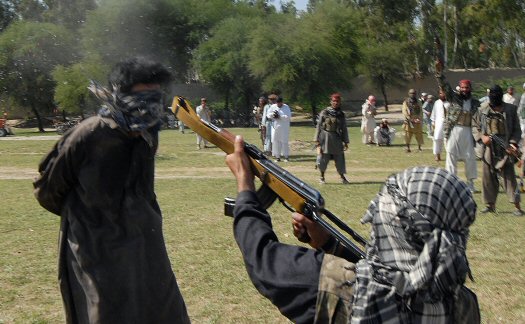
The Taliban ("students" in Pashto) are a fanatically intolerant Islamic fundamentalist[1] movement which exercised rule over most of Afghanistan from 1996 until 2001, when United States forces in conjunction with NATO invaded Afghanistan and removed them from their center of power[2] because they had either passively or actively allowed al-Qaeda, a militant international Islamist terrorist organization, to use Afghan territory to plot, train, and conduct international terrorist activities.
The Taliban fighters were educated in wahhabist madrassas (religious schools) in Pakistan (See: Tehrik-i-Taliban Pakistan), which emphasize the theological role of religious war (jihad), to be waged defensively against unbelievers who have invaded formerly Muslim lands or offensively at the call of the Caliph.
The Taliban retain control of substantial tracts of Afghanistan to this day and continue to co-ordinate attacks against the Afghan national government and supporting NATO forces. Many of the Taliban leaders and foot-solders are now believed to be based in Pakistan where they can launch attacks across the border into Afghanistan or train for attacks elsewhere.[3]
History
According to the International Socialist Review, the Taliban started as the one of the armed Afghan factions funded by the CIA during the Afghan conflict against Soviet Union.[4][5] The Taliban connection to the Mujahadeen weakened following the Soviet withdrawal and Afghan civil war. The majority of the Taliban leadership were born during the brutal Soviet occupation, and educated at Saudi funded Wahhabist madrassas. The majority of Mujadaeen appear to have taken on the Jihadist ideology as a unifying tool against the Soviets - nothing more. The Taliban however took on the Jihadist ideology as a way of life and subsequently fought a war with the remnants of the communist government and the warlords to gain control of Afghanistan by late 1996.
The Taliban had close links to separatist Islamic insurgents in the Russian Federation province of Chechnya, who waged Chechen Wars in 1994 and 2000 against the Russian government. Chechen fighters solidified the link to their Taliban allies by aiding them in their current struggle against the NATO occupation. Anecdotally, it has been noted that the Chechnyans are valued by the Taliban military commanders, as they have extensive training and experience in the operation of Soviet heavy weapons against high value targets. .[6]
Taliban Rule
See also Women under the Taliban
Taliban rule was characterized by a fanatical intolerance for other religions, and women could not be educated or attend most hospitals. They required all men to grow beards and banned television along with all forms of imagery, music and sports, resulting in Afganistan being suspended from the 2000 Olympics. They use stoning to execute men and women convicted of adultery.[7]
The Taliban were extremely sexist. Women were not allowed to go outside or use public transportation without a male relative, had to wear a burqa when they did go out, were not allowed to wear makeup or nail polish, and were not allowed to go to school. They were also not allowed to go to most hospitals when needed.
The Taliban and Narcotics
According to the BBC;the Taliban were strongly against drugs;since the NATO invasion heroin production in Afghanistan has increased massively and the country is now once again the world's largest producer.[8][9] This has had a backlash within the UK, as drug related crime has spiked since the NATO invasion in 2001, largely due to the wide availability of Afghani heroin flooding the UK. It is unclear if this is coincidental or deliberate.
According to the International Narcotics Control Strategy Report:
- the Taliban had cut Afghanistan's heroin production by about 95%, but
- heroin had "financed the rise of the former Taliban regime".[10]
See also
External links
References
- ↑ http://standupforamerica.files.wordpress.com/2009/10/taliban-shooting.jpg
- ↑ Retired Army Maj. Gen. Paul Vallely said, "We took down the Taliban in the fall of 2001, in 34 days with 100 men." [1]
- ↑ http://blogs.abcnews.com/theblotter/2007/07/terror-commande.html
- ↑ http://www.isreview.org/issues/20/ahmed_afghanistan.shtml
- ↑ http://www.isreview.org/issues/20/ahmed_afghanistan.shtml
- ↑ http://muslimvillage.net/story.php?id=370
- ↑ Fox News: Taliban Militants Reportedly Stone to Death Pakistani Couple Who Committed Adultery (April 2, 2008)
- ↑ http://news.bbc.co.uk/2/hi/business/2814861.stm
- ↑ http://www.earthtimes.org/articles/show/76421.html
- ↑ http://news.bbc.co.uk/2/hi/business/2814861.stm